

“If your game’s good, it’ll be cracked silly fast,” Mike Bithell, developer of indie smash Thomas Was Alone, tells me. He’s remarkably frank, but he’s also got a valid point, and it’s why his game doesn’t come with any draconian DRM (digital rights management) anti-piracy protection.
“I will resist putting DRM onto my personal projects as long as possible,” he adds, suggesting he’s doing this for all the right reasons. “At this point, it feels like bringing a knife to a gun fight. I don’t see the point of massively inconveniencing those who’ve paid for the game in order to momentarily inconvenience those who’ll pirate it anyway.”
Thomas Was Alone is only a few quid, but that obviously doesn’t stop people wanting it for free. “If you want to play my game, I think you should probably pay towards my bills,” Mike agrees. “And if you do pay me,” he adds, going back to the fact that the game is DRM free, “then I want you to have the best experience with my game possible.”
Thomas Was Alone has garnered nothing but positive reviews and huge amounts of praise for its bold style and slick presentation, along with a mostly smooth difficulty curve. I ask Mike what his inspiration was for the game.
“It kinda grew from playing with platform mechanics,” he replies. “I realised that two characters with different jumps could lead to some interesting moments, and when I started expanding on that to bouncers, anti-gravs and double jumpers, it became an awesome way to play with platformer conventions, and give it all a bit of a twist.”
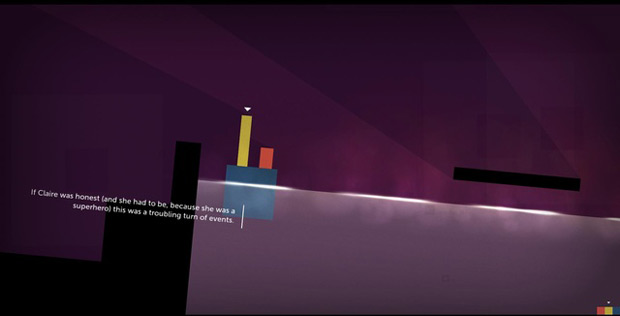
The game features some incredibly minimalistic visuals. There are fancy effects and some nods to animation, but on the whole the player is left staring at coloured blocks. “It was a choice that served the gameplay,” Mike says, when I ask him why he went down such a simplistic aesthetic route.
“I wanted to pull the mechanical interactions of the characters to the front, with nothing in the way of players. I then wanted to bring some quality to that, hence the lighting and particle stuff. And Danny’s voice over was crucial, because it brings heart to those characters.”
Ah, Danny Wallace. I ask Mike how it was working with him, an actor famous for many things but gamers will no doubt know him from his work on Assassin’s Creed. “Awesome. He’s a very charming chap,” he replies. “He’s been really supportive of the project, and brought a great performance to the voice over. I’m really glad that the reviews are giving him the credit he deserves for his performance.”
“He’s the heart of the game, no one else could have brought that performance.”
Back to the rectangles that populate the whole game. They might be visually basic, but they all have their own distinct personalities – were they based on anyone in particular? Mike laughs. “Chris is totally based on a very good friend of mine,” he says. “Beyond that, the key thing was that each character is emotionally based on their physical properties.”
“The idea,” Mike explains, “is to try and guess at how a character with this ability would have evolved emotionally up to the start of the game. How does a character whose ability is entirely selfless feel if they’ve never known any different? What happens when a useless character suddenly realises she has a unique ability?”
This is one of things that appealed so much to me – the overwhelming impression that the player is just peeking into a pre-existing set-up, a moment in time of an AI system that could have happily existed alone for considerable time. It works really well, not least because of Wallace’s smart, timely and often laugh-out-loud funny narration.
What are your thoughts on other 2D indie platform games making their way onto major consoles, I ask, mentioning the likes of LIMBO and Braid. Would he consider a console port? “Console’s interesting,” Mike replies. “The game was totally designed to be played on a keyboard, but I think the mechanics could move well on to a controller. Bringing to console is a mountain to climb, but if the players want it, I might have to give it a go.”
And if it’s not a console port, what’s next? “I continue to help make awesome social games at Bossa Studios,” he replies, “and in my own time… who knows. I’ve got a feeling Thomas will remain a big part of my life for some time to come, and after that…”
Thomas Was Alone can be downloaded from here.
TSBonyman
Nice to get a little insight into the thinking behind the game, have to say it sounds even more interesting now and a bit deeper than i would have suspected. I would love to see it come to consoles – as long as that includes PS3 of course.. :)
Kennykazey
I’ll buy it when my new computer arrives later this month. Can’t be bothered installing anything new on my current, prehistoric pc.
bunimomike
With such a great attitude to game design and a truly unique take on gaming itself, consider me on board and investing in a purchase. Rude not to!
KeRaSh
Same here.
xdarkmagician
His views on DRM make me want to buy the game even though I have no intention in playing it. The war on piracy is just like the war on drugs, you need to address the demand aspect and not the supply. The media companies of the world spend billions to only delay piracy. Meanwhile honest people feel the restrictions of DRM, truth is because of DRM, sometimes it’s more convenient to have a bootlegged copy- (I’m looking at you Blu-ray ultraviolet digital copy)
Kevatron400
It saddens me that my current laptop appears to be unable to play PC games, a fact I’ve learnt after buying the humbleIndieBundle with Limbo, Bastion et al. in it. It lets me play for about 5 minutes before becoming too hot and shutting down without warning. Sad times.