

Having a foot in the realms of plausibility is incredibly important for many games, lending them the ability to suck players into the world they create, and getting players invested in the story that they are trying to tell.
Call of Duty: Modern Warfare is an excellent example of taking a real world scenario, of a rogue Middle Eastern state the subject of US intervention, which at the time of release was still at the forefront of current affairs, and building from there. Modern Warfare 2, however, wasn’t anywhere near as interesting a plot for me, because it lost that grounding in reality in favour of an overly frenetic pace and a sense of oneupmanship to the sensationalist twists and turns in the story.
When it comes to the world of The Last of Us, it’s not quite as easy to draw from recent events as a base, but there is certainly an ever-present fear to the dystopian scenario which it paints, which plays on the human psyche.
It’s actually somewhat unusual that they have very carefully pieced together clear origins for a grounded and credible downfall for our current civilisation, in contrast to the vagaries of many apocalyptic settings, and part of why the expertise of biologist Dr. David Hughes was used to explain this recently to TheSixthAxis.
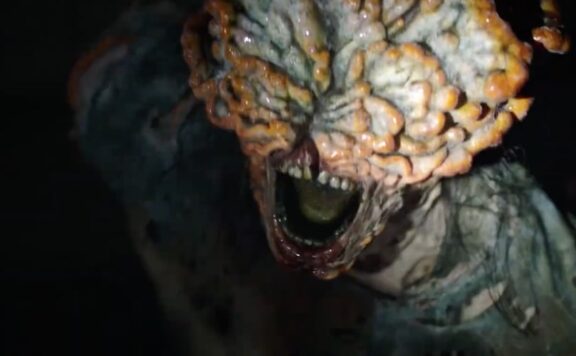
It’s quite well known that one of the inspirations behind the game came from the lead designers watching Planet Earth, as the Cordyceps fungus was shown in its current guise, taking control of an ant. It latches onto the host brain, chemically altering its behaviour ahead of its eventual death and transformation into a fungal spore delivery system, to propagate the infection.
It’s this kind of behaviour and development of the fungus which sits at the heart of The Last of Us, as the Cordyceps fungus made that jump from ants to humans around 20 years ahead of the game’s setting. Yet, whilst it’s a remote possibility, it ties in to a growing concern and fear for the real world in the coming decades.
As the human population of the world continues to rise at a frankly alarming rate, so too do the risks. Some estimates point to the population count reaching 10 billion people within our lifetime, but even at the current count of around 7 billion, vast numbers of people live in densely populated cities where close proximity to hundreds if not thousands of people occurs on a daily basis for the majority.
In this kind of environment diseases can spread like wildfire, but it gets even worse as globalised travel is taken into account. Cheap travel allows people to hop from one continent to another, coincidentally locked into close proximity with other humans and passing through global travel hubs, all of which help a particular infection spread faster than ever before. Pandemics are practically an inevitable consequence.
There’s a certain amount of insurance that the pharmaceutical industry can react quickly enough to incoming threats, and indeed it is only through the leaps made in healthcare that this rate of population increase is being sustained, but we have seen on several occasions that they cannot truly keep up with the globalisation of travel.
In particular, the cases of H1N1 and SARS over the past decade have shown an element of fragility, always with the attached fears that the next outbreak could reach the scope of historical pandemics such as the Black Death to the Spanish Flu (also the H1N1 virus), wiping out great swathes of the population.
Zoonosis of the sort leading to the recent swine flu outbreaks, where a disease jumps from one species to another, is a risky side effect of some of the close proximity to animals in which we live.
As a consequence of our food chain, animals are reared in large numbers specifically for slaughter, and the farmers will be in contact with these animals for extended periods of time, giving many more opportunities for a disease to jump species (not to mention that it’s the ideal conditions for it to spread within that species).
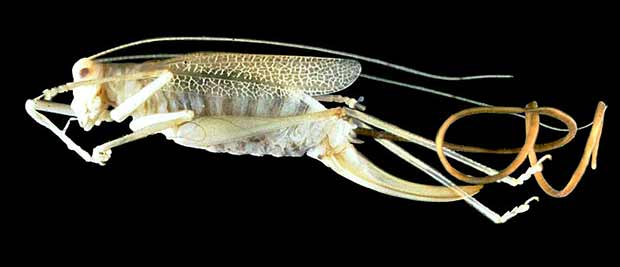
Photo: Wikipedia.
There are even examples of parasitic organisms who are designed specifically to manipulate other animals to their own ends. Paragordius tricuspidatus is a worm which will live inside a cricket, gradually taking nutrition from its host until it is ready to mature, at which point it will chemically force the cricket to find and jump into a body of water where it can leave.
Toxoplasma gondii will affect the behavioural patterns of rats and mice to approach and be eaten by cats, where the toxoplasma can reproduce. In both cases, the animal’s behaviour is altered directly leading to its death.
Not only are these a mind-bending twists of evolution, to head down such specific paths, but given the vast number of domesticated cats in the world, it’s estimated that one third of the human population is subject to this toxoplasmosis, with varying levels depending on the country. In turn, this can then alter human behavioural patterns in subtle ways, and it’s theorised that it can actually cause you to become more at risk to causing road accidents.
Which brings us full circle, back to the behaviour altering Cordyceps fungus.

Fungal spores are all around us in the world, and for most humans, their immune system is well versed in neutralising them. There are fairly isolated instances of fungal infections affecting humans, but viral and bacterial infections come in greater numbers and take hold much more rapidly.
As with zoonosis in the food industry, greater contact with fungi increases the likelihood of one taking hold in humans, and we have seen varying cases in Indonesia, with the famous “Tree Man”, Brazil, and with mid-Western American farmers.
Read more about him here.
From all of this, anyone involved with the game will take great pains to point out that those infected by the Cordyceps fungus aren’t zombies. However, there are certainly similarities to the projected spread of the Cordyceps fungus across the globe and the fallout from its rise, leading to abandoned cities quickly becoming reclaimed by the elements.
Whether its reanimation from death or effects whilst still alive, which we see from the behaviour changing Rabies-like disease in Left 4 Dead and Cordyceps in The Last of Us, it turns humanity in on itself from multiple angles.
The core to any “Zombie” fiction isn’t really the Zombies themselves, but the interactions of the humans who are trying to survive. Governments and corporations who we all rely on in our daily lives fail to react sufficiently or competently enough to the threat, leaving individuals and families to fend for themselves, often turning to the basest and most selfish of instincts to do so.
That kind of abandonment is, to some extent, scarier than the fungus. Then again, an unstoppable and invisible attacker which can wipe out the majority of the human race is also pretty terrifying…
Come back tomorrow at 3PM to see our review of The Last of Us, ahead of its worldwide release for PlayStation 3 on the 14th of June.



sabbat7001
Great article. Thanks Teflon. I’ve always felt that a game or a movie doesn’t have to be realistic, as long as it has realism which is totally different.
I also have to say that just the title of the game conjures an emotional response (in me at least).
Tuffcub
The video of the Cricket Worm thing we saw was utterly gross.
teflon
It made me feel a little funny just writing about it…
Takyu
I’ve had the pleasure of gaining some basic knowledge of fungal, viral and bacterial infections during my studies for my veterinary degree, remember being told about the increased risk of driving accidents while infected with Toxoplasma just last year. Definitely some weird and wonderful stuff out there, and I think Naughty Dog have done a great job in blurring the line between fact and fiction with The Last of Us.
colmshan1990
Brilliant.
As a Microbiology student, I’m going to label ‘The Last of Us’ as study.
I find viruses so much more fascinating than fungi mind you, but certain species such as Cordyceps act in similar ways to viral infections so as to hold my attention for longer than just to learn what I need to know for exams.
ron_mcphatty
Great article, really interesting stuff! I’d heard the ant behaviour story before and that was truly fresky, but the cricket, rat and human ones are terrifying. It’s a great angle that’s grabbed my interest, I’m not a fan of zombie/apocalypse games or films but I can’t wait to try The Last Of Us. As an aside, if anyone’s looking for a post apocalyptic fix before its out id recommend Enslaved, hopefully most of you have given it a go, I think it’s amazing.
blackredyellow
Enslaved is great. It’s odd because it seems to get a lot of attention, but sales were reported to be poor. Shame really, I’d recommend it all.
blackredyellow
*to all.
RudeAwakening
Thanks TSA for scaring the s*** out of me! Ha!
kofgoku
waiting for the review!!
blackredyellow
Having not following this release, mainly due to a backlog, I am now very interested! It definitely sounds like an interesting game, made by proven developers.
I’m off to the games cabinet to see what I can trade in for it!