

The new model of the PS Vita arrives in the UK at the end of this week, bringing with it a subtly altered design, a slimmer form factor and a few other changes. Sony has admittedly made some concessions along the way that mean this unit doesn’t offer a particularly compelling reason for existing Vita owners to upgrade, not to mention the £180 SRP, but that’s not necessarily the purpose.
The first thing that you will notice when you pick it up is that loss of weight and depth to the machine. Coming in at 219g, it’s 41g lighter than the original WiFi model and a more pronounced 60g lighter than the 3G version that I own. It might not sound like much and is easy to dismiss when the original design was far from being too heavy for extended play sessions, but this is a sizeable difference in weight and one that becomes more noticeable as you play.
The exact same thing can be said of the extra slimness. At 15mm, compared to the 18.6mm of the original, there’s really not that much in it. It’s still a bit too big for sticking in your pocket, for example, so it’s not really any more portable but the loss of a few millimetres, combined with a subtly altered design, creates something that feels a lot thinner in your hands than before.
Whereas the original’s plastic design featured some hard edges from the silvery frame to the front and the back, this frame and edges have been banished by the smoother tapered design. Everything is more rounded off and more comfortable to hold, and it creates the illusion of a greater difference in thickness.
It’s very similar to the loss of a few millimeters and a few grams when upgrading your smartphone. A seemingly inconsequential change leads to a surprisingly different experience when you pick it up and hold it.


Thankfully, Sony haven’t felt the need to alter the front controls, with the exact same feel and style of analogue sticks and face buttons and just the altered shape and raised profile of the PS, Start and Select buttons. There was one minor problem with the original design which they have addressed, though, which was that the large rear touchpad was very easy to accidentally brush against.
The rear touchpad has lost 3cm in width, from 11×4.5cm to 8×4.5cm, but in doing so actually comes to match the 16:9 aspect ratio of the front screen. Though most rear touch inputs in games are quite abstract, in my experience, making this change a general improvement and easier to hold, this could be a minor issue for games like Tearaway and LittleBigPlanet that do require precision or try to match front and rear touch in the same place.
Aesthetically, it’s more of a mixed bag. The front screen is now oddly recessed from the rest of the front panel and it’s not quite as visually pleasing as the seamless face of before. The lights once hidden behind the PS button have been moved to the top of the machine, the matte rear frame gives more of a toy-like feeling, though not unpleasantly so, and the loss of the silver highlights take away from the premium façade which the original managed to hide behind quite well.
While the UK will only see the release of the black design for the time being, the Slim did get a more colourful release in Japan, with black or white fronts married to various pastel shaded rears. Though it would have boosted that toy-like look and I didn’t like some of the colour combinations, it is slightly disappointing that we don’t have the option of that splash of colour at this time.
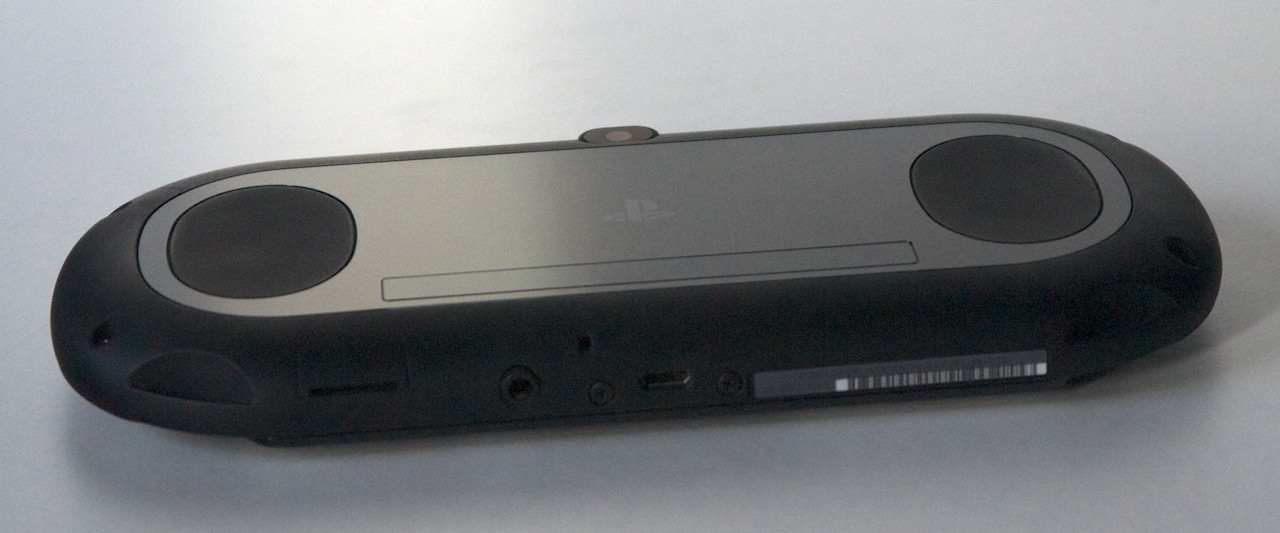
More than just an aesthetic and ergonomic redesign, the Slim model makes certain technical changes to the hardware. The proprietary charging cable has been dropped in favour of a standard Micro USB port, while the EXT port at the top of the machine has been banished so that there is now just the game card slot and 3G is no longer an option. The addition of 1GB of internal memory, while pitifully small in the long term, does provide enough capacity for a few patches, save games and even one or two smaller indie titles.
However, the biggest difference is that the screen has switched from OLED to LCD technology. This change has been much bemoaned as a step backwards for the machine and in many ways it is.
Set side-by-side, the LCD display of the Slim has a noticeable yellow cast to pure whites, though the OLED could be considered to be too blue. This is a small point compared to the much more vivid colours, deeper blacks and higher contrast of the OLED screen, while the LCD can often look washed out.
The gallery below illustrates the differences in brightness as well as the viewing angles, where the first and third images are at full brightness and the second and fourth at the lowest setting. Viewing angles are noticeably poorer, while the LCD isn’t as bright. The disparity is clear to see, but the screen still does a good job during gameplay and is bright enough to contend with the artificial lighting indoors or on the tube. A minor upside is that the darker screen at the lowest setting will help to reduce eye strain when playing in low light conditions.
Simply put, the LCD screen in the Slim is not as good, but it’s also important to temper reactions and realise that this is not that big a drawback. It will certainly be off-putting for existing owners, but is part of the way that Sony will be able to reduce manufacturing costs, deliver better deals in the coming months and it is partly through the change of screen technology that they have been able to increase the battery life.


While testing the battery life, I turned off Bluetooth and the microphone, left WiFi on and set both screen brightness and speaker volume to 50%.
From a full charge, I played Killzone: Mercenary multiplayer for two 1 hour stints, then downloaded OlliOlli and Stealth Inc with the device asleep which took approximately 30 minutes. Two hour-long sessions of OlliOlli were then followed the next day by another hour of Killzone multiplayer, before 45 minutes more of OlliOlli up until the battery died. The final 45 minute session was all under a Low Battery warning.
This was perhaps an atypically WiFi intensive load, but mixed the heavy 3D graphics of Killzone with the lighter 2D of OlliOlli. Across the two days, I accrued a total of 5:45 actual play time, with the additional 30 minutes of background downloading while the device slept. This puts it almost exactly in line with Sony’s 6 hour estimate.
By contrast, my original 3G Vita was only able to make it through 2 hours of Killzone, the 30 minutes of download and 45 minutes of OlliOlli, the final 25 minutes after the Low Battery warning. This would be partly down to the nearly 2 years of use it has seen, a big factor in not reaching the 5 hours Sony estimate for this model.
In both cases this could be extended further by focussing on single player gaming and to a 2D workload, which is quite likely with the extensive indie catalogue of games. Either way, it puts the Slim as a much more viable option to last the length of long journeys.
What’s Good:
- Longer battery life that easily matched Sony’s 6 hour estimate.
- Noticeably improved ergonomics through tapered design and weight savings.
- Smaller rear touchpad will lead to fewer accidental inputs.
What’s Bad:
- LCD screen pales in comparison to the OLED screen of the original model.
- Maybe not as aesthetically pleasing.
- Expensive memory cards are still a necessity.
- Initial £180 SRP price point feels too high.
As I said at the start, this is far from an essential upgrade for owners of the original design. In some ways the first generation Vita could be more aesthetically pleasing, has a brighter and more vibrant OLED screed and has the 3G option for asynchronous multiplayer on the go. However, there are many merits to the redesign, which achieves a tangible improvement when you have it in your hands and lengthens battery life.
What this means for the Vita is difficult to say. The £180 SRP is too high, especially considering recent pricing, but Sony have seemed to hint that this figure is to fall once old stock has cleared the supply chain. Doing so, and doing so quickly, will be a vital part of making the Vita a sustainable niche platform.
tonycawley
This isn’ta review, how can you call this a review? There’s not even a number at the bottom, it’s just, just words! Words on a Web page, that’s all this is. Don’t dare call this a review!
tonycawley
On a serious note, those words you wrote are pretty well written. Made me see the other side to it because before I read this, it was just a downgrade because of the screen.
Dominic Leighton
I won’t be grabbing one any time soon (hopefully) as my original Vita is still fantastic. However, the longer battery life and smaller rear touchpad sound like meaningful changes that wouldn’t go amiss!
zb100
Given I bought an official Hori holder adaptor thingie TM before my Vita arrived (having been a large mitted PSP fan) i will be giving the slim a miss. The size & heft of the existing model is spot on.
(Disclaimer: my mobile is a Note 2, I need something to hang on to! ;) )
sparkyscrum
Why aren’t we getting some colours. Im holding out for the green one.
freezebug2
Good review, mostly positive as far as I can see if people can get past the screen spec phobia. I was sold on the slim Vita until the prices were announced which were far from competitive compared to the latest phat pricing which I opted for.
Was comparing the newly arrived phat Vita yesterday with my PSP GO and the screen of the Vita is almost the exact size of the whole GO console utterly dwarfing the sliding handheld experiment!
I’ll try and get some side by side comparison pictures of my new Vita, PSP and PSP GO sent in either to Tefs rig spot or on the forums.
Loving the new Vita btw, although the 16GB memory card is bulging at the seams already! :P