
Throughout my long history of playing games, I have played a lot of morally questionable characters. Everything from dictators and tyrants to demons and sarcastic kleptomaniacs, but I suspect this is the first time I’ve played as a pharmaceutical company owner. Making medicines sounds great on the surface, but as you slowly need more and more profit to further your pill-making ways, you slowly find yourself sacrificing the effectiveness of your drugs in favour of making a little more cash.
In Big Pharma, you begin with a sizeable empty room and the means to build a few production lines. It’s simple enough to get going and the tutorial provides a decent, if slightly longwinded introduction to all your medication making needs. First, you need to click a convenient ingredient dispensing hole in the wall and then an ingredient. Highlighting said ingredient will tell you its effects, with both the intended purpose to, for example, act as an anti-inflammatory, and the unpleasant side effects, which range from spontaneous head implosion to something less extreme and more realistic.
The most basic machines increase or decrease the strength of the solution. To make an effective treatment, you need to raise or lower the solution’s strength until the desired effect is active, which is shown on its information screen. Using conveyor belts, you create a production line from import to sale, running your drug through machinery to tailor it to your requirements, press it into a pill, and ultimately sell it.
Once it is active you can go ahead and stick it through the pill making machine and export through another convenient hole in the wall. However, if you are looking for profit (hint: you are), you will likely want to upgrade the drug’s effect. Again, this is done by getting its strength in a certain range, but it must then be put through a specific machine to upgrade it, after which it will be more effective and, as such, worth more money. Careful you don’t upgrade any side effects though, and it’s best to keep them inactive when possible, as they will affect the price of your glorious life extenders.
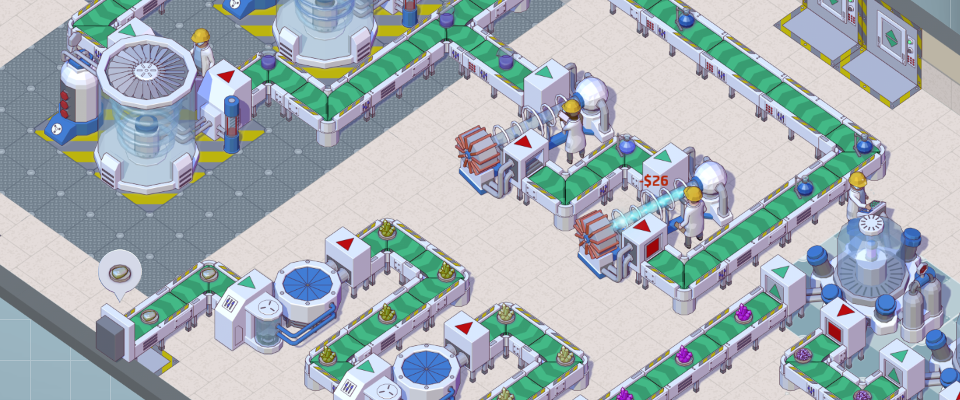
All of these machines cost money. Not only do you have to buy them, but they cost money in use as well, so your nice chain of machines needs to be as efficient as possible in order to minimise production costs and maximise profit margins. More advanced drugs require more work, more advanced machinery that needs to be researched, and more cold hard cash before they are viable for sale. On top of that, all that machinery takes up valuable floor space, so designing your machines to be efficient and compact is a necessity if you want to make the most of things. You can buy more space in adjacent buildings, but the price tag is a little steep if you’re strapped for cash.
Your company does not exist in a bubble, however. There are rivals for you to compete with and a dynamically shifting market that means that a big money maker you’ve been selling for a year suddenly becomes a lot less valuable due to some kind of media uproar, or because it turned children into tarantulas, or something else clearly sensationalised by the media to target your company. Of course, if you’re paying attention you can capitalise on shifts in the market as well, answering an increased demand for antidepressants with your Gamoc Brand Uppers (other names are available).
As you juggle all these aspects, you slowly start sacrifice little bits of effectiveness in favour of profit. If you raise the strength by one increment, you can increase the sell price by $6, but the machine to do it costs $20 every time it’s used, so you’re better off by having slightly less effective pills.. That relentless pursuit of profit slowly erodes any focus on customer satisfaction you may have started with.
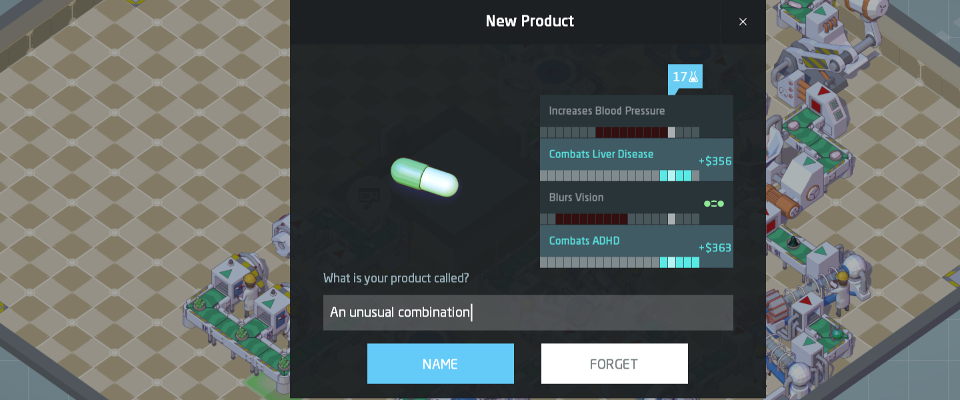
This, however, is the game as it stands. You choose an ingredient, make a production line, and then you sell it, before using the profits to do it again with something else. You have scenarios to complete to keep you going, but the game fizzles out after you have a few lines running, because you’re just doing the same thing again.
So far, Big Pharma is a good foundation for a game. It has some good ideas that could be great, provided Twice Circled can flesh them out with more content and more aim beyond getting some lines running. At the moment it’s lacking longevity, but it can be fixed and it certainly shows promise.