

The original Chime from 2010, and Sharp in turn, mixes ideas from a number of block-matching puzzling classics, though you can primarily look to the iconic Lumines and Tetris for the most obvious influences. We previously reviewed Chime Sharp when it released on PC, but having finally arrived on console, it feels as though this Kickstarter-funded underdog has found its perfect home.
The fundamental aim of the game is to create solid blocks that measure a minimum of 3×3 called quads, which you’re then looking to make or extend until you’ve covered the entire grid. The more you cover, the more extra time you’re rewarded with, and in turn the more opportunity you’ll have to increase your score.
You’re given various shapes, just as in Tetris, and you’ll be forever spinning them around trying to make them fit a coherent manner as you head towards a quad, or rush to extend it. Once you’ve formed a quad the block slowly fills, which corresponds with the time you have to expand it. The more separate quads you make, the higher your combo grows.
There’s also a secondary timed mechanic at work, with a scrubbing line that runs from left to right throughout the duration of a level. On each pass of the line any fragments left over from shapes that aren’t part of a quad are weakened, until they begin to flash. If you haven’t been able to build them into a quad on the next pass, you lose your multiplier and have to start from scratch again.
While this is the standard mode, the new Sharp mode introduces a different set of mechanics. While there are no longer any time limits, you are instead granted ten lives with which you aim to cover the grid. Every time a fragment drops you lose a life, while creating a perfect quad – one without any fragments left over – replenishes them. You’ll need them, as you’ll find that they can be wiped out very easily by having just a few too many rogue fragments.
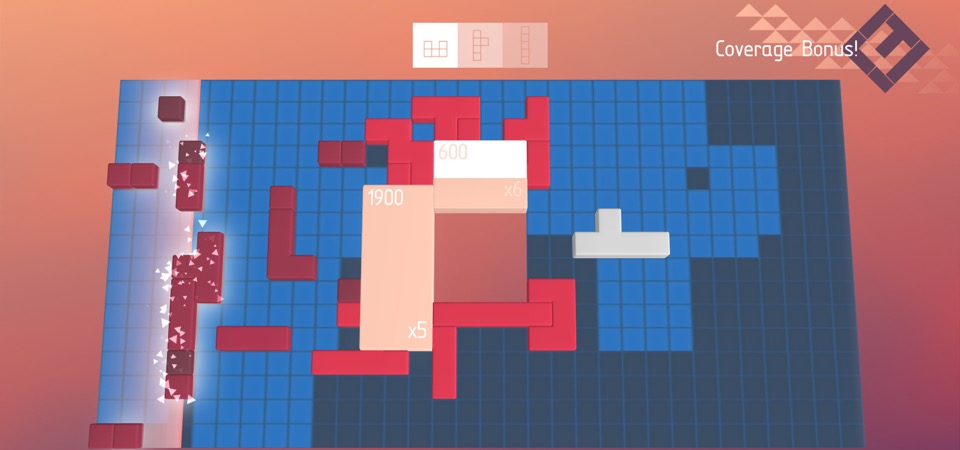
It’s a nice attempt to enliven the formula and it does the trick, but the standard mode feels far more involving and settled. Sharp mode is also excruciatingly tough, as you have to constantly try and use up every single fragment as swiftly as possible before they kill your multiplier and you in turn.
The package as a whole is more than generous enough for a game of this type though, and beyond the Standard and Sharp modes, there’s also a Practice option for getting into the swing of things, the 90-second score attack Strike mode and the Challenge mode which gives you one complex grid and a reduced piece set, and asks you to cover the board. Modes and levels unlock if you perform well on the previous tracks, so your earliest steps in the game will have you unlocking plenty of new content at regular intervals, before it slows into a real test of skill.
Playing for an extended period of time does emphasise the game’s slight trouble with the colour palette choices. Whether it’s for fragments or coverage of the grid, there are only subtly different from the colour of the level or your blocks. It’s not an absolute disaster, and you learn to pay closer attention on some levels, but it’s an unnecessary misstep.
It’s a shame when this is a great looking, modern puzzle game. There’s a real solidity to everything going on, and the presentation has taken a huge step forwards from the minimalist design of the original, with some great touches such as the album artwork appearing for each track.

Speaking of tracks, the music is – personally speaking – amongst the best curated collections for a video game soundtrack I’ve ever played. That is terribly hyperbolic, but having donned a pair of headphones I found myself utterly immersed in the game’s audio. Chipzel’s Psychonaut is possibly her best work, while Work Of Our Hands’ amazing A Mote Of Dust remixed by Living Phantoms is modern electronica at its best. Admittedly I enjoy this kind of music, so if your tastes don’t stretch into the genre it could leave you cold at times, but the rhythmic tones absolutely match the zen-like flow you can reach when playing at the top level.
There are a few other minor annoyances to be found beyond the previously mentioned colour palette problems. The level selection only shows your score for the Standard mode, and none of the others, meaning that if you’re on a run at the Sharp or Strike stages you can’t see where you are with them without going into the next menu screen. The game’s tight coverage requirements can also feel like an unnecessary step to unlocking those extra modes, and as such it can lose some of the fun factor along the way.
These are relatively small niggles in what is a compelling and addictive score attack puzzle game, and Chime Sharp certainly deserves to be mentioned alongside fantastic games like Lumines, boasting many of the same qualities. Few games are capable of capturing this kind of “one more go” drive, but Chime Sharp nails it, and every high score feels tantalisingly close, every extra bit of coverage within reach. This is an evolution of some of our most beloved gaming moments, and where others lack the conviction or creativity to evolve or innovate on a well-trodden theme, Ste Curran and Twistplay make it look effortless.
