

It really feels once more like humanity is trying to reach out into space. The SpaceX launch Falcon Heavy launch at the start of this month was a hugely exciting moment for those that have been starved of seeing real progress for the last few decades, and it’s the dream of seeing us colonise other planets that is at the heart of Surviving Mars.
With the release really just around the corner on 15th March for PS4, Xbox One and PC, we played the game a couple weeks ago as Haemimont announced the Mysteries of Mars feature. At the time, we pursued the more survivalist side of the game in our session, and so we later caught up with Haemimont’s CEO Gabriel Dobrev to talk about the inspirations for these mysteries and the kinds of things we might see. Obviously Gabi tried to do answer our questions without too many spoilers.
TSA: With Surviving Mars, it’s obvious that you’re going to be quite excited by the prospect of actually getting mankind to colonise Mars. I’m assuming you all watched the SpaceX launch the other week, so how was it for you to be seeing that?
Gabriel Dobrev: [laughs] We kind of feel that we’re running to the finish line! Things are happening so fast in that area that we imagined that we were doing a game about something that will happen some time in the far future, but now it seems more imminent than ever before.
That’s how I felt. I saw it and was like, “This is not the far future, this is now!”
TSA: [laughs] Was it with a slight sigh of relief that you saw they were actually going to miss Mars?
Gabi: Well, these things happen and sometimes things don’t quite work out as expected! The very, very interesting next step will be when they land something more than a robot, they try to do stuff on the surface and there’s a little bit more of a regular back and forth. Between Earth and Mars we will know what the next load will be, the next things that will go there, and I think that’s also exciting.
TSA: It is interesting that a lot of the ideas and technology that you’re building in the game is all based on real stuff and thinking on how things might work. I think that’s something that’s going to appeal to those looking to Mars and these rocket launches with such excitement.
Gabi: Yeah, and we already have all the people doubting what we chose to include in the game and if it’s going to work or whether it makes sense. We’re already seeing, even before the launch of the game, that this discussion is picking up and people are digging up more information about, for example, the wind turbines and how they’re going to work, or if they’re going to work!
TSA: I guess at some point you have to say, “It’s OK, this is still just a game. This isn’t a NASA training programme.” With that in mind, you’ve got much of the game based in science fact, but then the Mysteries of Mars are really quite out there. Why did you make the decision to have these crazy things in the game on top of the more realistic side?
Gabi: For me personally, and for a lot of the team that’s around my age, the science fiction came before we started playing games. Before I got my hands on my first computer (and it wasn’t even mine), I’d already met all of this science fiction, and so that world is very familiar and very much inspiring us. There was this special spirit that I don’t think people writing have when writing science fiction today.
If you look at the space race, essentially people did what was possible for the entirety of humanity. two whole countries was focussed on sending somebody to the moon and this was the pinnacle achievement, but right now, despite the giant steps that SpaceX is making, this is actually a private enterprise. We, of course, can get anybody to Mars, it’s a question of money. Nobody wants to get them there at the cost that is currently possible, they just want to do that when it’s, let’s say, a hundred times cheaper. Practically, the technology exists to send people to Mars, it’s just that it’s not viable because it’s too expensive, too risky, and so the whole enterprise is whether it’s commercially viable or not, but back then it used to be whether this was possible at all.
This kind of spirit is also important in the science fiction of those days. There was this door that nobody had opened and we had absolutely no idea what could be out there. It’s really humanity meeting what’s out there and responding to it in some way, and it’s that spirit that we wanted to put into the game and the main motivation behind the mysteries. There was no way we were going to make a game about Mars and not include any sci-fi!
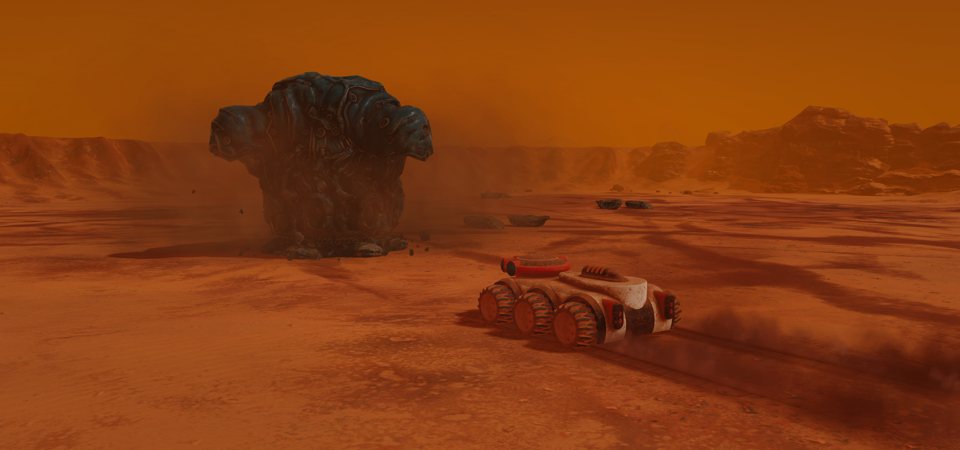
TSA: I guess one of the things the Mysteries do is add a little bit of spice and unpredictability to the later game. There’s almost always a point in a city builder, or in this case a colony builder, where you start to feel comfortable. Obviously, you want to keep players on their toes, because it is called Surviving Mars, after all.
Gabi: Yeah, and we’re trying to trigger that after the point where you’re not just trying to survive minute by minute. We do have challenges, but they’re more long term, like having to find a solution to something for which there is not an immediate problem, but it doesn’t always work like that when you’re playing the game.
Depending on your initial set up, you could be in that zone of trying to survive minute by minute for quite a long time, and sometimes the mystery starts and you feel that something is happening, but you absolutely cannot spare any resources and attention to it.
TSA: So one of the things I’m curious about is just how the mysteries are going to affect your game. I get the feeling that they’re going to be opportunities for you to advance your colony, but also a threat to what you’ve built. Depending on the mystery, do they offer up different aspects to the game? Can you maybe give one example of how a mystery might pan out?
Gabi: Well, what I can say first of all is that they are very, very different. There is no limit or formula to what we’re doing, so for some mysteries it’s only about the exploration and your attitude to what’s happening. They do modify the game a little bit and give you a new resource or something like that, but it’s more about expressing your attitude to these events where, let’s say, you have an alien encounter or just something weird is happening.
Sometimes the mysteries are focussed inwards, so there isn’t anything mysterious to find outside and it’s the people that are evolving and things are happening. This is also a very interesting aspect; what’s going to happen when humanity has two planets and those two planets are more or less independent?
The main motivation for Elon Musk going to Mars is that when we’re not a single planet species, we’re much safer in terms of survival chances. Let’s say there’s an asteroid, a huge meltdown or, you know, when the people building the Large Hadron Collider said they didn’t really know what would happen when they crash particles with so much energy, so maybe there was a chance of creating a small black hole. Anything can happen, not that Mars would be able to help us if there’s a black hole on Earth, but we’re exploring what could happen in that case.
It’s just different possibilities that could happen in the future, and those can affect your game pretty significantly. You may find yourself trying to use as much of the resources on Mars as possible to help Earth, or you’re trying to guard the resources because you have an adversary that’s taking over everything and leaving nothing for you, so it’s a case of who survives longer.
I really don’t want to spoil them…

TSA: No, of course not. It’s just that you tell us there are these mysteries and we want to know how they work!
Gabi: That’s the whole point of mysteries! We’re building a number of different possibilities.
TSA: I guess that the mysteries are also a good way to inject a little of Haemimont’s humour, as we saw throughout the Tropico series?
Gabi: Yeah, it’s nice to have the freedom to do these. The mysteries are something that you can choose to turn off, so I feel that we can include some content that may not be to everybody’s liking, but that’s also fine. It’s a part of the game that you can avoid, so we can have these optional things where we can be as goofy as we want.
Thanks a lot to Gabi for talking to us a bit more about Surviving Mars. The game is out for PlayStation 4, Xbox One and PC in just under a month on 15th March, and if it’s caught your interest, be sure to check out our latest preview.


