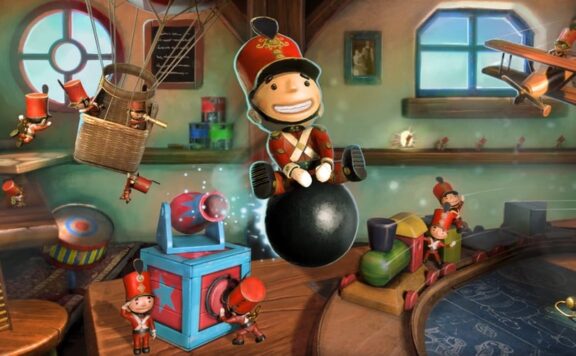
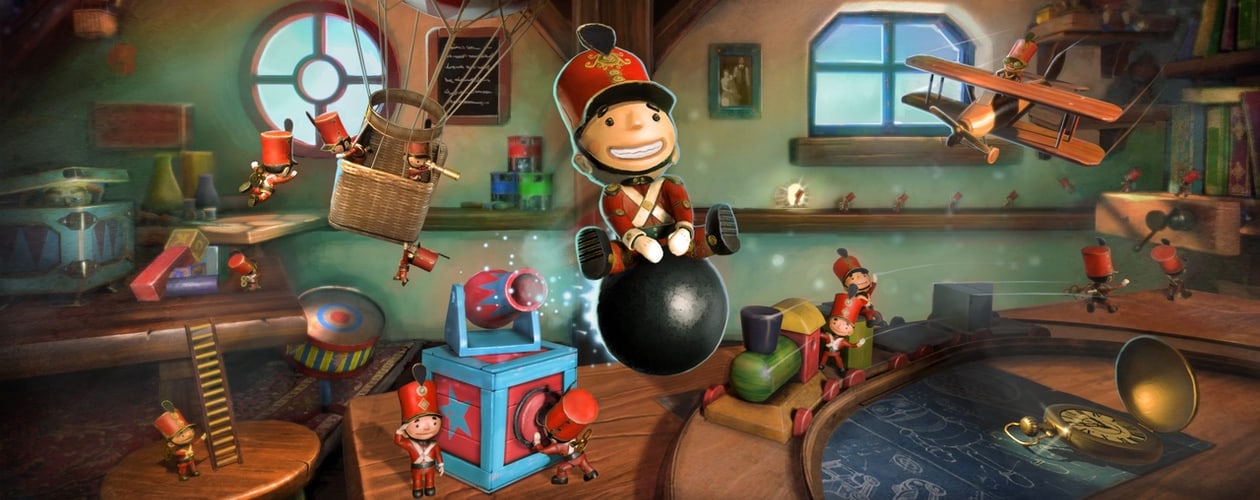
Tin Hearts is one of the most charming puzzle games I’ve played in a long time. Featuring adorable little toy soldiers that march implacably forwards until they find something that alters their path (or fall to the floor and shatter), it’s a little like Lemmings, but brings fully 3D puzzling into the mix.
You play as Albert Butterworth, a toy inventor in an alternate Victorian universe that has allowed for leaps ahead in technology compared to the actual period. That’s not really the focus of the early narrative that run through the game though, as you explore Albert’s memories of his young family, see his daughter playing in his workshop, visit his wife practicing violin and piano in the music room, and so on. In and around this, you have the puzzle of trying to help a string of little clockwork soldiers march from their spawning box through to an exit somewhere else in the level.
The game starts off as simple as can be, opening a magical box from which the toy soldiers spring forth and and then placing triangular wooden blocks to redirect them. These blocks are often strictly locked in terms of where you can place them, determined by the holes cut in them like a shape-matching child’s toy. At least, they are to start with, but as you work your way through the early tutorial-like levels, you find blocks that can be moved and placed wherever you like, drums and cannons that can be directed as they trigger, balloon machines to send your soldiers floating through the air, and more.

There’s a balance that the game strives to strike through this opening to teach you how to play the game and introduce all its mechanics in a gradual fashion, and do so without dialogue or written instruction. Starting off in fixed environments, the little toys will occasionally amble into boxes that unlock new tools and abilities for you, initially giving you the ability to quickly reach deeper into the 3D diorama before you, but soon giving your full motion within the environments. The puzzles start to grow to encompass an entire room, overlapping the solutions you put in place for a previous challenge, or building up in a multi-part solution so you can rewind all the way back to the beginning.
Scaling up bit-by-bit is an important factor in keeping Tin Hearts accessible. Firstly, it’s the kind of game that could appeal to relative newcomers to video games, so a gradual introduction of concepts is key for those players, but there’s also support for VR platforms as well, a completely different paradigm for interaction that many have still never tried.
Time control is an integral part of this experience, rewinding time when a possible solution goes wrong or winding ahead after resetting to get to the end a tad quicker. Again, you initially engage with this in a fairly limited fashion, interacting with special clocks in the environment, but you soon have full control to move back and forth as and when you need – you can always fully reset things by closing and reopening the starting box.

What’s pleasing is that, even through there is an intended solution to many of the puzzles, maybe with a couple of intended solutions and key parts of the environment already in place, the game still feels wonderfully freeform. Once you do have the blocks that you can freely place, point the cannons and drums where you think they should go, you’re imparting your playstyle and puzzle solving on the game. It might not work and you have to either make minor adjustments or go completely back to the drawing board, but it’s a creative spark that brings you deeper into the game.
I’ve said it once, and I think I’ll just say it again: Tin Hearts is one of the most charming puzzle games I’ve played in a long time. I’m really looking forward to seeing more of the game soon.