


When Marvel’s Midnight Suns was announced, it’s fair to say I was pumped. Fusing together two things I love very much – Marvel and strategy games – it promised a large roster of super heroes and the chance to tackle the aged story of the Midnight Sons, reworked for a modern age.
That said, I approached playing the game for the first time with a little caution. Marvel games can be pretty hit or miss, so even with Firaxis at the helm, bringing all their proven expertise from the XCOM series to bear, I was trying not to get myself too excited. What I wasn’t prepared for was how much there was outside of the turn based combat, essentially being a part-time RPG.
You take on the role of The Hunter, an ancient warrior who has been awoken from his deep slumber to help fight the demon Lilith. The character is customisable in looks and playstyle, so you can slot yourself into the role and pretend your fighting alongside Marvel’s finest. You can also make friends with them – oh yes, I almost forgot to mention, a lot of time will be spent hanging out and making friends, Persona style.
In order to get the best out of your comrades, you’ll not only want to take them on missions with you, but spend quality time with them afterwards, partaking in one of the many hangout activities in the Abbey hub world. Spend enough time with them, pay them enough compliments, train with them, and you’ll level up your friendship with them. This can unlock unique abilities and cosmetics to make battles even more hyped up. Plus, as a part-time RPG, it’s really quite cool to make nice with these characters and get to know them a little better outside of all the fighting. To make the experience even more authentic, you can even set characters to automatically change clothes on a daily basis, depending on what you’ve unlocked for them.

The main thing to focus on is each character’s battle deck, which is interchangeable between fights. If you want to experiment with other abilities before going back to something else, you are free to do so and not punished for it.
The Hunter has the largest deck and has three distinct paths you can follow: Light, Dark or Balanced. A bit like Mass Effect’s Paragon-Renegade scale, Light and Dark are balanced through abilities used by The Hunter and dialogue options chosen in conversations. I went down the Dark route which is focused more on dealing large amounts of damage, sometimes to a detriment to your own health. On the Light side of things, cards are more focused towards healing and defence. Of course, you can just sit in the middle and have a balance of both. Having the option to pick your path is nice, though.
Your Hunter’s deck and those of your teammates will help decide the course of battle along with your wits and ability to strategise – in main missions you’ll always have your Hunter in the party of three, but side missions let you pick whoever you want. At the start of each turn, you draw cards to your hand from a combined pool of your three characters’ decks and then have three card plays per turn, along with one movement and two redraws – these let you exchange a card in your hand for another in your deck. There’s no basic attack, so everything you do is dependent on the deck you’ve built and the luck of the draw.
It seems fairly limiting at first, especially if you are used to XCOM where each character is able to move and use abilities until their action points have expired. I soon came to realise how this card system still has plenty of flexibility – there are ways to increase player actions and reduce the seemingly daunting number of enemies on the field with certain card attacks and their abilities. For instance, one attack card could do fifteen points of damage but also has the Quick ability, which means that on a KO it refunds you a card play and gives you an extra move. If you can plan ahead, you can chain attacks and clear out multiple enemies in one turn.

Some card attacks have no cost while others cost Heroism to play. Cards that cost Heroism are usually more powerful than regular attacks and can swing things in your favour if it’s looking a little bleak. Heroism is generated on the free attack cards, so the flow of play is usually; play a few regular cards to generate Heroism and then use that heroism for a big attack play.
Case in point, I was able to use a few Quick attacks to KO some of the weaker enemies, refunding card plays so I could use slightly stronger attacks to soften up some of the beefier enemies. Then, good old Ghost Rider unleashed the force of his Hell Ride attack in which he gets in his fiery motor and tears through a line of enemies, costing Heroism, but dealing decent damage and able to KO most of the baddies caught in the attack.
Heroism can also be used to perform environment attacks, adding another layer to combat which needs to be carefully managed. Certain things like electrical cabinets, wooden pallets, and heavy boxes are strewn about the field and can be used to attack enemies with or throw them into. This is done outside of your main move/attack allocation, meaning the managing of Heroism is super important – if you get a bad hand one round, environmental attacks could save you.
I managed to clutch out quite a few fights just based on the fact that I could hit an explosive barrel or boot a cinder block into a tough enemy.
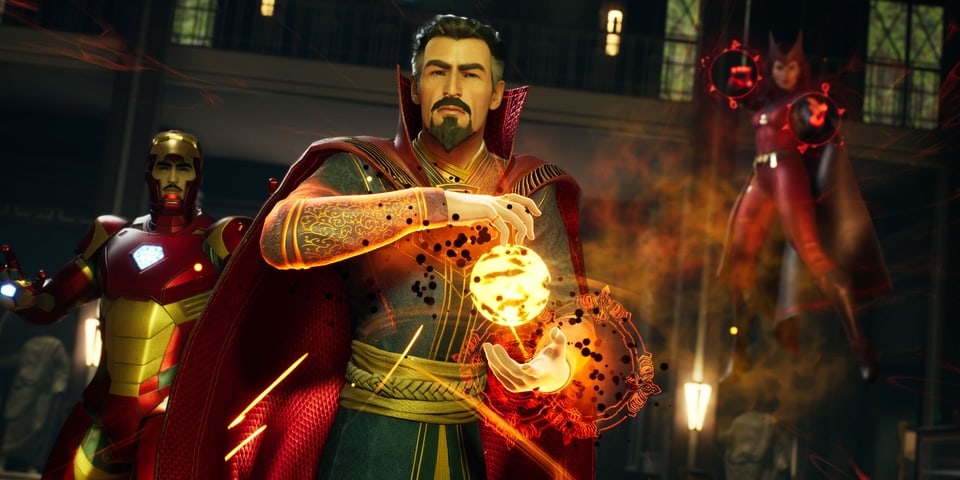
With roughly twenty hours already under my belt, I feel I’ve barely scratched the surface of what Marvel’s Midnight Suns has to offer. The combat system is incredibly deep, and I’m still managing to discover new ways of winning battles, having improved my skills and building streamlined decks for my characters. What also blows my mind is the secondary game to Midnight Suns in which you are basically making friends, having fun, and just generally exploring the sizeable hub world. One thing’s for sure, Marvel’s Midnight Suns is an intriguing enigma which I cannot wait to get to know better.
Marvel’s Midnight Suns is out on 2nd December 2022 for PS5, Xbox Series X|S, PS4, Xbox One, Nintendo Switch & PC.


