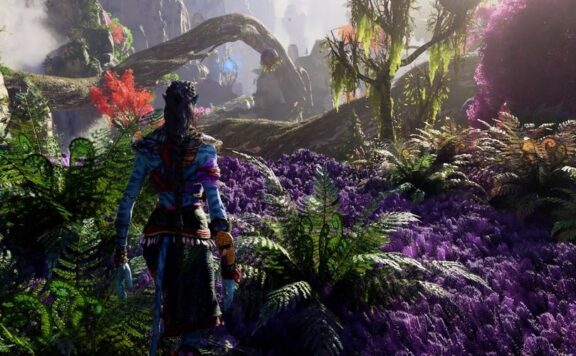


After more than a decade in suspended animation, Avatar is well and truly here to stay. Alongside the films, Avatar: Frontiers of Pandora is looking to capture every facet of the vibrantly realised alien world, its cultures and the battle between natives and human invaders.
Avatar still feels like a strange outlier within modern media. The original film launched in 2009, breaking box office records as so many rushed to see its stunning technical filmmaking achievements (even if 3D movies ended up being a fad), but equally being criticised or mocked for its, shall we say, overly familiar narrative. That its 2022 sequel, Avatar: The Way of Water, ended up being another multi-billion dollar film was perhaps a slight surprise, given the widely professed apathy towards its announcement and trailers – then again, how apathetic can you be if you need to proclaim it so proudly on the internet?
While some parts of the film stories can be easily mocked – ‘Unobtanium’ for one – what James Cameron managed to do so brilliantly was to create a vibrant alien world filled with unusual sights and moments of wonder. From the creature design, to the plant life of this jungle-filled world, the bioluminescence that glows up the setting at night, to the physical manifestation of the Na’vi link to nature, it was a real treat to see this rendered in such fantastic fashion.

One of the first things that struck me when sitting down to play Avatar: Frontiers of Pandora, was how well this game manages to pull the same trick. Unlike the 2009 movie tie-in, we’re now at a point where PCs and consoles can really throw around the same kinds of cutting edge visual techniques that are used in films, in particular with ray-traced reflections and shadows (for the PC version, at the very least). Massive Entertainment’s Snowdrop engine might have originally been developed for The Division, but it’s grown into a fantastically adaptable platform for so many different different genres, games and settings.
More fundamental, though, is the art direction and all of the alien plant life and creatures throughout, as well all the accompanying sounds. My hands on time didn’t start at the beginning of the game, and I was dropped right into the middle of the jungle to try and find my way around. While some parts of Pandora are similar to life on Earth, the first few minutes were almost an assault of my senses from all of the sounds around me, the plants blooping and glurping as I passed (before violently exploding at me), releasing poisonous gasses, or simply retracting all of their fronds should I come close enough to reach out and touch them.
Of course, spend a little time within this setting and most keen gamers will be able to pick apart exactly how Massive Entertainment has pieced together this world. You’ll spot plants that will yeet you across gaps between floating rock islands, or the light blue mist of plants that will lend you a speed boost to race through the forest even faster, and just learn more of how this world works (aided by a Na’vi vision that highlights key things around you).
That’s something mirrored by our protagonist, though Massive has taken a subtly different approach in creating to the films, and stereotypical anime RPGs. You’re neither a human in a Na’vi body, nor suffering from an inconvenient case of amnesia, but rather the result of cruel RDA experiments that orphaned Na’vi and trained them to be RDA soldiers. You’ve woken up fifteen years later in an abandoned facility, taken your first steps out into the wild and encountered your people for the first time, only for the RDA to show up again and start doing stereotypically exploitative stuff all over again.

On some levels, it’s hard to overlook the parallels that Avatar: Frontiers of Pandora will have to Ubisoft’s Far Cry series – both are open world action adventures, both have the player leading a resistance force against invaders/governments/dictators, and both have you doing so by attacking military outposts through a mixture of stealth and FPS combat. It’s kind of apt that, just as the first film could be slated for being a blue alien remake of Dances with Wolves, the initial impression of Frontiers of Pandora will invariably be that it’s a blue alien Far Cry.
Our demo time built up to one of these base assaults, with the returning RDA having set up a new drilling outpost that you need to take down. You’re almost uniquely positioned to do so, having been trained in human warfare and now starting to learn Na’vi combat techniques. You can absolutely approach this in a stealthy fashion, finding a side-passage and gap in the base’s defences, trying to pick off enemies from relative safety, and aiming to stop reinforcements from being called in. You can quickly be overwhelmed during a frontal assault, but you’re almost comically capable with a mixture of bow and arrow and large human guns letting you go toe-to-toe with humans in hulking mech suits. With two different bows, craftable arrow types with poisoned gas clouds and explosives, it doesn’t take much to make a big stompy mech go boom. It takes a little adjustment to realise you don’t have to be quite so fearful of them!
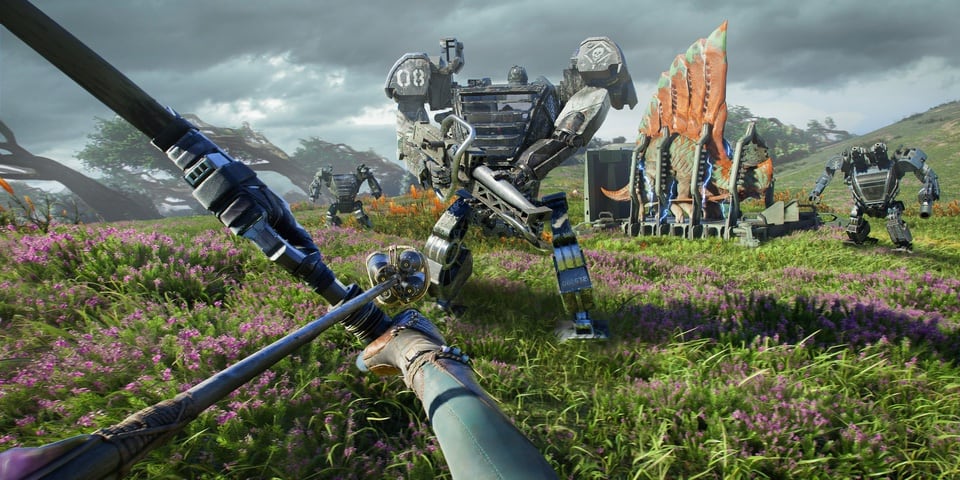
All of this was in an effort to prove to the local tribe that they cannot sit back and try to avoid engaging with the RDA’s influence, sparking a fresh resistance movement by showing how this one drilling facility was having such a negative impact on the local wildlife and ecosystem as a whole.
As much as that side of the game is rather Far Cry-esque, there’s also plenty here that will help Frontiers of Pandora stand on its own. After all, this wouldn’t be an Avatar game without letting you fly through the world on the back of an Ikran, and as an orphan, you naturally have to go through the ritual of courting one of these majestic alien birds to pair with and accept you as a rider.
It’s a great part of the game that strongly echoes the same character beat from the original film, as the Ikran repeatedly rears up and flies off in rejection, asking you to navigate the floating rock islands, clambering ever higher into the sky until they will accept you. Once they do? Well, you can choose a name, and I absolutely picked ‘fluffy’ from the list of options. Then it’s time to take flight, leaping into the air and plummeting to the ground until your newly bonded Ikran swoops in to catch you – as in every video game with a summonable mount, it’s a tap on the D-pad that will call them to you.

Having an Ikran makes getting around the world a simple joy, through the controls do feel a little odd, handling less like a plane and more like a VTOL or helicopter in how you can halt your momentum, hover and strafe around. Speaking of VTOLs, there’s also combat against RDA aircraft, again showcasing just how comically capable a bow and arrow is against sci-fi human technology.
It would be easy to overlook or dismiss Avatar: Frontiers of Pandora, but that would be the same kind of thinking that underestimated Avatar: The Way of Water. While there’s natural parallels to video games (and Ubisoft video games) that we’re all so familiar with, spending even a small amount of time with Avatar: Frontiers of Pandora demonstrates just how well Massive Entertainment have captured the alien environments, the Na’vi culture and the tone and overarching narratives that run through the blockbusting films.