


If you’re looking for a game that can consume dozens or hundreds of hours of your life, then the 4X and grand strategy genres are pretty safe bets. From Civilization through Crusader Kings and Stellaris, you can easily start playing in late afternoon and before you know it, it’s 3AM and you’ve lost half the day. But does it have to be that way?
Coming out in Steam Early Access on 4th December, Stellaris Nexus looks to try and condense all the expansion, development, wars for supremacy and diplomacy into short and pithy 60-90 minute games. It actually does a pretty good job of it!
Nexus comes with many of the trappings of Stellaris, leaning on Paradox’s alien life forms, ship design, and more, but shifts from real time play and a galaxy with hundreds of planets to turn-based and just a couple dozen. It distills all the various gameplay mechanics down, simplifying and limiting what you can do on any given turn with what amounts to action points, and randomised cards for actions.
Whether you play solo or in multiplayer, six budding star empires start a game dotted around the fringes of a small galaxy. Naturally there’s the United Nations of Earth, but you then have the cybernetically enhanced Voor, skilled warriors Kel-Azaan, the corporate Chinorr, the slow and steady Turtuon Federation, and more. Each one has specific strengths and quirks, that are then furthered by the leader that you choose who have their own particular traits. There can only be one of a given species in a match, so choose wisely.
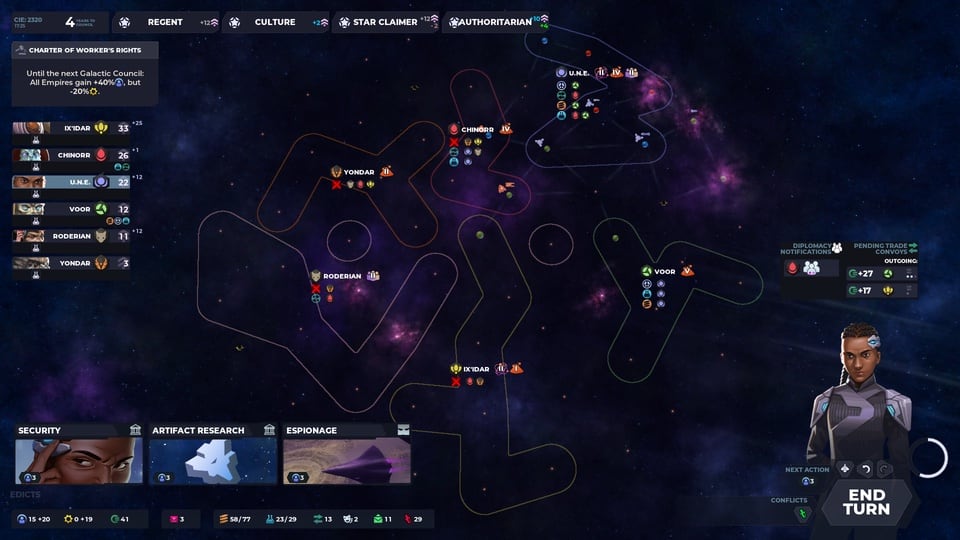
While the game is turn-based, you all play simultaneously, passing down orders and actions that will then all be resolved and calculated once the turn is ended by everyone – combat will take place if two hostile fleets are inhabiting the same system, so there’s no crazy surprise attacks. In single player, you can take your time, but in multiplayer, there’s a turn-timer ticking down to keep the game moving along. There’s a good bit of flexibility despite this, thanks to both the ability to undo any actions and orders you’ve made before a turn is over, and a 60 second ‘overtime’ that gives just a fraction grace across the whole game.
You can’t just hand out orders and actions willy-nilly and have everything happen, though. Actions can only be taken if you have the Support to spend on it, and there’s an escalating cost associated with these. Your first action costs 1 Support, the second costs 2, and so on. You get a fresh portion of Support each turn, but the amount you get each turn is affected by how big your star empire is and the buildings you’ve constructed.
Alongside Support you then have Materials to spend on construction and fleets, and Credits that can be used to substitute for either. You’ll need to spend everything wisely, as constructing on planets, building up fleets, research and more all come from the same pool. In those areas you’ll also be restricted by the handful of action cards that the game gives you, based on context. This gives you other opportunities, like sending a trade envoy to a neighbour, for example.
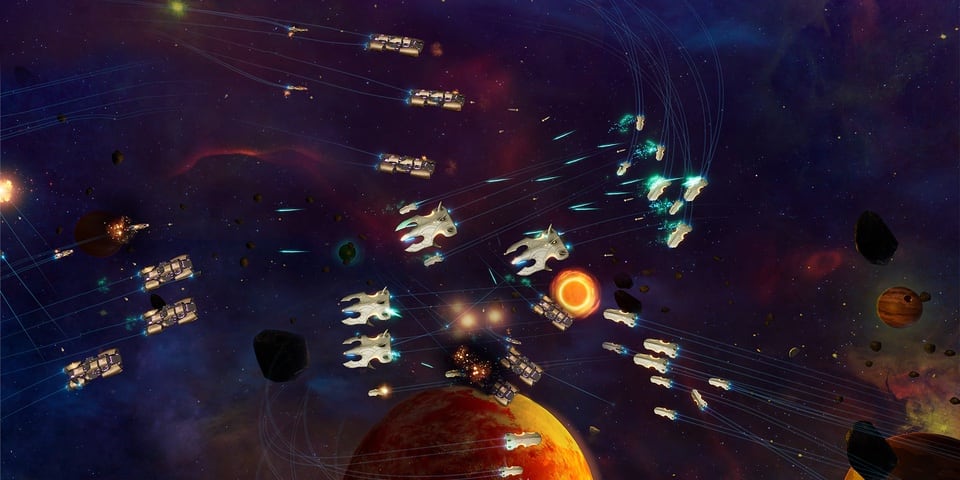
Waging a successful war will take a good bit of tactical nous, but these will typically be wars over one or two star systems, as opposed to sprawling empire-wide brawls. There’s a simple triangle of combat strengths and weaknesses, and each fleet can only be of a single ship type, so you’ll ideally want three complimentary fleets or look to spot which of your rival’s key weaknesses you can exploit.
But there’s other options in the form of espionage, which can do everything from destroying a structure or stealing a technology, to fomenting an all-out rebellion and a planet regaining its independence. This will take a good few turns to take effect, giving the victim a chance to spot and counter the uprising effort, but it’s an incredibly powerful move that can shift your relative borders very significantly.
Alternatively, you can just make friends. You can engage in diplomacy with any of the other empires you’ve met, setting out non-aggression pacts, alliances and more. Just beware that, as you approach the endgame, those alliances can be very easily broken…

And those alliances will be broken depending on who’s got the lead in the race to win the game. There’s no full galactic conquest here, but rather a sprint to reach a total of 100 succession points. Each cycle of six turns, a new objective will be doled out, from trying to destroy the most ships in combat, to having the most systems with star bases or the biggest fleet. You also earn points for having control over the central system of Nexus, making this a focal point for military actions and squabbling.
All of this gives Stellaris: Nexus the feel of a digital board game. The tokenised way that you gain Support and spend it on actions, the narrowed focus and contextual action cards available to you, and the cyclical nature of the scoring are reminiscent of sitting down around a table with your friends and the more social side of gaming. Stellaris Nexus will certainly provide good short bursts of 4X strategy for solo players, but by far and away you’ll have the most fun if you can get a group of six buddies together for one or two hours pouring over a galactic map and trying to plot your way to victory.