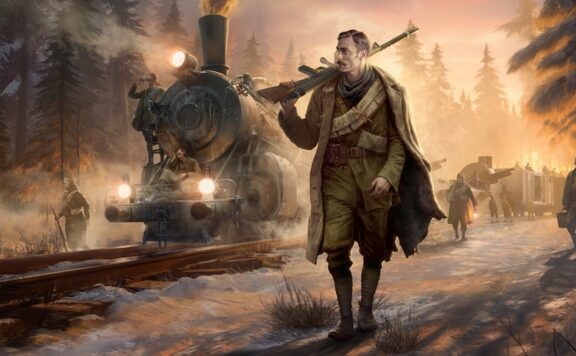


For the Czechoslovak Legion in Last Train Home, the difficulties they face are very different from realising you’re not going to catch the 00:40 from London Victoria to Bromley and need to face up to an expensive as heck cab ride back. Instead, they face an almost impossible mission simply to survive, having to go thousands of miles away from their newly independent home of Czechoslovakia, charting passage between two sides of a cruel civil war on the way from Moscow to Vladivostok.
Inspired by true events of the Czechoslovak Legion’s actions at the tail end of WWI, this game shines a light on what is an easily overlooked part of history of the time – in Western Europe and the US, the focus is all too often on trench warfare and the broader strokes of the Russian revolutions and civil war. The only option available to them is to take trains and start chugging down the tracks to travel the full length of Russia. Where there were tens of thousands of soldiers making this trek in reality, Last Train Home narrows down the focus to your one train and a small outfit of soldiers.
Last Train Home starts with a short journey to Moscow with a heavily armed military train, hoping to get good news from negotiations to secure your safe passage. Right away you’re presented with the two sides of this game. On the one hand you have the train journey itself across the Russian countryside, with a bunch of points of interest dotted around, narrative moments to encounter, and then there are missions to take on, in which you switch to taking control of a small squad of soldiers in real-time tactical combat. To be utterly reductive, it’s like FTL with a side serving of Commandos.

The train and crew management is full of layers as you marshal pretty much every aspect of the locomotive using limited resources and manpower. You can zoom in to inspect the train and carriages as it passes through the countryside, and assign legionnaires to various jobs and positions throughout. You’ll need both day and night shifts to stoke and run the main engine, once you have a kitchen car and artillery car, they’ll also need staffing.
The two main resources you need to worry about are coal and food, fuelling the engine and legionaries respectively, but you’ll also need metal, cloth, herbs, gunpowder for upgrades, repairs and crafting, and just money in general if you’re going to survive. Getting a hold of resources is a case of scavenging from the world around you, regularly stopping the train so that you can send a squad of soldiers off to investigate some abandoned houses, hunt in the woods, fish at lakes, and barter and trade with villages to find and get what you need.

You’ll do well to consider which of your available legionnaires you send on missions and assign to tasks. Each one has specific characteristics, beyond their fundamental stats, so you might have someone who’s a little light-fingered and great for scrounging through an abandoned house, or someone who’s good at negotiating and bartering to get better trades, but they’re just as likely to be an alcoholic or injured with diminished stats. As they gain experience you can assign stat points that will unlock more specialised roles both on the train and in combat – each legionnaire has a potential role in both – and level those roles up to give better proficiency.
You’ll feel the most impact when it comes to heading into battle, as you assemble squads of 3-10 soldiers from the available legionnaires. Each will be a rifleman, grenadier, sniper, machine gunner or medic, and you’ll want a little balance for the various perks, weapons and abilities they provide. The sniper has powerful ranged single shots and binoculars to scope out enemy positions, while machine gunners can place their gun and lay down a withering hail of bullets at oncoming enemies.
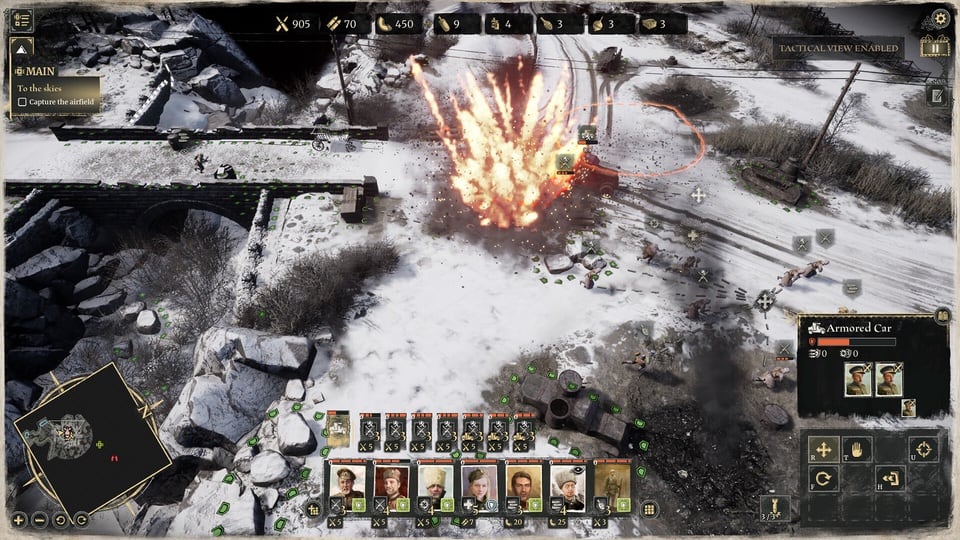
The real-time tactical combat is fast and brutal with quick flanking manoeuvres and bayonet charges, but you always have a tactical pause to halt the game and issue more precise orders for using cover, throwing grenades, and the like. You’ll probably want to lean on quick saves as well. Depending on the mission and objective, you can absolutely take different approaches, sneaking you way through patrol routes and taking out enemies quietly, or going in all guns blazing. As we’ve made our way through the opening chapters of the game, there’s some good variety within a combat mission – heck, one optional level had me performing chores to win over local village who’d been terrorised by the Red Army.
And that ties in with the general narrative of the game. The Czechoslovak Legion doesn’t want to fight or pick sides, but is effectively forced to. Rejecting the order to lay down their weapons (leaving themselves defenceless in the face of such uncertain times), you’ll have plenty of run-ins directly with the Red Army to face off, and there’s a moralistic bent to the situations you’ll encounter along the way.
There’s a few little rough edges to the experience at launch. I’ve had a revived soldier be invisible – to be fair, they were downed within an exploding truck, so not having a body was a little logical – and some animations fail to happen in combat, or cones of vision passing through trees and trucks somehow. I also wish you could filter out soldiers with core roles on the train, when it comes to constructing a squad, even if there is a (small) marker for what everyone’s assigned to do.
With a compelling historical story as its inspiration, multi-faceted train management and tough small-scale tactical battles, there’s a lot for strategy fans to like about Last Train Home, and I’m keen to keep chugging away with my own journey through the game.
Last Train Home is out now on PC. Keep an eye out for our finalised review in the coming weeks.