

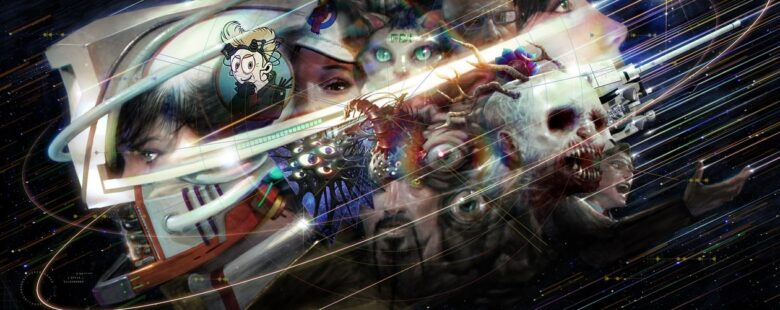
It’s an exciting time to be a fan of Grasshopper Manufacture. With nearly three decades of bewildering punk-personified video games, the studio doesn’t seem to be slowing down at all. The team has spent the last few years celebrating their greatest hits, with the hotly anticipated finale No More Heroes 3 and a sharp remaster of Shadows of the Damned. Now, sights are set on new horizons, new worlds, and a new hero with the upcoming release of Romeo is a Dead Man.
For all the change that Grasshopper Manufacture has gone through over the years, the unorthodox and endlessly inventive vision of studio head Suda51 has seemingly never wavered. We jumped at the chance to sit down with him and check in on how he’s feeling about his upcoming game, and reflect on some of his favourite projects, collaborators, and giant robot anime.
TSA – Well it’s really awesome to be talking to you guys – especially right before Romeo is a Dead Man, a new game of yours is launching. How are you feeling about it?
Suda51 – We’re really happy to be talking to you right now too, and thanks a lot for, you know, for covering us.
It’s kind of like, ‘Wow, it’s really, actually, finally coming out,’ you know? We’ve been really busy. We’re doing this promotional tour right now, we’re also still making final tweaks on everything, making sure everything’s in line. So it’s been really busy and pretty exhausting, but it’s also just super exciting, again, to finally have the game come out!
TSA – I can tell you guys have been putting a lot of work in – Romeo is a Dead Man looks incredible. It’s definitely the most high-fidelity, graphically detailed game that Grasshopper Manufacture has made up to this point.
Suda51 – [Laughs] Wow, thank you.

Romeo is a Dead Man features a more traditional “AAA” art style to previous Grasshopper games.
TSA – Was there a specific reason you guys wanted to go for that AAA graphic style for this game, instead of a more stylized or simplified style?
Suda51 – Well, when development really first started kind of getting going, I spoke with our art director, Tanawaki-san [Kunihiko Taniwaki], and he had the opinion that this time, we should go with not exactly a photo-realistic style, but more realistic graphics in general. More high-quality graphics, instead of, like, creating a whole new style of art and visuals just for this game.
One of the reasons for that is, obviously, it takes a lot of time and brain power and creativity to come up with a whole new style. The other thing is, when you’ve got a whole studio full of people working on the same game, it takes a lot of time and effort to everybody on the same page and get everyone to really understand ‘OK, so this is what everything’s supposed to look like. This is how I should make this.’
That was part of the reason there – it would just take a lot of time, it would take a lot of effort. And also, we kind of just wanted to see what we could do making more high-quality, more realistic graphics than we were used to doing.
TSA – In the game, Romeo Stargazer is an FBI space-time special agent, and it’s the first time Grasshopper Manufacture has made a game about being on that side of the law since The Silver Case and 25th Ward. Why make a game about an interstellar FBI agent instead of, for example, a demon hunter or assassins?
Suda51 – This is kind of a weird way to start off the answer to this question, but when I first came up with the idea for the story and the character, as you could probably tell by playing the game, I was mainly inspired by Back to the Future and Rick & Morty. Not only the space-time travel stuff but the relationships and everything.
So when I started thinking about what kind of main character I was going to make, to be honest, even I’m not sure of the exact reason why I decided this, but I thought ‘OK, this time I want to basically portray just a regular young dude, and write the story of how he kind of grows and develops into a grown man. And, you know, gets tough and stronger and really fulfils his own potential and stuff.’
Then came the ideas of him getting the special helmet and becoming Deadman and having to overcome all kinds of challenges and stuff. But yeah, I didn’t really set out with the idea of ‘OK, this time I’m going to go against the grain of Grasshopper titles – I’m going to make the guy somebody on this side of the law!’ It just sort of happened, to be honest, and I don’t really have a specific reason why.

Romeo Stargazer is an FBI space-time special agent.
TSA – It’s interesting that you talk about the idea for the character kind of being about wanting to see a young man become stronger and grow. It feels like that’s a little different than a lot of your previous characters, where they start already kind of being these rough, mean, weird dudes. Was there a reason why that kind of story really appealed to you this time for Romeo is a Dead Man?
Suda51 – Up ‘til now, like you said, there’s been a lot of characters who are kind of the exact opposite. For example, Travis Touchdown – you got this guy who, he’s a grown man, but pretty immature and kind of screwed up and, you know, he’s got a pension for being a bit rough and violent.
I think it might have been subconscious – or might have actually been a little bit of a conscious decision and I just didn’t really notice until recently – but I think part of me was probably like, since I’ve been working on characters particularly like Travis Touchdown for so long, I think maybe this time I’m going to go the other way and have the character start out not fully developed yet. And also, you know, not be this kind of… funky asshole, I guess you could say. I think that probably did, at least on a subconscious level, influence my decision to start with this sort of character in this sort of story and how he was portrayed.
TSA – You’ve talked in the past about how your team works collaboratively to share ideas and build them together. Is there an idea that made it into the final version of Romeo is a Dead Man that surprised you? Like something you didn’t come up with yourself at all, or something you would have never thought of or expected to work in the game?
Suda51 – [Laughs] Uhh… oh, there’s a part of the game called [Deadgear Cannonball], where you can use it to power up Romeo and the stuff he can do. And at the beginning [of development], one of the staff members said ‘Hey, I want to put this type of mini-game thing in the game, it’ll become like a Pac-Man style thing, and you just power up, and this is how it would work.’
When they explained it, I was kind of like ‘What the hell are you talking about, like why…’ and they were like, ‘No, I really want to do this, we should try this out.’ And then, you know, it got put in the game, and when we started the debugging phase, bit by bit, I tried it out and I was like ‘Yeah…I still don’t really get it. Like, again, what is this Pac-Man rip-off thing? What’s this really even for?’
But then, when development progressed even further and it got to the point were we could play through the game linearly, I started realising not only does it fit in really well and it kind of flows really well with the rest of the game, but it’s actually a really important element in the game. Yeah, that was a really good idea. I’m really glad we put that in.
To be honest, I haven’t told that person that! [Laughs]
TSA – In Romeo is a Dead Man, and a few other Grasshopper Games, you’re credited as “SUDA51” for the Directing and the Story, but Producer gets credited to your real name, Goichi Suda. Why the distinction?
Suda51 – [Laughs] I feel like Suda51 is more connected to the creative side of things, and naming wise it kind of fits better with that. But using my real name, you know, Goichi Suda, that sounds a bit more serious, like, you know, CEO-ish, than just Suda51. Like a dude wearing a suit with, like, a proper tie and everything. And so I thought it might be best to kind of split the way I use my names in that way.
Also, to be honest, I’m also just trying to look cool.
TSA – You could look cool wearing the leather jacket and the necktie. Could be interesting?
Suda51 – Sounds like a pretty bitchin’ style. I might try it out.
TSA – I know that your original vision for Shadows of the Damned ended up spawning multiple drafts, and some of those drafts inspired later works like Kurayami Dance and Black Knight Sword. Did any ideas from those drafts end up inspiring Romeo is a Dead Man?
Suda51 – Nothing from Shadows of the Damned, no. All the different drafts that got made for Shadows of the Damned either just got trashed, or got canned, or turned into something else. But none of them had anything to do with Romeo.
TSA – The last few games from Grasshopper Manufacturer almost feel like Avengers movies with how many returning characters there are. You’ve brought back characters from Let it Die, Killer 7, Shadows of the Damned, and even your short story ‘Aka to Ao to Midori to’.
Suda51 – Woah, haha. You did thorough research!
TSA – For Romeo is a Dead Man, did you have any characters you’ve wanted to bring back, but couldn’t?
Suda51 – Actually, yeah: Fleming from Shadows of the Damned. I believe it was the seventh draft, maybe, that I had him actually appear as one of the bosses in the game. It’s really unfortunate, but things changed and he ended up not being able to make it. It’s a shame.
I actually wanted to put Fleming in No More Heroes 3, as well. That also, as you know, ended up not working out. But in my mind, Fleming is this character that I want to have battle all these other characters in my other games and stuff. I just really don’t want him to be a one-off thing – I want to use him again, you know?
And this is just, like, talking out of my ass here, but if someday, like 20 years from now or something, if we end up doing like a remake of No More Heroes 3, then I’m hoping to be able to kind of shoehorn him in there.
But I really do want to see him head into battle against a lot of the other characters that I make. Actually, for both Romeo is a Dead Man and No More Heroes 3, it got so far, to the point where I actually wrote the scenario with Fleming in it – both with Romeo and with Travis in the two different games. Again, unfortunately, it just ended up not working out, so, what are you going to do? But it wasn’t just kind of like a one-off idea that I had and said ‘oh no, never mind.’ I actually did put the effort into it.
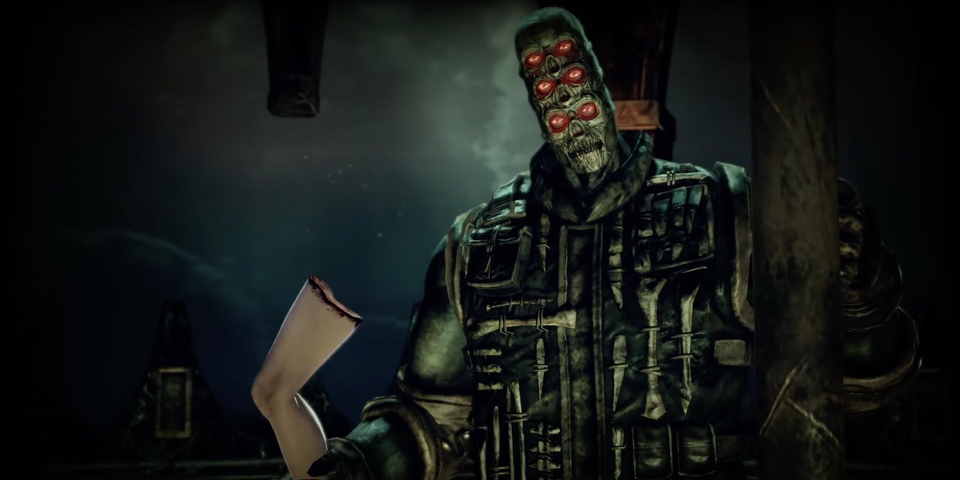
Fleming from Shadows of the Damned never quite made it into later games.
TSA – What was the reason for Fleming not making it, in that case? Was it kind of just that creatively the draft and your vision for the game went in a different direction where it didn’t make sense to have him there for Romeo is a Dead Man? Or was it some sort of outside reason?
Suda51 – It’s actually a really simple reason, to be honest. Just scheduling reasons. We have to deal with both scheduling, and someone’s got to pay for this stuff too. When it came down to it, we were like, ‘Okay, we’re gonna end up going way over schedule on this. We have to tweak some stuff, we’re gonna have to cut some stuff.’
And honestly, just one of the parts that happened to be easiest to cut without screwing up other parts of the game would have been the Fleming part. So he got cut because of that.
TSA – You’ve regularly collaborated with surprising multimedia artists for your games, like Boneface for Travis Strikes Again or AC-BU for the Velvet Chair Girl scenes in No More Heroes 3. How do you decide when to bring in outside artists like this to collab with, and how do you pick them?
Suda51 – It really just comes down to the artist, and the art they make, and whether I dig it, and whether I feel like it’d be something that would be a good fit. For example, Boneface, I’ve been aware of his art, I’ve seen it online and in different places and just thought it looked really cool, and reached out and said ‘Hey, would you like to maybe do something with us for this game series that I got going here?’
For AC-BU, I happen to know a guy who had connections with them, and went through with the director named Mizuno and ended up being able to talk to them directly and show them what we were trying to do and the kind of thing we were trying to achieve. And, also, I’ve seen the stuff that they’ve done before, and just thought it was really cool and thought ‘okay, considering what it is we’re trying to achieve now, considering the stuff that these people are obviously able to do – I think this would be a pretty good fit, so let’s try and work it out.’
Sometimes, it’ll be that somebody introduces me to these people and I’ll check their stuff out and be like ‘Oh, yeah, that’s somebody I’d like to work with.’ And sometimes it’ll be somebody that I’ve kind of found on my own and just kind of reached out to on my own and been like ‘Oh, hey, this is who I am. You want to work together?’
But yeah, as far as how I choose the different artists to work with and why? It’s pretty much sort of a case-by-case.
TSA – Are there any artists you’d like to collaborate with for the next Grasshopper Manufacture game?
Suda51 – I don’t really have a concrete idea yet for ‘This is the person I want to work with for our next game!’ or ‘This is exactly what our next game is going to be!’. But we do have a couple projects that we’re sort of not working on, as in actually developing, but planning and fleshing out the ideas for and everything. We have a couple of those in the works and I do have a couple ideas for those. Like if we really are going to do this project, then this is somebody that I’d like to work with for this particular one.
Actually, there is one guy that I just thought of who I’d like to work with a little more, in a much more full capacity, you could say. He’s a manga artist name Asano Inio, he did the art for Midori Midorikawa and Kamui in No More Heroes 3. Not only did I really like the art that he did for that game, but I’ve seen the manga he does, I’ve seen the art he does before, and I think it’s awesome.

Instead of just having him be sort of like a guest artist or guest creator on a game, I’d really like to get into a whole game with this guy, do like an actual collaboration where instead of just doing one or two characters, this is the guy who’s doing a whole lot more art for the game. I’d love to do some sort of collaboration with him at some point.
TSA – Oh, I’m a big fan of that author. He did that manga, Dead Dead Demon’s Dededede Destruction.
Suda51 – Yeah! That one! Yeah.
TSA – One of my favorite games of yours is Let It Die, and it’s also the only console game you’ve worked on with online interactions, where you send NPC hunters from your game to other player’s worlds to hunt them. Is there a reason you haven’t returned to that online style for your games since?
Suda51 – To be honest, as far as Let It Die goes, it’s known to be a Grasshopper Manufacture game, but I don’t really consider that to be the case.
Technically, I did participate, and some of us did participate in development, but it was a GungHo game, basically. And, you know, the online stuff is because GungHo is basically an online game company.
I consider Let It Die to be, not necessarily a Grasshopper Manufacture game, but a Supertrick Games game. They’re the ones who did most development. So yeah, the online elements aren’t exactly our thing, that’s much more of a GungHo thing. Nothing wrong with that – it’s just not really something that we’re into, I guess.
TSA – Well now I feel embarrassed for saying it’s one of my favorites from you.
Suda51 – Don’t worry, it’s cool, technically we were involved in the development and stuff! So it’s not wrong, don’t worry about it.

Travis Strikes Again
TSA – Well, another one of my favorites from Grasshopper Manufacture is Travis Strikes Again, and it felt like an incredibly personal video game, where so many of the stories and characters seemed to be reflections of your own history in the world of game development. Did you face any challenges making that game and writing it the way you did?
Suda51 – For Travis Strikes Again, I wouldn’t say that it was hard or difficult to write the characters and write them the way that I did. It definitely felt different than the way it usually does to write characters. […]
Travis Strikes Again was actually done around the 20th anniversary of Grasshopper Manufacture being established, so we wanted to do something special for that, and we got a lot of leeway from companies – for example at Capcom, they were like ‘OK, well seeing as how it’s their 20th anniversary and stuff, you can use stuff from Killer 7,’ and things like this.
I did include a lot of characters that, for most players, probably seemed to be new characters, and a lot of familiar characters from previous games. But the thing is, a lot of the characters that people hadn’t seen before, they weren’t made necessarily for Travis Strikes Again – they were characters that I’d come up with either for other games that ended up not making it into that game, […] or the game itself ended up getting canned for some reason, or just ended up never coming to fruition.

Travis Strikes Again
So a lot of the story and the characters that I wrote for Travis Strikes Again, it was almost an elegy to these characters who, you know, they… not necessarily died. I mean, most of them in the game died, but you know, they were kind of stuck in this limbo. By finally being able to get them out there and put them in the game, I was kind of trying to help them to finally just ascend and finally move on, you know what I mean? And not just for the characters, but for myself as well.
So, I did put a lot of my older ideas and past ideas and characters into the game. Again, that was also partly because it was for the 20th anniversary of Grasshopper. I personally wanted to do something special for this game. That’s why you see so many things that kind of feel like they come out of left field. Sometimes they feel a little bit more natural, but they’re clearly, you know, ‘Oh this is this guy from that other game!’
And again, a lot of the stuff that people assumed were new were actually, you know, they may have showed up, or almost showed up in 1, 2, 3, 4 past games, but ended up not. So, yeah, Travis Strikes Again, it was a big sort of jumble of these characters, and me not only trying to help these characters kind of move on and finally, you know, get what I felt they deserved, but also sort of letting myself kind of let them go. Finally being able to say, okay, I was finally able to put them out there. I’ve done for them what I can have done for them, what I owe them. This is their elegy.
That’s kind of what Travis Strikes Again was like writing, for me.
TSA – I know batting centers are important to you, so important you made sure to include one in The Silver Case. When you’re travelling abroad for work, is there a place you go to that feels like the overseas version of going to the batting center to be alone with your thoughts?
Suda51 – [Laughs] Yeah, I’m kind of too scared to like, actually go out on my own when I’m overseas to like, find a place where I can just kind of be alone with my thoughts and stuff. That would mean that I have to go out all by myself like a big boy and, you know, find some place to chill and everything. And I can’t really do that.
So, I’d probably say my hotel room. [laughs] I guess that would be my overseas batting center.

Uh, here’s a screenshot from RBI Baseball 19, which we have handy…
TSA – I also know that bars and beer have been important to you for a long time, no matter where you are in the world. What is it about drinking at ‘bar plastic model’ in Golden Gai, hunting for Blue Moon when you’re overseas, and going to your old “third meeting room” Motsuyaki Kawakami that you enjoy the most?
Interpreter – I mean, have you had beer before?
TSA – [Laughs] I have had beer before.
Suda51 – Have you been to ‘bar plastic model’ before?
TSA – Yeah actually, I was in Japan two years ago and went!
Suda51 – To me, it’s kind of like a present to myself, kind of like a reward to myself. I don’t know how people outside of Japan feel about this, but to a lot of Japanese people, that’s kind of what having a beer after work is. So you finished a day, a long day of hard work, and ‘OK, I’m going to reward myself with beer.’ You know?
Unfortunately, during Corona I just kind of stopped drinking that much and kind of stopped being able to. Partly because I stopped being able to go out to drink so much, I also stopped being able to drink so much at all. […] I get wasted a lot easier than I used to. So instead of staying out having a bunch of drinks, yeah, usually I just keep it to like one beer or so and that’s enough. I’m like ‘OK, yeah, that was some good work I did today. Just pound one back and that’s cool.’
TSA – I can tell you’re a big fan of beer because you called it Corona instead of Covid.
Suda51 – [Laughs] that’s just what it’s called in Japan, but that’s a good one!
TSA – What haven’t I asked that you would like to talk about?
Suda51 – Hmmmm, I’m not sure. Let’s see… have you beaten the game yet?
TSA – Not yet! I’m on the second boss right now.
Suda51 – Ahhh, okay. When you beat it, there’s gonna be a lot of questions you want to ask, and a lot of things i want to talk about. So let’s save those, and after you beat it let’s talk again.
TSA – Alright, I’ll beat it, and we’ll talk about that, and we’ll talk about Char’s Counterattack.
Suda51 – Oh, have you seen GQuuuuuuX? [Mobile Suit Gundam GQuuuuuuX]

Mobile Suit Gundam GQuuuuuuX
TSA – Oh, I loved GQuuuuuuX. I have the model kit for the GFreD mobile suit!
Suda51 – Oh. Nice, nice. I was waiting for ‘How much influence did GQuuuuuuX have on Romeo is a Dead Man?’ – that’s one question that I was hoping you’d ask.
TSA – Well, I definitely wanted to talk about anime. I’d love to know what you thought about GQuuuuuuX, being such a big fan of the original Char story. Did you like GQuuuuuuX?
Suda51 – There’s one part of the game where it’s really clear that this part was really, really inspired heavily by GQuuuuuuX. So, yeah, once you’ve cleared the game, once you got to that part, let’s talk about that again!
Thanks to Suda51 for taking the time to talk to us about Romeo is a Dead Man and everything else! Romeo is a Dead Man is launching on 11th February 2026 for PS5, Xbox Series X|S and PC.


