
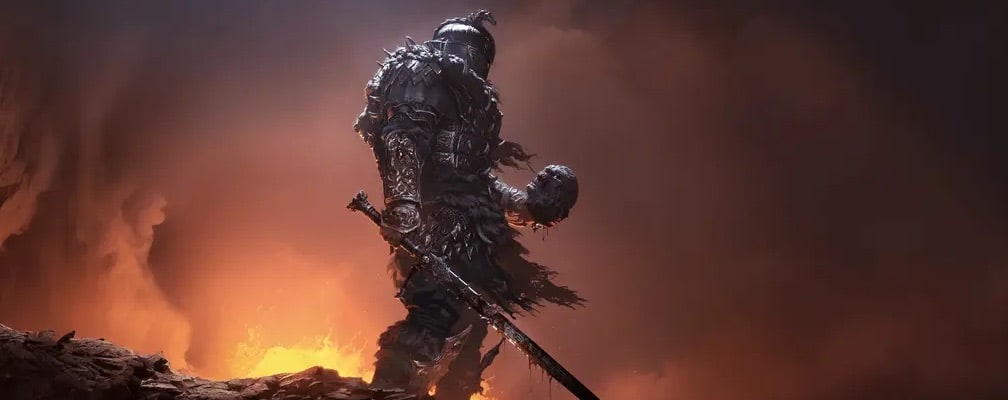

Fatekeeper, in Early Access at least, doesn’t mess around. With a minimal amount of narrative impetus, you’re dropped straight into the thick of it, embarking on your second expedition – I imagine the first one may be a tutorial that will be added later – and setting you on your way to Haven and the island of Solace. As you wend your way through incredible forests, mysterious tombs and imposing mountains, you’ll fight off myriad monsters that don’t seem to want you there.
Fatekeeper’s first and most immediate highlight is your Muran Tor, your spirit guide. In this case, he’s a rasping, talking rat, propping himself on your armoured forearm and asking to take a sip out of your mead – when you finally find some. He’s a mentor, a guide, and he’s pleasingly sharp-edged, like a vicious Remy from Ratatouille, lending the game some of those dark fantasy vibes of fellow THQ series Darksiders.
Your first steps into Fatekeeper find you working your way up an impressive stone staircase, set amongst the towering crags of Solace’s mountains. Foliage shifts in the breeze, sunlight dapples the root-wrapped stone, and you move from staircase to cavern to forest. It certainly makes for an atmospheric and great-looking first impression, even if performance is currently a bit weak. My PC with a Ryzen 5800X and GeForce 3070 isn’t the highest end rig out there anymore, but it struggles to keep things smooth, even after dropping the resolution down to 1080p.
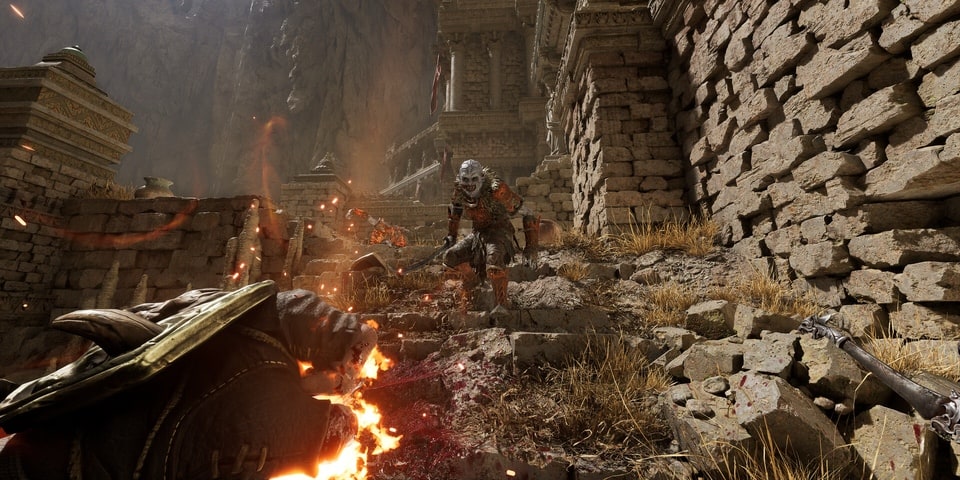
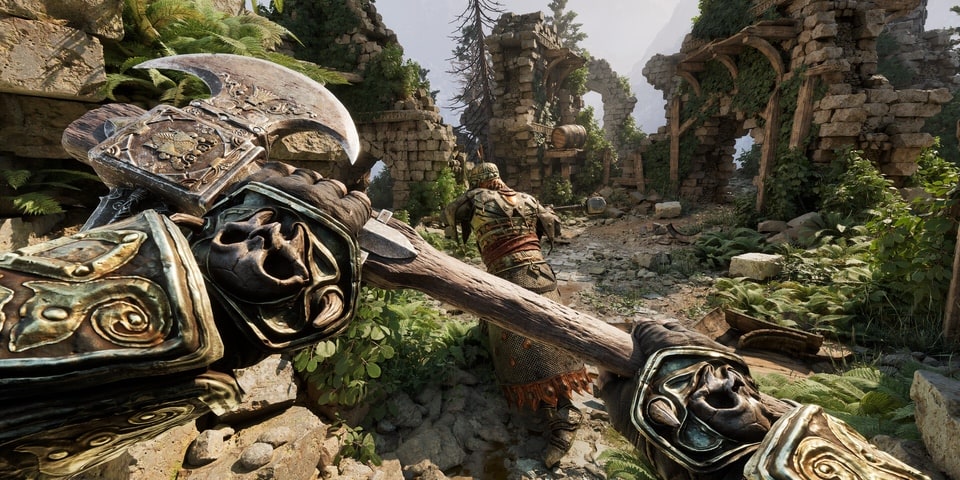
These early moments feel like Skyrim by way of Styx, some of Nacon’s long-running dark fantasy franchise seeping into the look and feel here. The first-person physics-based combat is a bit messy and mushy, but walloping creatures with a massive axe and seeing their body flop messily to the floor remains a good time.
You’ve got a stamina bar that limits how much running and sword swinging you can do, while you can choose to pepper enemies with faster, weaker strikes, or opt for a massive, but incredibly slow swing, while there’s a suite of magical spells at your disposal, starting with a fireball and telekinesis. There’s also a nice, satisfying kick that breaks the enemy’s guard, and can even send them tumbling down into a handy abyss below or into some vicious spikes resting against a wall. It’s funny how those spikes always get left leaning against a wall, isn’t it? It’s not exactly Feng Shui.
The monsters on the other end of your axe are well-realised, if a little generic for anyone that’s seen Peter Jackson’s The Lord of the Rings. The Vrög are certainly Orc-adjacent, though their gurning, pink-skinned mugs make for suitably hateful opponents to dash to pieces. They are a bit short though, and you have to make sure that you’re swinging your sword at their height, otherwise you’ll completely whiff the attack. It reminded me of playing GoldenEye multiplayer, and some smartarse choosing Oddjob.

As you’d expect, there’s a range of loot and equipment to upgrade your character’s stats with; I particularly liked the fact that you can wear up to four rings on each hand, a loadout option that actually makes real, physical sense. Besides that, armour is currently a single body piece, rather than being broken down into different gauntlets, boots, etc., which I’d hope to see expanded further on down the line, though you can equip two weapons that can be switched between as needed.
One of the interesting choices right now is the way the skill tree works. Once you’ve chosen your first upgrade – Fortitude, Wrath, Insight or Power – it locks you into that pathway, rather than letting you branch off in other separate directions. You’ll be able to work your way around to the other upgrades, but it looks like it’ll take a long time to travel your way across the extremely busy configuration.
There are a number of foibles that show just how early a point Fatekeeper is at, whether you find that some of the control listings are incorrect (just press everything), or combat feels messy and chaotic. The Vrög that throws unblockable rocks can also get in the bin. On top of that, returning from the menus or the inventory screens can tank the game’s performance, even if it was running perfectly before. It feels like there’s missing audio too, like a Blacksmith who doesn’t talk to you, despite turning his attention your way, and a soundless hammer banging on a silent anvil, but these are all elements that will undoubtedly be added as development progresses.
There’s plenty of potential in Fatekeeper’s old-school fantasy adventure vibes. While You can tell that Fatekeeper is at a very early stage in its development, and that fact is reflected in the current price. Coming in at just £8.49, that feels like an easy down payment on the game’s proof of concept. The downside? It might mean that you’re waiting for quite a while for this one to reach full release. Hopefully, with the backing of publisher THQ, they’ll have the time and support to bring their concept to fruition.

