

Star Wars fans have been eating pretty well in recent years, at least when it comes to video game representations of that galaxy, far, far away. From Cal Kestis’ adventures in the Star Wars Jedi series to the impressively realised underworld of Star Wars Outlaws, there’s been a lot to enjoy, but 2026 carries a new doubleheader: Star Wars Zero Company, and Star Wars: Galactic Racer. While we patiently wait to smash Sebulba off the track, we took our first opportunity to go hands-on with Star Wars: Zero Company and came away hugely impressed by the narrative-led tactical adventure.
Hawks is a former Republic soldier carrying around the trauma of a battle on Antine that went south, killing most of his battalion. After leaving the service, he went private, set up his own team, the Zero Company, and has since been working his way through different regions, taking work from the highest bidder.
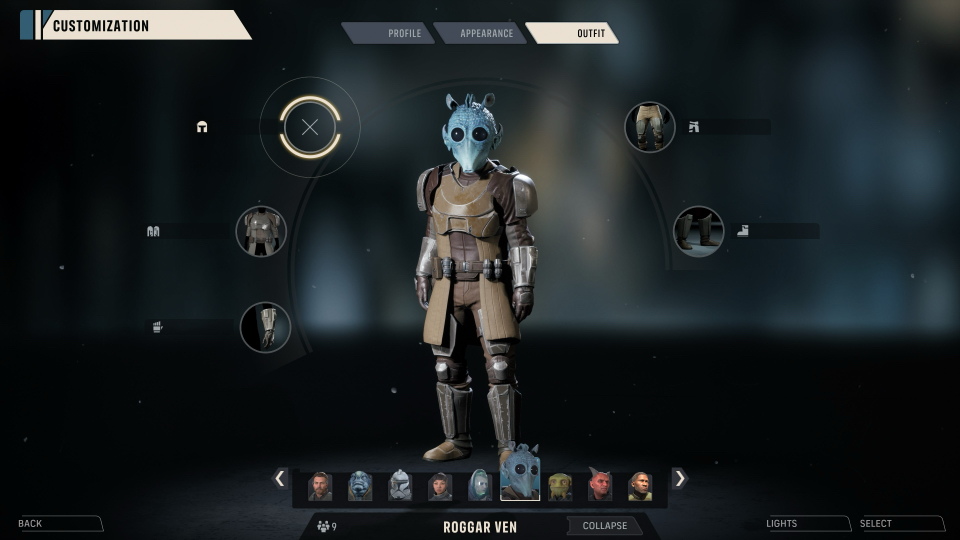
Creating Hawks gives you a massive suite of customisation options, far more than I’d expected as a narrative-focused title. From choosing your race and gender, you’re then onto an array of facial options, followed by a great batch of clothing or armour types. I settled on a relaxed, smuggler-type affair, though I was definitely tempted by the options that looked like the resistance soldiers from Return of the Jedi. This version of Hawks is then fully represented throughout cutscenes, giving you a real sense of ownership and individuality, and it sets you off for a great sci-fi adventure.
That adventure begins with Zero Company in a bit of a bind. You’re in debt to the Hutts, and there’s a great big counter at the side of the screen in case you’re hoping to forget. Your accountant Runa sure won’t let you forget, though, and you get an immediate sense of the nonchalant but clearly charismatic Hawks, who’s channelling a touch of that Han Solo energy in their pithy back and forth.
There’s certainly some shared atmosphere and outlook with Ubisoft’s Star Wars Outlaws, with Zero Company offering a different view on the criminality and lower-level problems of George’s Lucas’ sci-fi universe. Through our hands-on, the teams at Respawn and Bit Reactor have struck a great tonal balance, with playful, engaging dialogue, and characters that you’ll find genuinely interesting.
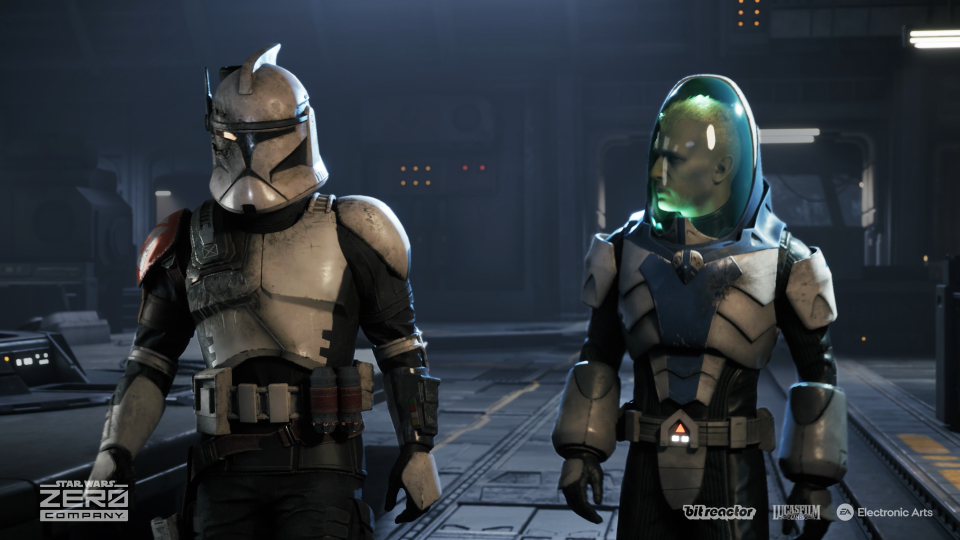
Zero Company’s initial lineup is headed by Hawks, who’s then backed up by ex-Republic soldier Trick, decked out in his Clone Wars-era armour, Kabb Uppercut, a wonderfully named Felshi prize fighter with a cybernetic arm who speaks in enjoyable little rhymes, and a particularly unlucky Rodian who doesn’t make it through the first mission as a lesson in permadeath.
Ah, yes. Star Wars Zero Company takes a leaf out of Fire Emblem’s tactical book, and if an agent dies during a mission, they’re gone for good. I don’t think there’s any other mechanic that makes me take more time, or forces me back to earlier saves more often, than permadeath, and in Zero Company, even though you can find new recruits exceptionally easily via a terminal in your home base, I won’t be leaving anyone behind. It might make the game twice as long for me, but I can live with that.
Key to the game’s early successes, though, is its narrative. Zero Company feels, at least at the outset, like a genuinely intriguing story set in the Star Wars universe, delivered with some excellent animation and voice acting. Hawks makes for a likeable central character, and as the team get wrapped up in the Republic’s fight against the shadowy Coil, you really feel like you’re part of a team who’s looking to do some good in the universe. While making money, of course.
Your home base lets you interact with each of your team members, and chatting with them might open up new missions or opportunities, though it’s on the battlefield where you can forge new links and affinities with both members of a burgeoning relationship granted a choice of permanent upgrades to their stats.
There’s further factors to work your way through while you’re back at base, beyond recruiting new team members or upgrading and outfitting your current ones. You might need to send an injured Operator to the medbay, or you can expand your current facilities by building new areas or upgrading pre-existing departments.

Before you actually head out on a mission, you’ll want to spend your intel points gathering information. There’s a galactic region map that you can use to choose where to investigate, with some giving you tactical options to pick from, while others might have you send operators out to deal with the situation.
These are hands-off, text-based narrative snippets, though they can have immediate repercussions, occasionally returning a couple of members of your team with injuries that’ll need treating. The advantage is your increased reputation in different galactic regions, which can give you further bonuses and upgrades to deck your team out with, and it often ties together with the central narrative or characters that you’ve previously encountered.
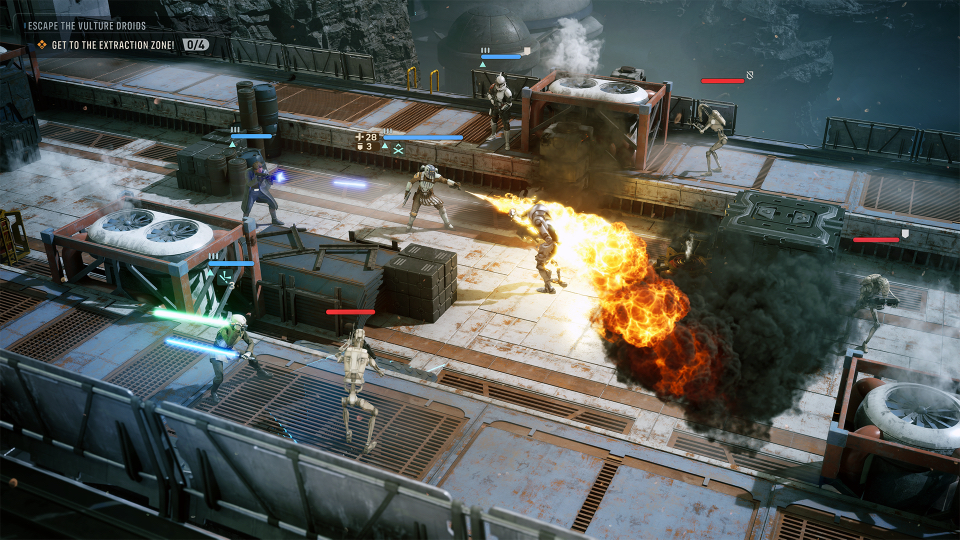
It feels at this point that it’s taken a long time to talk about the tactical action, and that’s partially because it’s the least groundbreaking portion of the game. It is excellent, though, giving you battlegrounds with a variety of elevation, reliable turn-based strategising, and a few interesting wrinkles in the form of weaponry mods, unit-specific moves, individual consumables, and the Advantage meter. This can be used to fire off powerful special moves, such as Trick’s devastating rocket launcher or Hawk’s 100% accurate precision shot. However, with its narrative grounding, missions often have somewhere you need to get to, a console to finagle, or an ally you need to reach, which lends them a touch more impetus and importance than a slew of other tactical games.
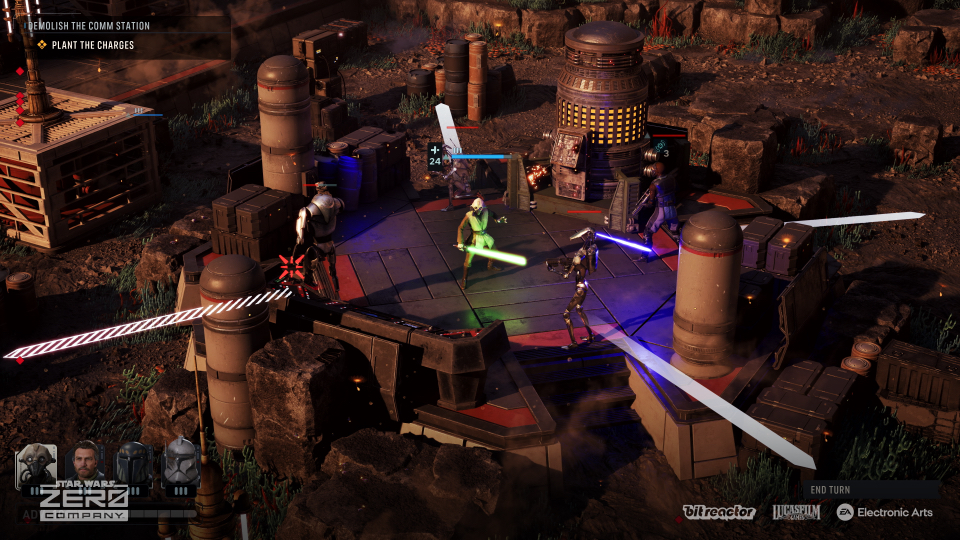
While I’ve mentioned Fire Emblem before, Zero Company actually does a better job of making its missions feel like a compelling part of the narrative than Intelligent Systems’ long-running series often does. I think that’s helped by the pre-mission exploration sections, and the viewpoint and high-fidelity graphics, which bring the whole thing to life that little bit more, and it’s something I hope can carry through the entirety of the game.
Steam Deck and Steam Machine fans will be glad to hear that Zero Company works great via SteamOS, and while I spent a lot of our preview time with it on my Legion Go S, the power difference shouldn’t be so great to make Valve’s own handheld run it any worse, albeit on the Low graphical presets. For all that it’s a tactical game, the controller implementation is also very good, and I think console players are in for a deeply tactical treat.
If I have any worries after playing Zero Company, it’s simply that I hope players are willing to tune in for the tactical action. The recent memory of Midnight Suns – a similarly excellent strategy game set in a beloved universe, which also had the advantage of a raft of well-known characters in its roster – and its failure to connect with players runs a little too close for comfort.
Through our hands-on time, Star Wars Zero Company has repeatedly proven itself to be nothing short of excellent. If the storytelling, characterisation, and tactical action are sustained from start to finish, this could easily be one of 2026’s strategy highlights.

