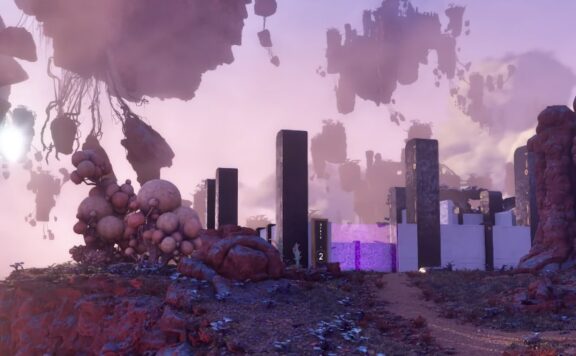

After over a decade of Serious Sam games, a thought provoking puzzler was probably the last thing that people would have expected to come out of Croteam. Yet, that’s exactly what they managed to create with The Talos Principle, and it’s this same world that Road to Gehenna looks to paint in a slightly different but equally fascinating light, as it arrives on PC, Mac and Linux today.
It picks up following the events of the main game, with Elohim, the god of this land, awakening one of his messengers, Urial, to undo some of the wrongs he now realises he committed. The spark that causes him to reevaluate his decisions might just be an ending to this digital domain that befits the numerous religious and mythological touchstones that are embedded throughout. Rather than solving each puzzle chamber with the aim of collecting the tetromino blocks at the end, the puzzles in Road to Gehenna see you freeing those few androids who have defied Elohim over the ages.
On the surface, The Talos Principle is a game that holds much in common with other first person puzzlers. There’s pressure switches to stand on, fans to activate, laser beams to redirect, and an omniscient voice in the sky. The main game features dozens of such puzzles spread across three chapters, gradually ramping up and up in their difficulty, but Road to Gehenna drops you right in at the deep end.
Having got roughly a third of the main game under my belt before diving into the expansion, the step up in difficulty was noticeable, The various puzzle solving tools are all put into action across the sixteen stages, twisted and contorted into some rather fiendishly tricky puzzles. The device that lets you record your actions and play alongside them had often lead to particularly troubling conundrums, but even without that, there’s a consumate skill to the design, so that the solution almost never feels out of reach.

However, one big problem persists for me, in the form of a small degree of motion sickness. It’s clearly something that Croteam have tried to address, with options in the menus that are designed to try and tackle it by reducing player speed, removing view bobbing and so on. Playing with a controller and a locked frame rate certainly helped – which should be good news for the eventual PlayStation 4 release of the game – but after playing for some time, I still felt a little out of sorts.
What made The Talos Principle stand out from the crowd, though, was its complex and philosophical story. Elohim’s booming voice is often heard, pushing you to serve your purpose without question and solve these puzzles in order to unlock tetromino blocks and further chambers to tackle, but dotted around the world were text-based computer terminals, filled with messages and relics from what went before and thought provoking interactive discussions on the nature of life and consciousness.
It’s those computer terminals which provide a deep and fascinating story. It’s within these terminals that the message board that has been branded as Gehenna exists, but its community don’t seem to be as wicked as the religious connotations of such a name might imply. Rather, they will question everything, study ancient records and use their time locked away to turn their minds to creative endeavours.

As androids within their odd digital world, they leave messages that ponder the human need for food or question what cats are, but there are also thought experiments that see you take you on a tour through an art gallery, stocked with ASCII art creations of the small Gehenna community, or text adventures into fantasy. As they talking amongst themselves about what’s happening and interact with you by way of multiple choice and branching dialogue trees, they manage to feel like actual people populating a niche internet forum, which is a testament to the writing of Tom Jubert and Jonas Kyratzes behind the game.
Road to Gehenna is perhaps not as deeply thought provoking as what I’ve experienced in the main game, but it’s no less fascinating to visit a little commune of rejected thinkers, bringing with you the news that the world is coming to an end. And there’s some excellently crafted puzzles, too.