

Lumo’s a curious game to behold, when first you start playing. A small wizard appears in a shower of light and sparks, right in the middle of a stonewalled room that’s simply hanging in the void of space. There’s no explanation as to what is going on in this fantastical setting, as the kid sneezes and two torches light up on either side of a door. That lack of context isn’t resolved at all, during my half hour with the game.
“I wanted the player to think ‘OK, hang on, I’m in a different space.'” said Gareth Noyce, the man behind Triple Eh? “By not being overt with narrative or text, I hope the players decide what it is for themselves, and whatever they get out of that is right, you know what I mean? I know what it is in my head, but that’s not important.
Gareth’s background is less ambiguous and mysterious. He’s a developer with a lot of experience working on major games like Crackdown and PGR3, and was a co-founder of Ruffian Games, back in 2008. But Lumo sees him going it largely on his own.
Gareth explained, “I’ve done the large majority [of the game]. The character was done by a friend of mine called Paul Large, who I used to work with at Ruffian, and the music was done by a guy who’s under the handle of Dopedemand. The character art was one of the most important things, and I wanted to get that done by someone who’s actually good!
“When I started, I hadn’t done any 3D modelling for years, apart from when I was grey boxing levels back in, sort of, 2002, so I had to pick all of that stuff up again. But the animation and a lot of the props and a lot of the modelling, I’ve ended up doing. I’ve done a lot of the audio sound effects and stuff, but it’s a mix.
“There’s a lot of props that have come in from the assets store, there’s a bunch of textures that I bought from GameTextures.com. If there’s something that I can buy for a few quid that maybe saves me half a day, it’s good enough quality or it gets me halfway there, then I’ve done that and maybe twisted it and moulded it into what I need for my game.”

It stays with a tried and tested fantasy style, initially at least, but it sits well with the isometric viewpoint. Moving from room to room, the first 30 minutes of the game ease you in with simple obstacles and a very gradual ramping up of the difficulty. You don’t even start off with a particularly big jump, stopping you from hopping on top of the numerous crates and barrels which can be found in the world, but it’s not long before you do and the platforming puzzles start to increase in complexity and difficulty.
“Head Over Heels in my head is definitely the biggest inspiration,” Gareth said, “but it’s really how I remember Head Over Heels. I’ve not actually gone back to play it and I’ve tried not to look at it, but Head Over Heels was actually the first game that I bought. So I was, what, 10 or 11, and I spent quite a while in the summer just playing, and when I was a kid I used to just doodle little rooms. It had always been in the back of my head as something I wanted to do.
“A lot of the Pickford brothers games are kind of an influence as well, Equinox particularly. Equinox was the conversation with Ste that started this whole thing. I’d spent a summer trying to beat that, as well, so that was always quite an important isometric game for me. […]
“But Lumo’s kind of a take on those game, where it’s not really trying to remake them. They’re quite slow and they’re quite fiddly and there’s a lot of instant death… I actually put perspective on my camera, even though it looks isometric. It’s an isometric view, rather than an isometric projection, so it gives you a little bit of depth. I’ve tried to knock the edges off what I remember from those games.”

That being said, a single misstep, and you’re done and dusted. Accidentally bump into an electrified wall, a rack of spikes or fall into the water, and your little boy wizard is done for in an instant, a cute little cry shaming you for your mistake. But you’re back in an instant, as you respawn at the start of the room once more, and passing through successfully generally takes just a few moments.
Gareth said, “Originally, that little yelp was, you know in Space Harrier when he dies, he goes Aaaaaaaah!’ It was originally that, but I couldn’t use that because Sega would go mad, so I did my own impersonation of the Space Harrier death rattle, sped it up a little bit and that’s what his little scream is when he dies!
“But yeah, when I did the prototype, there was a little character on the asset store, this little wizard. I think it was $10 or something, and I was originally using that in the prototype, so when I said to Paul [Large] that I wanted something this kind of size that looks like a wizard, he went to town on that basic thing. I really like how he looks. He doesn’t make any sense; he’s this stubby little kid running around in this world, but it’s lovely. He just looks really cute!”
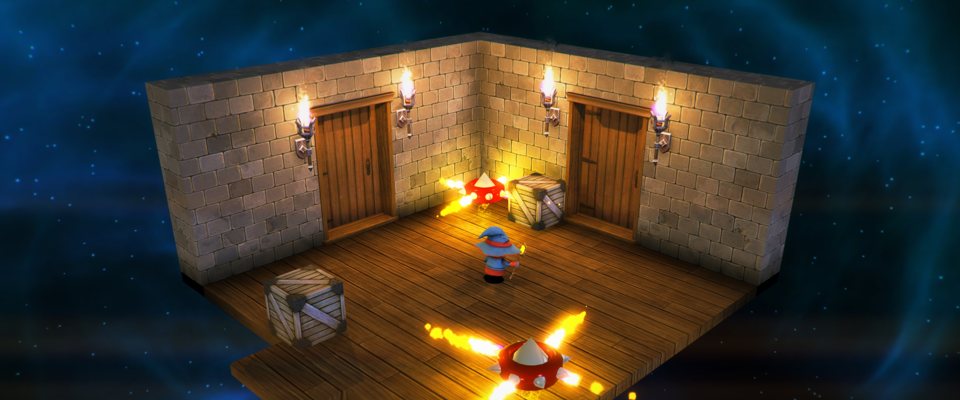
However, the isometric viewpoint is an unusual one these days, and playing on keyboard with WASD moving me diagonally across the screen, my brain would often struggle to find the right key combination. Altering the controls was a possibility, but none felt better than the default and it just took some getting used to, as did deciphering the 3D positioning of floating objects in certain rooms.
With each room a self contained puzzle only a gradual increase in difficulty, there’s bound to be plenty of time before having to deal with some of the hideously devilish looking rooms from the trailer. Yet the controls are surprisingly minimalist, with just movement and jumping, so a magic box is vanished into thin air by jumping from the top of it, before being placed back into the room by your next little leap. Other puzzles tend to involve timing to avoid deadly elements, trying to navigate while dealing with the inverted controls of being on top of a large ball, bouncing atop giant soap bubbles, and so on.
It wasn’t always so minimalist, though, as Gareth said, “Lumo’s a PC game at heart. I mean, when I started making it, I had no idea it would get onto consoles. I honestly didn’t think that would be a target, but it was really interesting because there was a lot of interest around the Greenlight.
“It did actually change the design a little bit, because it was originally, for the first couple of months, a mouse and keyboard game. […] I actually swapped it, pretty much straight away after Greenlight, and I decided to make it a kind of one button game. That is a concession to the old school, retro stuff, I thought, ‘You know what? I’ll do that. I’ll make it a one button game, so it’ll kind of feel a bit like Head Over Heels.’
“That was really interesting from the design point of view, because you have to think of different ways of doing the mechanics. How do you pick things up? How do you attach to things? How’s this going to work? You realise that, actually, you don’t need a lot of buttons to do all of this. There’s really straightforward solutions to a lot of things, and that kind of opened up the console stuff. But it had always been envisaged as a PC/console game.”



The rooms don’t exist in a vacuum though – except for the vacuum in the background. They’re interconnected and form a dungeon reminiscent of Zelda or Metroidvania games, in which you’re unlocking new areas by finding switches, keys or new abilities. It’s also full of little secrets and asides – some more unusual than others – which will doubtless delight those with fond memories of Lumo’s inspirations, and quaint little collectibles, as rubber ducks float in water that kills you on contact.
There’s another callback for those wanting an old school challenge to match. “There are two modes in the game,” Gareth revealed. “The main adventure thing is obviously infinite lives, and that is the main mode and where I expect most people will play the game, but there’s an old school mode in there, which is a limited number of lives, no map, play it like it’s 1985!
“That’s actually twisting Lumo more in the direction of being an old school game. It’s interesting how much it changes the feel. It drastically alters how you start approaching the game, but I’m glad I never built the game with that mode being the primary. I wanted something that’s quite joyful. I didn’t approach it like I was making an old school thing, I approached it as if I was making a modern console or PC game, and then it’s the look and feel that’s retro.”
And it is full of joy, even without having played the games that inspired it. There’s plenty of charm to the art style and the simplistic controls and gameplay that you can almost let just wash over you, gradually being drawn in to the game and the increasing complexity of the puzzles. Now, if only I could figure out how to get to those rubber ducks without dying…
TSBonyman
What a charming-looking puzzle game, i’ll keep an eye out for it in 2016.
bunimomike
With you on this one. Looked so much fun I went off to download it straight away, forgetting that it wasn’t out yet. :-P
Stefan L
You plonker.
lambchop
This is almost exactly what I was seeing in my head when I was playing any, Ultimate Games on my Spectrum all those years ago….