

Sony’s current domination of the console space exemplifies a company that has been willing to evolve, to progress, and to build on the successes of the past while learning from their mistakes. Ever since their first foray into the gaming headset space, they’ve delivered headsets of a very good quality, and the newly released Platinum headset marks their fourth in the last six years, this time aiming to bridge the gap between entry level sets and those at the top with this £129.99 headset.

Opening the box sets an immediately positive tone, with a solid black cardboard case unfolding to reveal the headset itself. As with so many of Sony’s products, you’re immediately struck by how attractive the Platinum Headset is, and it definitely lives up to the premium pricing when you compare it with the chunky, moulded design of the Wireless Gold Headset.
The main headband features a large, fingerprint-attracting metal strip with a cut-out, while the housing for the folding earpieces are a mixture of matte and glossy black plastic. Owners of the Gold Headset will be pleased to learn that the earpiece joints feel more robust here, though only extended use will answer if they are indeed stronger.
The black leather-effect padded earpieces are large enough to cover all but the largest ears, and form a good seal that both keeps out external sounds, and reduces noise bleeding out to those around you. The pressure is just at the right level to ensure you’re not going to get fatigued from wearing them, and the headband has an added rubberised band beneath it to spread the weight as evenly as possible so that it sits comfortably without much pressure. In terms of comfort, it’s a huge improvement over the elderly Pulse headset, and manages to exceed its immediate predecessor, the Gold headset.
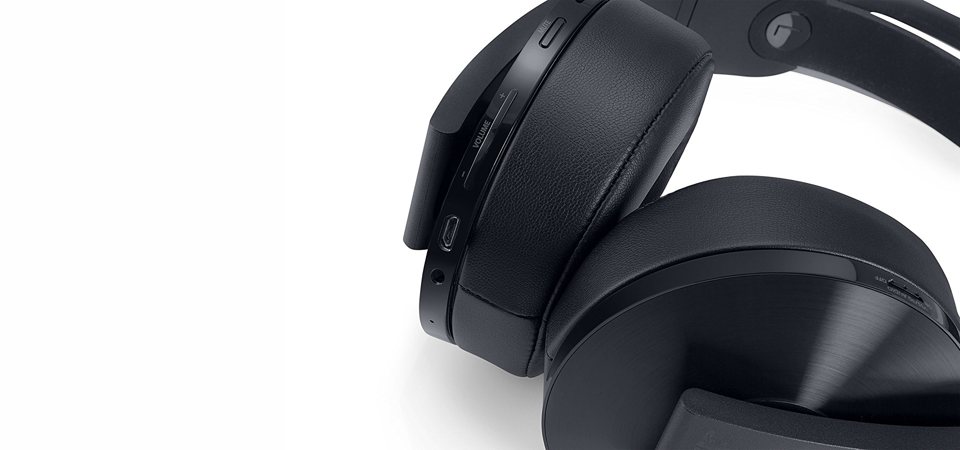
Controls are minimal, but functional, with a low profile volume rocker, mute button, 3D audio selector, chat/game balance, while the power selector also switches between two personalised sound profiles. They all do the trick, and once you’ve learned where they are it’s easy enough to make adjustments while wearing them.
Connecting the headset via a cable to your PS4 allows you to use the headset management software to make changes to the two sound profiles, with a range of pre-determined equaliser settings available for most game types, as well as a custom option, while a limited number of game specific profiles allow you to bring out the best in a particular title. Disappointingly there’s only set-ups for Uncharted 4, The Last Guardian and, oddly enough, MLB 17, but the list will undoubtedly expand in the coming months.
The headline new feature though is the headset’s ability to create virtual 3D audio. Not only can you identify sound on a horizontal axis, but also on a vertical one, with Uncharted 4 and it’s multi-level game world the first game to be able to showcase the feature. It’s a hugely impressive additional layer to the standard surround sound seen in so many headsets, and you can genuinely tell that a shot is coming from above or below you. For a game as cinematic and action packed as Uncharted, it’s ideal.
I’m hoping that there’ll be custom patches for Overwatch and other major multiplayer games appearing in the near future, as I think it would be a total game-changer. In fact, the biggest disappointment at the moment is how few titles utilise the headset and its new abilities at launch, with only Uncharted 4 really making the most of it. That just seems to be Sony’s way of handling new hardware at the moment.
Even without 3D audio, the overall sound reproduction is excellent for gaming, particularly if you select the corresponding audio profile for the genre you’re playing. Personally I would have liked a touch more bass response – these aren’t as bass heavy as a pair of Astro A50s – but there’s a pleasing depth delivered by the 50mm drivers that’s matched by well defined highs.
Listening to music via Spotify with the virtual surround enabled is a fantastic experience too, enhancing pretty much anything you care to listen to. However, while you can plug in the 3.5mm jack cable and listen to a variety of different sources, it automatically cuts out the set’s powered enhancements, leaving it with a somewhat unremarkable flat response.
As with the previous two headsets, the microphone is built into one of the earpieces meaning that you may not get the same level of response from it that you’d get from one with a dedicated boom arm. However, whilst the microphone’s audio is a touch thinner, it remains more than adequate for average game and party chat, which can in turn can be further offset by raising the responsiveness via the PS4’s menu.
While there’ve been a great number of enhancements and improvements made over Sony’s older gaming headsets, the big feature that I miss is the Pulse’s ability to house six different profiles, and to cycle through them with a voiced notification of what they actually are. Even with only two profiles to pick between, I still ended up forgetting which was for Uncharted and which was designed specifically for music, and it’s going to become more of an annoyance the more games the headset comes to support, as you’ll have to constantly connect it to the console to alter the profiles.

The Platinum headset is yet another well built and well equipped piece of Sony hardware, that’s made a number of improvements over its predecessors. However, while the addition of 3D audio is a resounding success, it remains under utilised and you may be better served waiting for wider support before thinking of upgrading. For the £129.99 price point though, it’s hard to argue with what Sony have achieved, and as a mid-level set that should see you through the next few years, it’s easy to recommend.

Tony Cawley
Want!
Jag
I still have the Pulse headset and it’s lasted me a good few years now, so I can vouch for the quality of Sony’s headsets.
I like the sound of the 3D audio support but until they add it to more games I can’t see me upgrading given how happy I am with my set.
Robothamster
I still have the Sony Wireless Stereo headset from my PS3 days and it’s still going strong.
Would get these if they ever break I expect.
Tuffcub
So does this have a mic in it? And can you wear it whilst having a PSVR on your bonce?
Tony Cawley
I’d be hugely surprised if Sony had produced a gaming headset with no mic, and equally surprised if they lacked the foresight to make it fit with the psvr. I could be proven wrong though.
bunimomike
I was thinking the same thing. Even searched the article for “microphone” but no mention of it.
Also, something I’ve found consistently disappointing is the lack of sound boom on previous headsets which means I simply cannot hear the guys as well. GTOWN/Kitch and Scuba_Steve are two that own headsets like this, I believe.
I like minimal design but not at the cost of basic quality of sound.
Dominic Leighton
Sorry guys, here’s what happens when you have a somewhat tired brain. I was convinced I’d included a paragraph about the mic!
I’ve updated the review to reflect my thoughts on it.
bunimomike
Cheers, fella. Very much appreciated. :)
duke
Bottom of the page, second bullet point
https://www.playstation.com/en-gb/explore/accessories/platinum-wireless-headset/
bunimomike
Cheers, fella. Shame this wasn’t covered in the review and a mention of its quality. I find headsets can often be wonderful (for listening to) but the microphone often feels tacked on when it comes to quality.
Stefan L
It does have a mic built into the earcup (there’s no extended bits, it’s just a tiny little hole) and yes you will be able to wear it with PSVR, but it will have to be cabled so the PSVR can do its own form of 3D audio processing.
stonyk
On one hand I’d love a set of headphones like this but on the other Sony can eff off. I have another set of expensive wireless headphones that the ps4 manages to be on first name basis with but refuses to work with when trying to connect. As if to say ‘hi bose, nice to see you but your name’s not down, you’re not coming in’.
Andrewww
Sounds interesting, I’ll get a proper headset soon.
But, what about the usual pains of using wireless stuff:
How long does the battery last?
Can I plug it into the DS4 while playing and have full sound quality with no or less battery drain?
How long does recharging take, and can I plug it into my PS4 to achieve that (just like the controller)?
Dominic Leighton
Hi mate,
Battery life is between about five and six hours, plugging into the DS4 directly doesn’t allow you to use any of the advanced features sadly, and I charged it overnight everytime via the PS4 just as you do with the controller.
Andrewww
Thanks a lot..!
Hmmm… seems not to be the ideal solution convenience-wise, but I’m still tempted…
TrumpyMx
Sixty different Sony PS4 headphones and not a single remote control to prevent me having to watch movies with a gamepad. Come on Sony get with the programme.
I originally cut you slack on focusing on gaming first, that didn’t mean that 2 years down the line I am trying to predict if circle or square is the pause button, and having to deal with controllers turning off 10 minutes in to a Netflix movie.