
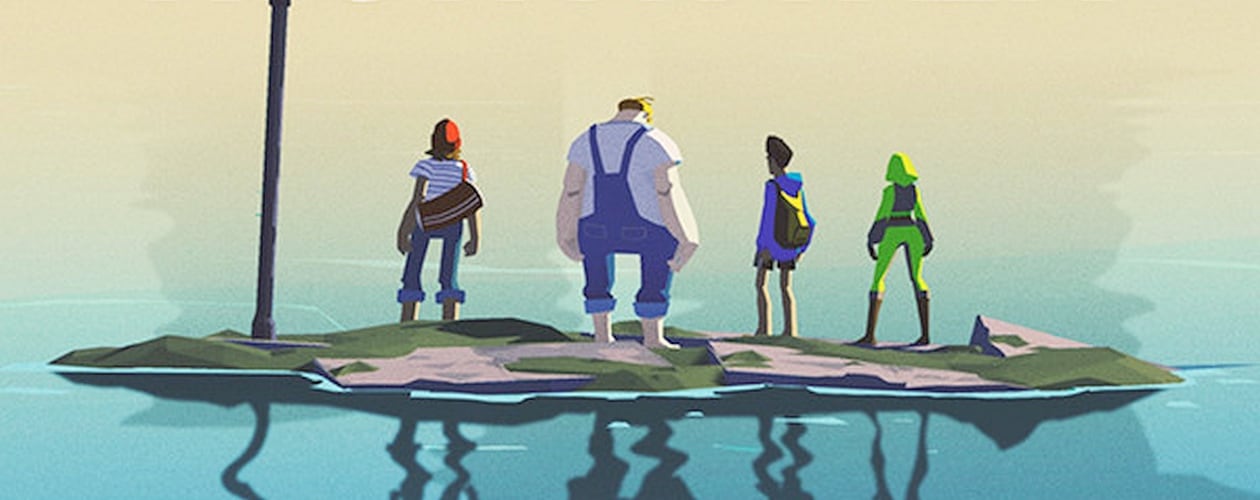
Highwater is a story-driven tactical strategy game set in a ruined and flooded world. You play as Nikos as he sets off in his dinghy to try and reach Alphaville, where he plans to sneak onto a rocket that the ultra rich are using to escape the ruined Earth they destroyed. While it might be a premonition from the future and it looks good on a surface level, there is a lack of polish and depth here that undercuts the game’s better qualities.
First things first, Highwater really does look rather nice. Using a cartoon style and bright colours, Highwater presents a surprisingly pretty apocalypse where almost everything is flooded and the few bits of land are the shattered, decrepit ruins of fallen civilisation, full of convenient newspapers to give you a little backstory. People are generally living in run-down shacks on tiny bits of land or machinery that certainly wouldn’t pass health and safety these days, but what else can you do when you’re basically in Waterworld, without the mutants or Kevin Costner?
The only problem is that, once the initial novelty wears off, there isn’t really that much to see. You spend the majority of your time outside of combat in your little rubber dinghy as you slowly make your way through the world, which mostly means heading towards a yellow dot on your compass, or maybe an optional white one whenever they show up. In the meantime you’ve got occasional islands, a few conveniently preserved street lights so you’ve got a path to follow, some very repetitive ruins, and so on. Initially, with the game’s radio turned on, the effect is quite calming, but it doesn’t take long before you wish the dinghy was faster, or the objective closer. There isn’t much incentive to explore because everywhere you go in each area of the game looks the same.

The music on the radio is an eclectic mix of styles, so while this original soundtrack is a bit hit-and-miss, it has a certain kind of charm to it. A few tracks miss the nebulous requirements for getting me to vibe with the long, uneventful journeys in boats, but I appreciate the ambition and effort involved in an OST. Plus, a few of the songs are pretty great, and only one of them was actively annoying. The radio presenter, who gives some background information every time you get into the dinghy before playing a song, is also inconsistent. He doesn’t quite sound… radio enough? There’s just the amateurish tone of a 15-year-old’s podcast – not to judge, since I had a podcast when I was 15 – but then again, it’s also quite fitting that there’s maybe there are no radio hosts left in the apocalypse and this guy stepped up when nobody else dared.
Combat, and indeed everything else mentioned from here on out, has its issues. The combat’s main problem is that it’s too simple and, once you realise how overpowered one particular character is, a bit too easy. That character is Josephine, who gets “Bloodlust” when she kills someone with a melee attack, which basically means she gets a whole other turn. This has a twofold effect, the first and most immediate being that you’ll use your other characters to damage a string of enemies so that there’s a path for Josephine to kill them all one after the other – this is very, very satisfying, and there’s even a trophy for killing four in one turn called “Unbalanced mechanic”, so Demagog Studio clearly know it’s overpowered. This isn’t necessarily bad, but it means that battles are either very easy when you can take advantage of the Bloodlust, or become a difficult when you can’t. There’s no inbetween here, in fact there was only one fight I struggled with and that was just because of an overabundance of enemies who could stun characters, which is a whole other issue.
This is a real shame, because there’s a lot to like in combat generally. A focus on environmental damage is great, such as dropping a tree onto enemies, pushing a shopping trolley into them, or using the fishing rod to pull enemies off a ledge to their death. Although in the later battles these elements seem to be absent for some reason. One character can also hack robots to turn them to your side, (though they’re completely useless once there are no robots left), another can jump over obstacles, and so on. There’s quite a few creative and interesting mechanics here that could carry you through the game, but again, it’s a bit too easy. You also can’t rely on any character being with you for your next fight, since you don’t have control over who you’re with and the game swaps them out with wild abandon, sometimes even splitting them up so you do two smaller battles instead of one bigger one.

The story has its issues as well. It did manage to make me chuckle a few times, but other than the occasional moment of peace when the music and environment combined just right and the obvious ring of truth to the idea of private companies and the ultra rich ruining and then abandoning the Earth, it just doesn’t make an impact. I don’t really feel anything for the characters outside of Josephine being a badass in combat. Again it’s a shame, as there seems to have been a lot of thought put into the background, but it falls flat a little too much. It might be partly due to the presentation. The only voice you’ll hear in this game is on the radio, so instead dialogue is in speech bubbles, but Highwater is too wordy for its own good when a little more brevity would have improved the pace of the storytelling – it’s not helped by cutscenes not letting you skip through individual lines of dialogue, but only the entire scene.
Then there is a list of other issues with the game, such as menus that are messy and unclear, the camera getting caught behind scenery when it moves during attacks so you can’t see, there’s just a general lack of polish overall. The map is basically useless both due to how hard it is to read and the compass pointing you in the direction you need without factoring in the environment you need to go around. Also, one of my characters couldn’t attack a flying drone for some reason. I initially thought it was due to her being a melee character but my other melee characters did fine, so I have to assume it was a bug.