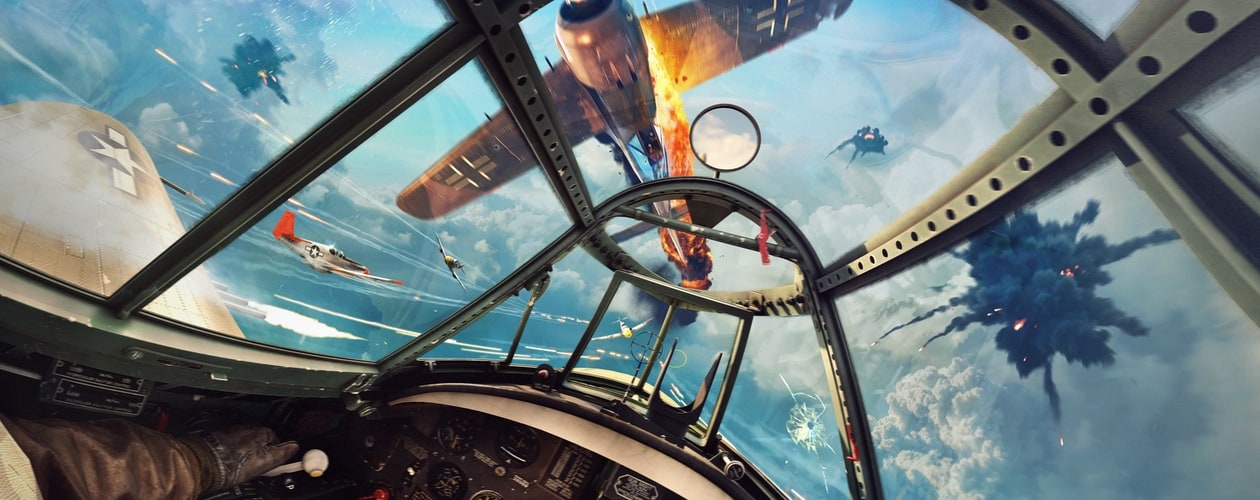
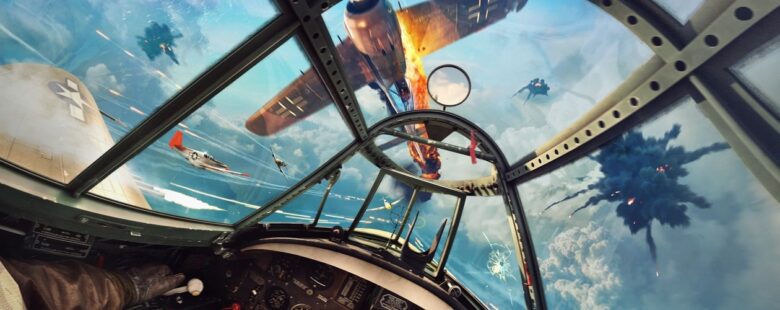
Aces of Thunder brings an authentic World War 2 plane combat simulation game, both to flat screens and VR. That authenticity means that not only are you flying very detailed planes through (mostly) WW2 era combat missions, but if you turn your plane too quickly, you’ll lose control and likely spin down into the ground. It’s pretty realistic in that way, sometimes to its own detriment, but its bigger issue is that it doesn’t feel like it’s finished.
When launching the game, you’re presented with a very detailed plane. The one thing that Aces of Thunder really nails is the planes; they’re incredibly accurate both on the outside and inside. In the cockpit, the sheer number of dials is almost staggering, and they’re all labelled when you look at them – specifically by moving your head, if you’re playing in VR, and not with the PSVR2’s eye tracking, which is a shame.
The accuracy extends into the flight mechanics as well, with 24 planes featured in the base game, four of which are from WWI, and an additional five for DLC. Turn too quickly and you’ll either lose control in a mechanical sense, or you’ll blackout from the G-forces that pilots of this era weren’t equipped to handle. Take damage from the enemy and you can feel it affect the performance of the plane, hear it in the now slightly sputtery sounding engine or, worse, be unable to hear the engines at all! You can even personally take a bullet and die instantly. The game’s planes and physics are undeniably very impressive.
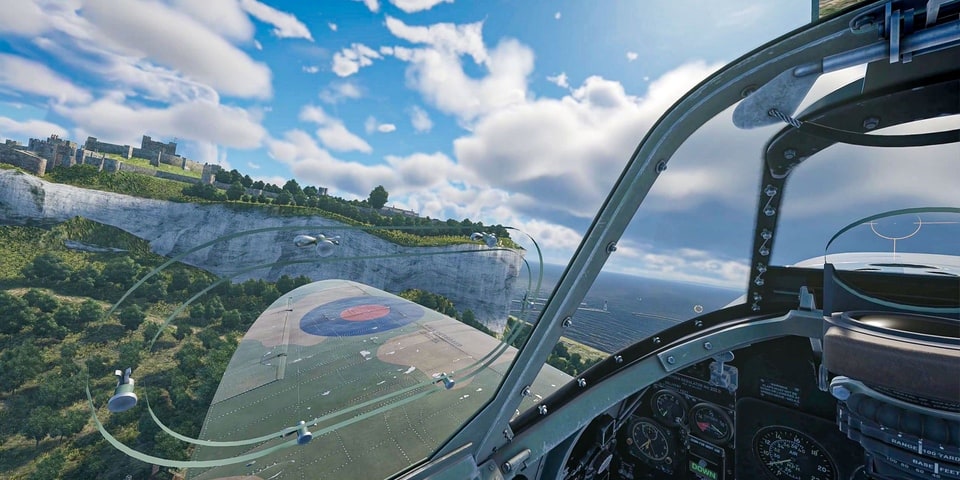
It’s a shame that the rest of the game seems to be either threadbare or unfinished. There’s no tutorial here, which would be welcome for a realistic recreation of flying planes that are nearly a century old. Instead, you’ll crash and crash again as you figure things out by trial and error, frustrated that you seemingly have to wait for your plane to spin all the way to the ground before you can respawn. Except, you can actually bail out with a parachute – if only the game had told me that and saved me the first moment of VR-related motion sickness I’ve experienced in years.
Trial and error is fine when the errors are clear and the trials are entertaining, but as the game doesn’t explain anything to you outside of a “getting your license” style mission for basic flight, you’re left to draw our own conclusions. Plane combat is just brief periods of intensity separated by longer periods of repositioning for another approach, so when you are flying through a swarm of enemy fighters missing every single one, all you can think about is “Did I do something wrong? Am I missing something obvious?” All because the dogfighting simulation game didn’t give you any training. At least you maybe didn’t collide with one of them, so that’s progress at least.
Once you do get used to controlling a plane, there are still issues. How do you aim a bomb? I’m not really convinced my plane was dropping the bombs I was telling it to, because there was no explosion or other indication that I had. I spent half an hour trying to take out an aircraft carrier, getting more dangerously close with each attempt, but the thing was unharmed when I gave up on the mission entirely and went to play something else.

The UI – which is a bit of paper with a map and ammo info on it for some reason – tells me I’m dropping a bomb and that it takes a full minute to reload it, but there’s no feedback beyond that. The lack of feedback extends to dogfighting as well, but at least there you occasionally see a plane start smoking or fall out of the sky, when you’re bombing things, you’re too busy facing the other way to visually see. I could have been missing every single time for half an hour, but I’m really not convinced.
That paper map comes with a little floating circle to mark an objective, but it’s small enough to be practically invisible from any significant distance. In an early mission, you are directed to fly around an attack site to gather intel, which is incredibly simple to do but immersive and satisfying nonetheless as the things you fly past are listed over the radio. Then the game tells you that enemy planes have been spotted coming in for another attack. Oh no! But it doesn’t tell you where from – there’s no direction or heading, they’re not marked on your map, and you can’t see them on the horizon. Cue the confused John Travolta meme until they eventually get close enough a few minutes later.

If you can bear the trial and error of getting use to Aces of Thunder, there are a good amount of single player missions to play through. Some of them are bare “follow a path” missions, and most of them end abruptly, sometimes with little to no input from you – I’ve won three missions without actually successfully shooting any planes early on. There’s also free play, where you can just fly around in a plane of your choice, or set up a custom battle on one of the maps, and then there’s online multiplayer. This is in two forms, with the “To Battle” button dropping you into a game with matchmaking, and the custom game, where you can see a list of custom games are join them. The former always put me into matches with too few players, and while the latter all of the custom games claim they have 30 players, actually loading in would reveal it was one or two. So the multiplayer isn’t exactly populated, but it would work if you’ve got some dedicated friends.
Then there are weird issues both in and out of VR. The handheld menu you use whilst in VR is also the menu when you’re not in VR, which feels a bit strange. Playing with the PSVR2 Sense controllers means you have quite small analogues and, as throttle is on the left along with yaw, you can end up cutting your engine by accident. It’s much better with the DualSense (or there’s HOTAS joystick support, though I don’t have one to test with), but when you do, your VR hands are still there often blocking the map, and you can’t use any of the menus, including the pause menu, without them, in spite of the fact that when you’re not in VR you use the exact same menu with the DualSense. It’s a bit odd, at the very least.