What happens when highly-skilled, highly-trained covert operations agents go rogue? Well, if Ubisoft’s latest entry in the Splinter Cell franchise is anything to go by, we get a great piece of cinematic action gaming to enjoy.
Splinter Cell: Conviction is very much a game of choices. That doesn’t mean it’s filled with dialogue options and endless moral dilemmas for you to deliberate over. There is no question in the majority of actions Sam Fisher is taking and you have no option to just play nice and help the bad guys perfect their grenade throw. You are on this journey, like it or not. The choices are much more subtle than that.
The primary choice you have to make is this: stealth or action? You can play almost every area of the game with your trigger finger twitching and your grenade arm flexed but you can also play it in the shadows, learning patrol routes and practising the values of distraction, deception and a precise headshot. During certain sections of the game you will have to fight and for others you will be forced to sneak but for the most part it’s your choice.
Each level of the game consists of numerous areas which feel very much like challenge rooms. You progress through the area and onto the next. Choosing which path to take, each with their own benefits and problems is often more tricky than it sounds. Take the wrong one and you could end up in a dead-end with guards closing in and no more choices to make. It is usually possible to dive behind cover and shoot your way out of trouble but if cover is scarce or enemies are plentiful then you will find yourself dying very quickly.
If you’re lucky there will be an auto-save checkpoint in between areas but occasionally these are placed infuriatingly far away from particularly tricky parts and, at least once, before a dialogue scene which could not be skipped. So you will probably find yourself repeating some sections a few times and cursing the checkpoints as you figure out which is the best method and route to take.
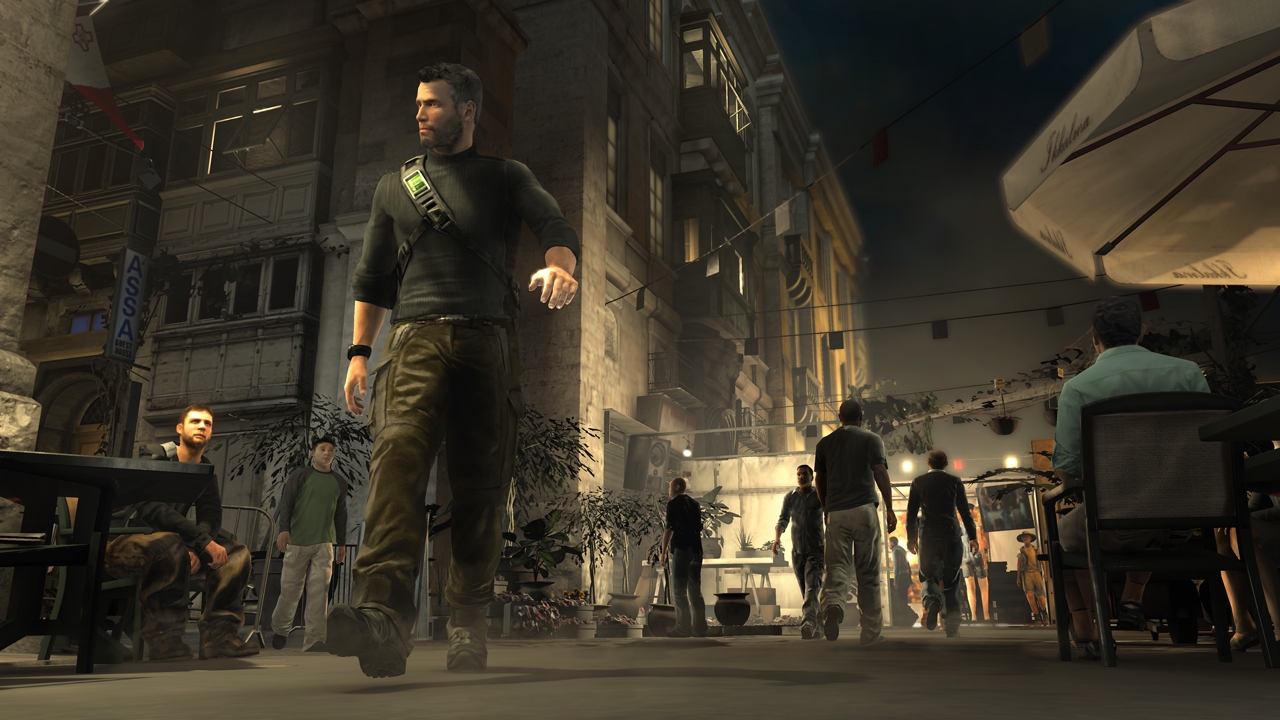
The texturing and character models are very well realised, with every area and individual looking realistic and complete. Even the recurring enemies are comprised of a few different styles and models so they never feel too generic. The lighting is very good but in certain areas it doesn’t seem to create realistic shadows, most noticeably when a surveillance camera’s spotlight meets a handy piece of cover. It’s a small gripe but worth mentioning for the perfectionists out there.
Voice work is at times repetitive and annoying. The same phrases are often shouted by enemy soldiers continuously and to the point of bizarre obsession. Even Sam Fisher’s voice work is often very poor. Perhaps it’s an attempt to make the character seem rage-fuelled and gruff but at times the gravelly, grunted responses were slurred and barely discernable. Strangely, Sam’s voice work seemed to improve hugely as the game progressed so perhaps it was an attempt to show him as unfit or out of shape in the early stages of the story. Either way, it is peculiar but nothing unforgivable.
The game is paced exceptionally well with each area giving you just enough of a reason to push on to the next. The accomplished cinematics guide you through a complex and interesting storyline with several twists. The narrative of Splinter Cell: Conviction is perhaps its strongest aspect but the gameplay is also excellent.
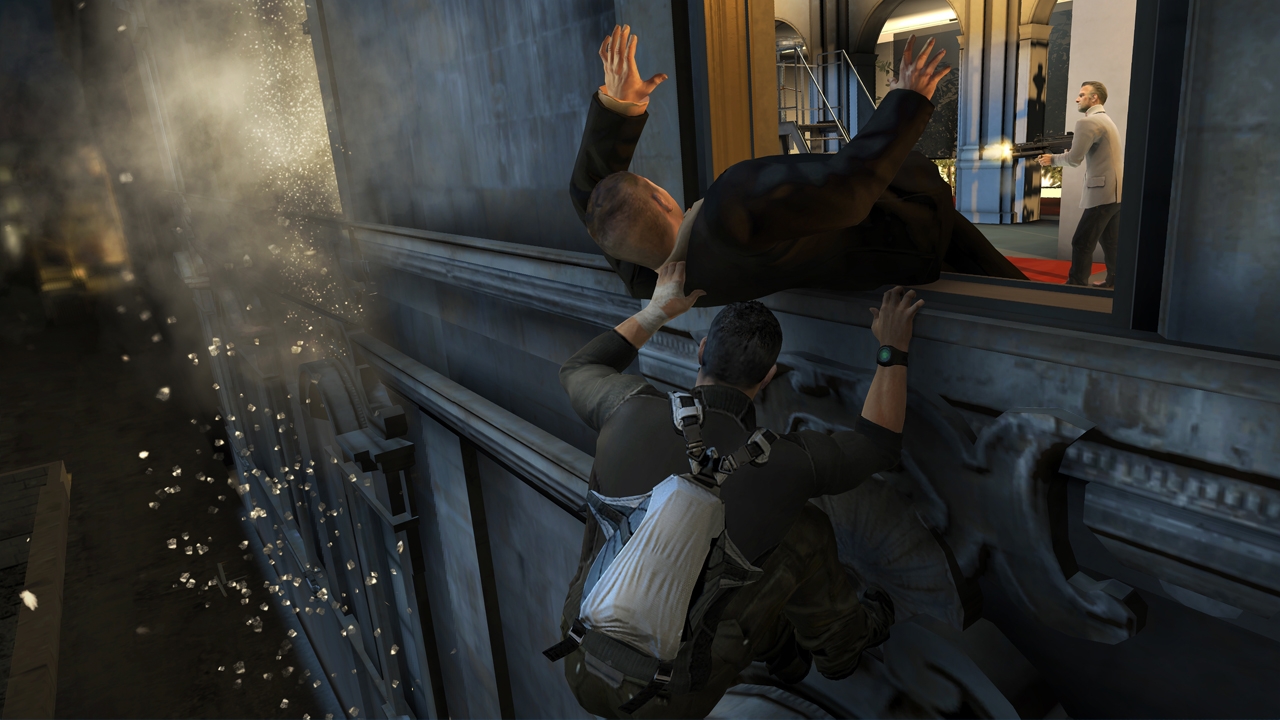
The smooth fluidity of the controls and the unrivalled quality of the movement animations make this game play like a dream. There are occasional points when activating interactive elements causes your character to glide slightly but the animations are generally better than anything else we could mention within the genre.
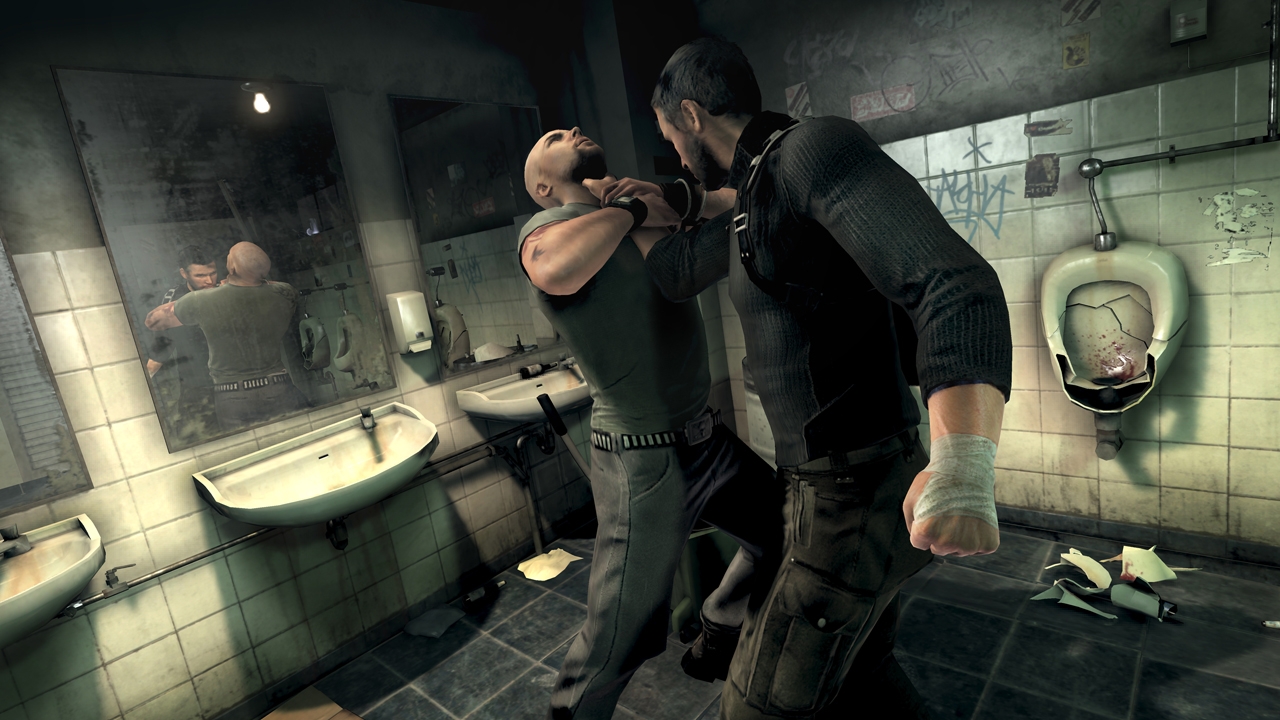
The most interesting aspect of the gameplay mechanics lies with the “Mark and Execute” action which allows you to target several enemies at once (after charging the ability via performing a hand-to-hand takedown) and hit them all with one button press. This allows you to clear a path to your next cover point or objective and gives the game another dash of visual flair.
Speaking of visual flair, the desaturation of an area when Sam is hidden in shadows is a beautiful method of dispensing with a “stealth meter” and giving you that information right there, in the scene. Just like the method of displaying Sam’s memories and key story exposition as projections on the scenery, this is a great way to keep the player immersed in the game-world.
There are several cooperative missions in the game with two players joining forces to work through. You will carry over any weapons and gadgets you have unlocked in the single player missions and the two characters from the co-op missions also feature in the other multiplayer modes. This side of the game sees a variation on the horde style with waves of enemies coming at you, an area-clearing challenge and a face-off mode. There is also a split-screen mode and certain game types can be tackled alone, if you wish.
This is the most accessible Splinter Cell game yet and Ubisoft have done a great job of making it easy to play but difficult to master. Die-hard Fisher fans will no doubt decry the loss of the hardcore stealth-based gameplay but in truth this style of game is much more forgiving and open to a much wider audience.
Pros:
- Fantastic narrative.
- Stylish and well-presented.
- Plenty of chance to replay and refine your technique.
Cons:
- Voice work is a let-down.
- Occasional, if rare, moments that lack a bit of polish.
- Some bad choices with checkpoint locations.
Splinter Cell: Conviction includes one of the best narratives in the world of action video games mixed with some great gameplay and a solid visual style. Some of the voice work leaves a lot to be desired but the other sound is generally good. The solid single-player story is complemented with a great co-op campaign and some fun multiplayer modes which have the potential to add to the game’s already considerable replay value.