
Those of you who have been TSA readers for a while might remember that a couple of years ago I shared the three part tale of what happened when my launch-day PS3 succumbed to the dreaded ‘Yellow Light of Death’ (YLoD).
Where I left the tale was that having bought a PS3 Slim to replace it I was trying to find my dead PS3’s original 60GB HDD, having replaced it a few months after launch with a larger one, so that I could have a go at taking advantage of the Sale Of Goods Act to get a refund or exchange. I told you at the time that I would let you know the outcome, though I did not expect it to be a couple of years later.
Wherever the ‘safe place’ was that I put the original 60GB HDD in it has remained safe and hidden these last two years. Doing some clearing out at the start of this year I decided that I had waited long enough to find the original HDD. Rather than keep my dead PS3 around any longer I decided to just get rid of it.
I could have tried to repair it but so many of of those repairs turn out to be temporary and it had been sitting unused on a shelf for so long that, to be honest, I just could not be bothered with it anymore.
Before disposing of it though I did have one last question that I wanted it to help answer; was its death my fault? One of the reasons put forth by some as a cause of the YLoD is that the user is often to blame for not keeping their PS3 clean enough.
Mine had lived on an AV rack that is dusted regularly and there was no evidence of dust buildup on any of the air intake or outlet grills. At the time, and several times since, I have been told that my PS3 would have been fine if I had diligently vacuumed it out weekly to prevent any dust buildup inside.
Now I don’t know about you but I have never given my consumer electronic kit a vacuum, regularly or otherwise. My house doesn’t get particularly dusty and I have no furry pets shedding all over the place so I have never considered it necessary. Indeed, I would consider it a design flaw if a piece of consumer electronics needs vacuuming out regularly when kept in the average home environment.
A curious mind can be a danger to free time though, so before disposing of the old shiny black beast I determined to answer the question of whether vacuuming was likely to have saved it. Time to get the tools out.
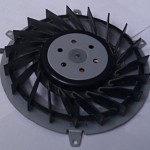

The first appreciable sign of any dust during the disassembly was on the inner portion of the fan blades but it was a pretty insignificant amount to see for someone who is used to taking PCs apart. The main heat sink assembly with its cooling fins and heat pipes, where I’d expected to see dust, was surprisingly clear.
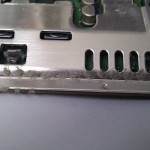
The only noticeable build-up was on the outside of some of the EMC shield which had sat just inside one of the intake vents. Here, small dust bunnies had begun to form but the population was far from becoming out of control or a problem.
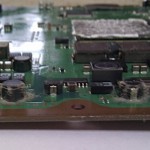
It was possible to see that some had climbed through the holes and onto the motherboard itself though, so off came the EMC shield. There inside were a handful of small bunnies clinging tightly to what had once obviously been some very attractively charged electronic components.
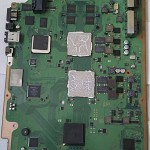
Again they were not present in sufficiently large numbers or of a size where they would have been the problem. Most of the motherboard was entirely free of dust and showed no signs of damage from excessive heat or electrical shorts.
My conclusion was that it was likely that the usual cause of YLoD had killed my PS3, cracking of the solder joints underneath one of the main chips. There was probably nothing I could have done to prevent it other than to have not used my PS3.
There would have been no harm done had I gently hoovered the air intakes and rounded up those few errant bunnies but neither would have doing so saved my memory card reader-equipped piece of gaming hardware. PCs regularly fill up with far more exotic dust-based lifeforms and continue to work for years and you should expect your PS3 to be able to operate without regular application of a vacuum cleaner.
Don’t Forget To Deactivate
One useful thing about the entire exercise was that it reminded me that although the PS3 was dead and so couldn’t be used to deactivate itself from my PSN account it was a perfect time to use the web-based method of doing so. A great guide to doing that can be found here.
Not only was I able to deactivate my PS3 but it also showed me that my old long-passed-on PSP-1000 was still registered. At the time, it was a couple of weeks before the PS Vita launched and I certainly would have been very flummoxed if my PS Vita had failed to properly activate because that old ‘1000 and my current ‘3000 were using the two valid activations.
You can only deactivate devices using the web interface at most every six months, so that ethically-challenged gamers cannot keep activating and deactivating a host of different PlayStation consoles on their accounts, but if you have either sold on or otherwise retired any PlayStation consoles that were tied to your PSN account it may be worth checking that they are not still taking up any of your limited activations.
And that ends the tale of the death and its aftermath of my launch-day PS3. I did not bother to reassemble it and merely took the bag of bits to the local recycling centre where the circuit boards and scrap metal could be processed as far as possible to recover the raw materials. Who knows, perhaps it’s already been reincarnated as a toaster? As long as they didn’t reuse any of the solder it should be fine.
jeccross
That last picture clearly shows the reason for the death. The cracked looking square things are the CPU and the GPU. They aren’t cracked, there’s a layer of thermal paste that sat between them and the fan. Sony use sh*t thermal paste for some reason, this becomes cracked and doesn’t transfer heat to the fan (therefore your PS3 is always hot and fan is noisy) and then eventually it overheats and the solder cracks, then you get YLOD.
To solve this you can open it up before you get YLOD, use compressed air to clean out all the dust and then clean the thermal paste off the chips and reapply new stuff, there’s plenty of vids of this on youtube and it’s not hard.
I just did this for the second time this weekend, and I’m not someone who takes electrical stuff apart much, it’s not hard if you’re careful. My 60 gig fatty is still going strong.
Greg Aldridge
For what it’s worth, the thermal paste on the chip packages and heatsink seemed fine on my PS3. There was no sign of it having hardened. The lines in the picture aren’t cracks they’re just the patterns left in the semi-fluid paste after I took the heatsink off, where the paste was still doing its job and trying to adhere to both surfaces as I separated them.
Awayze
It doesn’t matter if the thermal paste is dry and cracked. The CPU and GPU can work at high temperatures and PS3 warns you if the PS3 is overheating. The PS3 doesn’t overheat unless you see the warning.
The solder does crack as its cheap shit.
Greg Aldridge
It’s not that the solder’s cheap it’s that we all have to use lead-free solder these days which has a higher melting point and so is harder to make good connections. BGA-style devices like the PS3’s main chips are much more difficult to ensure a well-soldered connection as you cannot see the soldered links under the chip and the mass of the chip makes it harder to get even heating. It’s a process problem for the manufacturer rather than poor design or cheap solder. The high thermal envelope of the original versions of the Cell BE and RSX compounded the problems making any flaws in the soldering more likely to cause fractures during the heat cycles. AFAIK.
Awayze
I see, then they should screw them on like with PC mobo’s.
arrybags
My launch model 60gig died on Friday. Bit annoyed that the backup I had done recently wont restore downloaded content off the psn. Have a 40gig usage cap and I will easily get through that with 5 years of downloads!
Awayze
We all know why PS3 get YLOD, cheap manufacturing and cheap solder.
XisTG
One thing: it is true you can deactive online, but that seems to be only for PS3s; I tried it a couple of days ago and a PSP I no longer have is still active :/
XisTG
Oh, the PSP did get deactivated afterall :p
Blayney
Amazing how sparsely populated the boards are. They could make PS3’s so much smaller with external power supplies.
Greg Aldridge
Current PS3 motherboards are much smaller. Some of the spacing of components will be due to having to space the chips out for the heat pipes, etc., some for separation to reduce interference between high frequency parts, some to make track layout simpler (e.g., to make it easier to make the tracks for parallel interfaces the same length) and don’t forget there are components on the other side of the board too.