

It’s typical, you wait what feels like decades for a bus to come, and then two or three come all at once, the same could be said of the A-B puzzler, or Lemmings game genre. Two of these games are arriving in quick succession, with Crunching Koalas working with Curve Studios to bring Mousecraft to PlayStation in July.
Now, I’m a little hazy on the science backing this up, but the game’s premise sees a cat-scientist named Schrödinger playing out a series of bizarre experiments surrounding mice and cheese. It’s quite barmy, but lends the game a quirkily humorous overtone.
When I asked what he was possibly trying to achieve with his experiments, Tom Tomaszewski, one of the five co-founders of Warsaw-based Crunching Koalas explained, “He’s just trying to make a machine that is powered by mice. You know these crazy Goldberg machines, where you have a lot of parts and the machine is very big, but it does a very simple thing? He’s doing something very similar here.”
Sophie Rossetti, Producer at Curve Studios, who are working to bring the game to PlayStation, added, “You can see when the mice get to the cheese plate at the end, the little cup starts spinning and the machine is working, and it all gets revealed after you’ve completed all 80 levels and the purpose of the machine is only shown in the final video!”
As you’d expect, the rather adorable mice will wander ever forwards under the cat-scientist’s eager gaze, until they encounter an obstacle that they cannot clamber up, before doubling back on themselves and ambling off in the other direction. It’s up to you to help them get from their running wheel to the cheese on the other side.
However, in a shift from the traditional formula, rather than issuing commands and lending the mice special abilities, your help comes in the form of tetromino blocks – the shapes from Tetris – which you can drop into the similarly blocky world to help the mice get around.

“We make these crossover games that are a little bit casual,” said Tom, “but at the same time we want to offer something for the core players. So here we’ve got a simple casual game, but with references to games that are remembered by gamers who played games like Lemmings and Tetris in the 90s, while our second game is a dungeon crawler mixed with Scrabble, so you defeat monsters by forming words!
“Our studio was founded by five people, and two of the guys were a casual developer before this, with hidden object games, match three games that they published on Big Fish. They wanted to go in a different direction, but we also wanted to have something from their experience with casual games, and that’s why we wanted to mix more core ideas in.”
The tetromino blocks aren’t time sensitive, but instead hang from clips at the top of the screen and can be placed wherever they’ll fit, regardless of if they could drop in from above. In other words, you can place them into slots and gaps as you see fit.
It lends the game a simplicity that’s really quite easy to pick up and play during the early stages. The levels are all set out in a rather horizontal manner, which should make it easy to grasp and follow whether on a computer screen, TV or the Vita’s more portable size. Additionally, each level featuring just three mice to get to the end, and during the first handful of levels, you can generally drop the tetrominos into place before setting them loose.
However, it soon starts to get more complicated. Puzzles begin to require you to think on the fly and drop blocks after the mice have been set loose and progressed through the level, especially if you want them to reach some of the collectable shards and items which are dotted around the level.

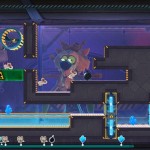
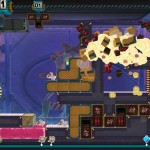

You also have a few extra elements helping your puzzle solving. There’s the ability to pause the game and place bricks without time pressure, as well as letting you undo a brick’s placement. They’re two little ideas that will be especially helpful when you delve deeper into the game, but also call back to the more casual aspects of the game design. However, even without such a sense of urgency, the game’s puzzles start to become rather complex.
“There’s seven different brick types and some of them interact with each other,” revealed Sophie. “There’s also water hazards and acid, so if you have an electric brick and put it in water, you get electric water.”
As you progress, you’ll start to encounter mechanical rats, from some of Schrödinger’s previous failed experiments, jelly blocks, exploding blocks, acidic water, and plenty of other hazards besides. It starts to add up to create some particularly complex puzzles that even Tom struggled slightly to remember as he was giving a whistle-stop tour of some fiendishly difficult looking later levels.
There’s something to be said for this mini-resurgence of the old Lemmings formula, but what’s fascinating to see with Mousecraft is the way that it has been merged with the tetromino blocks from Tetris to gently shift the gameplay in a different and quite unique direction. Whether it’s pulling on those emotional heartstrings for retro gaming, the increasingly complex puzzles or the family friendly visual style, it has the hallmarks of a game that can appeal to practically anyone.