

Considering the long legacy and the nostalgic popularity of the early Star Fox games on SNES and N64, it’s perhaps surprising that the series hasn’t been a more regular feature on Nintendo’s consoles since then. The wait is almost at an end though, as Fox McCloud and his team of anthropomorphic flying aces are back to take on Andross once again.
Some of the biggest changes and innovations come with the game’s control scheme. It endeavours to make best use of the Wii U’s GamePad and its second screen, but in doing so creates a steep learning curve for anyone trying to jump straight in and play the game, as it pulls your attention in multiple directions at once.
The GamePad now permanently displays a cockpit view, so that you can fly in one direction while aiming and shooting in another, and uses the GamePad to display a cockpit view as well as use the built in gyroscope to let you aim the reticule. During the corridor-based gameplay, it’s really not all that important, and making use of the gyroscope is to all intents and purposes a replacement for using the second analogue stick to aim independently – that instead lets you pull a quick barrel roll and controls your Arwing’s speed, alongside special moves on some of the face buttons.
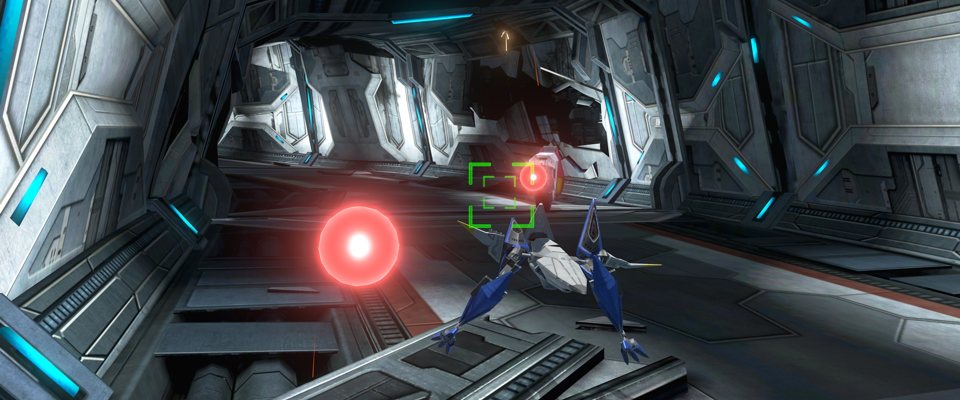
I briefly dabbled with the Walker as well – a transformation of the Arwing which exists alongside the returning Landmaster tank and the Gyrocopter – restricting myself to the ground for a couple of minutes. It takes some of the pressure of the constant forward momentum off you, as well as removing the need to control your vehicle in three dimensions, so that you can really focus on hitting targets. You’ve got the same burst shot and homing charge shot at your disposal, and can engage a little hover mode to help you get around as well as dodge out of the way of incoming fire.
The lush green lands of Corneria make a return as the battleground in the first mission I played, with the traditional corridor-based battle heading towards a boss fight at a central tower. There’s some big set pieces, as buildings are sawn in half and collapse as you fight through a warzone, but this lacked some of the refinement and polish that I’ve come to expect from Nintendo’s Wii U games, with an unsatisfying, chunky look to all of the buildings and clearly polygonal mountains.
Alongside the rest of your fighter wing’s comms chatter, you can see the series’ heritage from the angular design of the ships and vehicles to the world design. It’s just that outside of the gorgeous Cornerian sky, the environments are just so plain and uninspiring to look at, even if they do stretch off well into the distance. Of course, with the Wii U’s hardware such as it is, this is clearly done in the interests of having smooth and responsive gameplay across the two separate viewpoints on TV and GamePad.
The climax to the Corneria level saw a central tower being attacked by odd spider-like walkers emerging from distinctly evil shipping containers, as the game shifted from flying down a set path to All-Range mode, with an arena of enemies both in the sky and on the ground to take out. It’s here that the GamePad’s second screen really comes into play, as you can start to aim at things outside of the restricted view on the TV, as well as get pinpoint shots on target. The trouble being that, by focussing on the GamePad’s screen rather than the TV, and physically moving your point of view away to boot, it’s very easy to find yourself crashing the Arwing into buildings or not realise that you’re under attack.
Of course, when the Weaponised Flying Fortress Androssa descends from the sky, it’s difficult to miss what it is that’s shooting at you, especially with another viewpoint switch to Target Mode – which you can call upon yourself with the ZL trigger at other times. It cleverly gives you different options on how to take out the boss, either shooting the big lasers so that large sections of the ship break up and fall away, but this also exposes an internal structure that can be accessed by the Walker, giving you the possibility of getting inside and tackling the core while on foot.

For all my struggles with the controls, there eventually came that moment where it all clicked into place. A big All-Range dogfight in space had dozens of targets popping up all over the place, and I could quickly and easily just nip after a particular target. Returning side-kicks Peppy, Slippy and Falco occasionally called for help in getting an enemy off their tails – or berated me for shooting a friendly target – eventually leading to a one on one dogfight with the dastardly Pigma.
It’s in this situation that all these disparate elements come together and feel really natural, without the peril of running into world objects or having to worry about too many enemies. Pulling the ZL trigger to snap the view to your target quickly lets you know when you can pull a loop-the-loop to get behind Pigma and unleash a stream of fire at him, while banking hard and flying round in circles would be fruitless were it not for the second screen’s ability to aim precisely and hit the otherwise untouchable target. It wasn’t long before I had sent him running with his little curly tail between his legs.
Naturally, I’d expect a more graceful learning curve in the final game, but even then, I fear the control scheme for Star Fox Zero is going to confound many people. However, once you’ve become accustomed to it, it looks to be a major leap forward for the gameplay, which experiments and pushes the Wii U’s unique capabilities and second screen gaming to the limit.