

When it comes to video games, every platform needs a mascot. Xbox has the Master Chief, it’s Nathan Drake for PlayStation these days, and while Mario would be the favourite for Nintendo, they have plenty more to choose from. Apart from being some of our favourite gaming characters, over time these icons have become ambassadors: outward-facing conduits that reflect the values of those who create them.
For mobiles and tablets things are a bit different, however. Despite having designed and built the operating systems on which they are played, Apple and Google don’t have an active hand in video game development themselves – Windows Phone might be a slightly different matter. For third party studios this is no doubt somewhat of a boon, leaving a gap for them to fill with their own iconic characters.
Although there are literally thousands upon thousands of games milling around Google Play and the App Store, very few of them have produced noteworthy figureheads. To name a few there are the Angry Birds, that bloke from Temple Run, and – dare I say it – Flappy Bird. The thing is that they’re really rather nondescript characters, at least when compared to the likes of Mario, Crash Bandicoot, and Sonic the Hedgehog.
He’s certainly not of the same calibre as these all-time greats, yet it’s hard not to see Heroki as an attempt to create a mobile gaming mascot. Running down the list, he fits just about all the main criteria. “Does he star in his own platformer?” Check. “Does he always wear a smile and exude charm?” Check. “Does he have some kind of fun and unique ability?” Double check.
If one quick look at Heroki hasn’t already given it away, he has – quite naturally – got a helicopter rotor attach to his unusually shaped head. It goes without saying that hovering is the game’s core mechanic around which all of its features are built.
Much like the platforming games of old, Heroki is split into worlds which are then comprised of smaller, self-contained levels. Your objective is simply to guide our hovering hero from start to finish while keeping an eye out for traps and enemies. Just so it isn’t a straightforward A to B sprint, Heroki throws plenty of puzzles into the mix. Many of these take the form of levers and pressure pads which, when activated, open doors and reveal new areas.
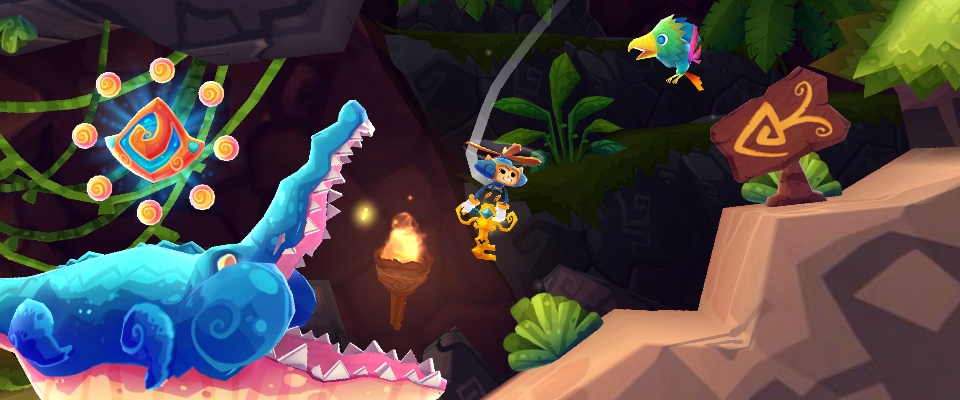
Keeping things simple, developer Picoma has given Heroki a limited yet effective array of actions, including the ability to fall out of the sky and launch objects at enemies. Helpfully, these are mapped to some equally simple touchscreen gestures. That simplicity seems to a running theme throughout, and though it may benefit a younger, more casual gamer demographic, it leaves somewhat of a void for those who crave complexity and depth to an experience.
We can hardly blame a game for successfully catering to it’s primary audience though, can we? Further evidence of this targeting can be found in Heroki’s cookie cutter narrative of good versus evil along with its cute characters, upbeat soundtrack, and vibrant level designs.
Although he certainly has the makings of a video game mascot, Heroki lacks that one crucial ingredient: a following. Sadly, he’s not likely to find one anytime soon as more and more games pour into the mobile marketplace, attempting to do little more than simply jig up a much-loved genre on touchscreen devices, but maybe, he can grow into a character that deserves one.