
Playing SoulCalibur VI is like slipping on a pair of old boots. The old characters are there, they have the same old moves that you’re oh so very familiar with, and the graphic style and fidelity feels almost exactly as I remember it from the middle of the last generation. In a lot of ways, with the series having been on an undeclared hiatus for the last five years, this is as much of a nostalgia trip as Crash Bandicoot N.Sane Trilogy or Wipeout Omega Collection. There are still plenty of new touches though, and if, as I did, you skipped the last one or two games because your brother was getting too good at it and you suck at fighting games, there’s a number of new ideas to get used to.
At its core though, SoulCalibur VI has the same style of combat as previous games. Fighting one on one, all of the fighters have melee weapons of one sort or another – usually swords. Attacking is built around horizontal and vertical attacks, backed up by kicks, grabs and the ability to block. Fights take place in 3D arenas with eight directions of movement, meaning that you can simply step to one side if you see a vertical slash or stab coming at you, though that won’t save you if it’s a horizontal swipe of a sword.
Eight characters have been announced so far, with all but one of them returning favourites. I say favourites, but alongside Xianghua, Mitsurugi, Sophitia and Nightmare in this build, you have Kilik, who feels about as cheap as ever with his damn poking stick. He can, of course, be countered by someone that knows what they’re doing, but he’s a character that grates and delights in equal measure, by inherent design. Zasalamel and Ivy have both also been confirmed, but weren’t in the version that we played. The new addition is Grøh, with a double-ended sword that he sweeps around himself in an acrobatic Darth Maul style. He’s an interesting new character, and there’s definitely a feel of Kilik’s long attack range to him, which I’m sure will make him quite popular.
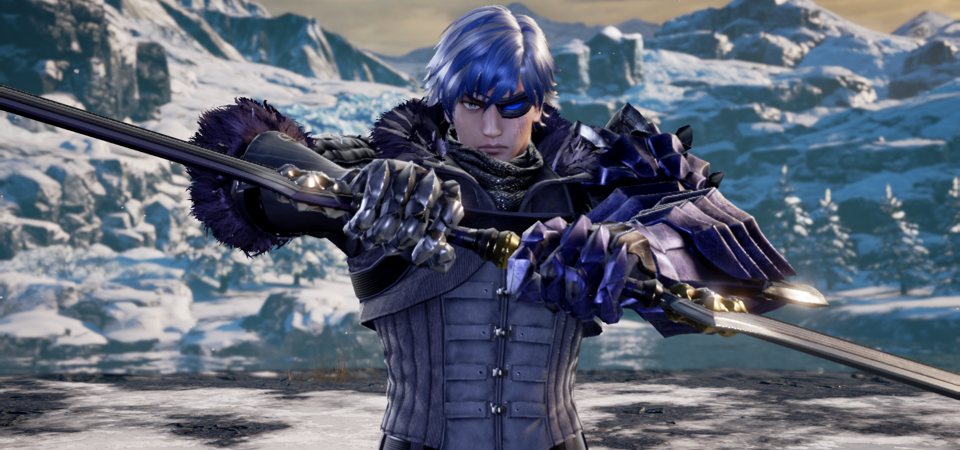
The two arenas available showed off this good looking game, which has been built in Unreal Engine 4 this time around. One took place in a opulent Greek setting that wouldn’t have looked out of place in older God of War games, while the other is a much more arctic setting, set with a deep cavern behind and ice floes on the other side.
Wrapped around the core combat are a number of different new and returning special moves. One of the biggest is the returning Critical Edge system, which lets you unleash a powerful string of attacks in a dramatic, cinematic style, all with just the pull of a trigger. Of course, you have to time it right and land the attack, but several big chunks of health get knocked off your opponent if you do, though thankfully not taking things to extremes. This attack is built up over time in the Critical Gauge as you land attacks, letting you store up to two Critical Edge attacks or using this energy for less supercharged Brave Edge attacks. To ensure some epic showdowns that go to deciding rounds, losing two rounds gives you a bonus Critical Edge charge to use.

The key new ingredient is Reversal Edge, a dramatic addition that triggers a dynamic camera angle and a flashy slow motion strike between the two characters. It’s a counter of sorts, but throws you into what’s effectively a quick round of rock, paper, scissors, with the vertical, horizontal and kick attacks at the three corners of this triangle. It’s a leveller between players that can turn the tide of a battle, as you effectively have to gamble on what you think will work and hope you gain the upper hand by landing a hit of your own. Then again, you can simply choose not to take part, either by dodging or blocking to avoid.
Beyond that, you now have Lethal Hits that can knock characters up into the sky, and are often a key part of knocking parts of their armour off in an amusing fashion – How do you break Sophitia’s boots and socks and not cut her legs off? And don’t be surprised when seeing Mitsurugi’s traditional Fundoshi underneath his Samurai armour! There’s also the Soul Charge, which was missing in the last two games and returns to supercharge a character’s attacks for a time while also changing their appearance. Kilik, for example, gets big wavy hair and takes on a more demonic appearance.

It might have been half a decade since SoulCalibur V, but VI feels like a good step forward. There’s an enjoyable mixture of the old and familiar with new and overhauled ideas that should help to spice things up – the Reversal Edge in particular. Of course, fans of SoulCalibur are probably just going to be glad to have a new entry of the series on the latest generation of console.