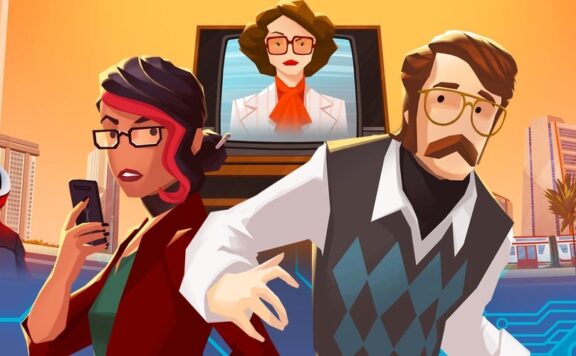


There’s a very specific and special kind of dystopia at the heart of American Arcadia, a game which takes The Truman Show and ramps up the concept tenfold. From an attempt to break out from a reality TV show set in a giant bubble, to the efforts in assist from the outside and the surprising scale of the deception along the way, my recent hands on time at Gamescom 2022 has shot American Arcadia right up to the top of my indie wishlist.
At its core sits the reality show ‘Arcadia’. Broadcast 24/7 around the world, everyone in its bubble is treated to a 70’s style retro-futuristic utopia. Sure, there’s the daily grind, but Trevor Hills surely doesn’t mind all that much when he gets to hang out with his buddies.
What he doesn’t realise is that he’s trapped in a game show with winners and very real losers.
“Trevor is just an ordinary man,” explains Creative Director Tatiana Delgado. “He lives an ordinary life, he’s an average person, he’s not an athlete – so he’s overwhelmed by what is happening to him. He’s not a person who creates drama or gets into arguments, he’s not interesting for the show, so that’s why they’re going to get rid of him. He’s not TV material.”
Lead Writer Alfredo Gonzalez-Barros adds, “In fact, Trevor likes his life. He’s not like Truman who always wanted to get out.”
Even if he was aware that this was all a TV show, he’d probably be shocked to discover he’s not even the main character. Where The Truman Show surrounded the protagonist Truman Burbank with knowing actors and careful choreography to keep him blissfully unaware, everyone living in Arcadia is kept completely and utterly in the dark. Trevor is just some guy.
Tatiana told us, “We are fans of these movies like The Truman Show, The Island, Logan’s Run, all these things about escaping from a dystopian world. We thought it would be so cool to try and escape from a world like that, and that was the inspiration.”
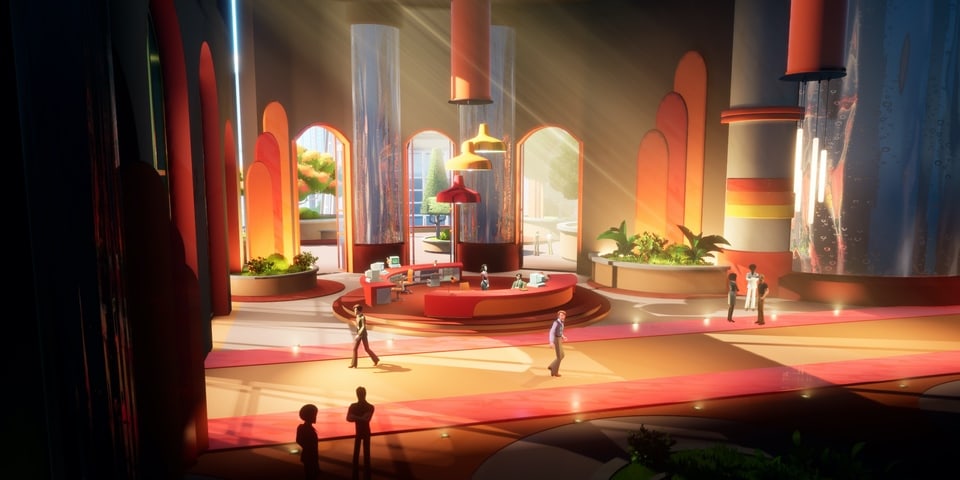
So someone gives Trevor a bit of a push. As he wanders into his job at INAC, he spots that his buddy Gus has surprisingly won a competition to go away on luxurious holiday — announced, as always, by the city’s matriarch Vivian Walters. Huh, that’s odd — Gus never said he wanted to go on a holiday like that before…
Still, carrying on to his regular old desk, now without a buddy on the other side, he starts getting to work, right up until the massive, slatted billboard freaks out. The usual advertisements no longer cycle through, but rather give off a shocking message: “Gus is dead.”
Hijacked TV screens lead you along to the next room and a restricted doorway opens up in front of him, leading to what is clearly a backstage area filled with TV cameras and other gear.
It’s here that he gets an earpiece, a woman’s voice — Angela — telling him quite abruptly that this is all a TV show, that Gus really is dead and that he will be too if he doesn’t get a move on and escape.
Tatiana explains “Angela is working for the show and she’s been a long-time fan of the shows that the company made before American Arcadia, and that’s why she started working for them, but now she’s horrified by the things that they are doing. That’s why she’s trying to help people escape.”
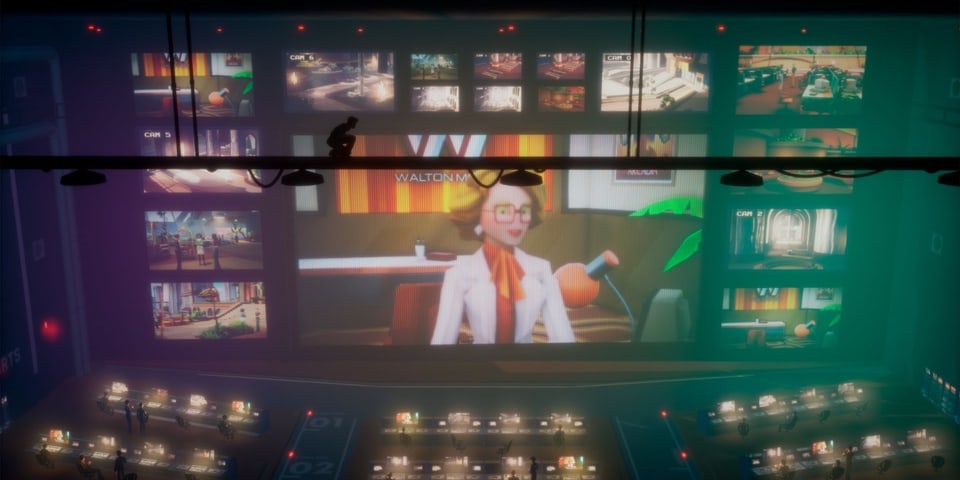
With Angela in his ear pushing him forward, what follows are some neat side-scrolling puzzle adventuring, moving around objects so Trevor can reach higher places, and the like. It grows in depth and complexity, and there’s certainly some Inside vibes to this as you look into the backdrop while sneaking along a gantry, seeing behind the scenes at the workings of the TV show, a callous and dismissive recording with Vivian calling Trevor a complete nobody.
And then comes the twist: while Trevor waits at an elevator, the screen pulls out to reveal another screen, another perspective, and a completely different world. It turns out that you’ve been looking through Angela’s eyes the entire time, guiding Trevor through the world, but now you need to go more hands on. It was something that I’d totally forgotten from the announcement trailer – “It wasn’t all that secret!” Alfredo points out, continuing, “We want to do this a lot in our game – playing with something that happens on screen, then you get out of the screen, and… I don’t want to give much away, but it happens a lot in the game!”
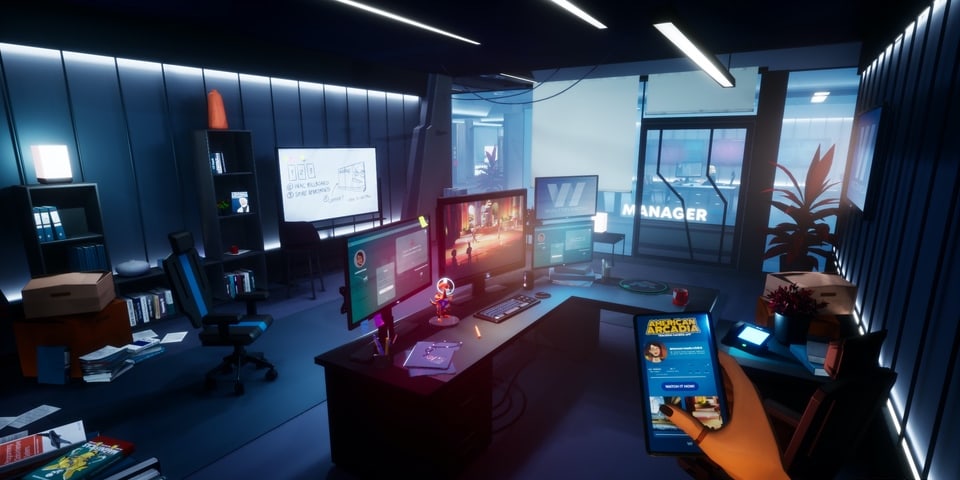
It’s a shift that calls to mind some of the modern-day segments from Assassin’s Creed, as you get to wander the halls and offices of the company managing the American Arcadia show. There’s a sudden leap to today’s tech, with flat screens and smartphones, glass-walled conference rooms and all the paraphernalia you’d expect from a modern tech giant — just one with a glowing orange dome clearly visible through the window. “She lives in a very dark version of the real world today,” Tatiana said, “so the real world [in American Arcadia] is inspired by the Black Mirror TV series.”
The goal with Angela is to get access to a server room, and to find cameras and upload looping video clips to them to help cover her actions. It’s a sudden shift narratively, and it comes with equally contrasting gameplay. Trevor’s escape plays out in 2.5D side-scrolling fashion, while Angela’s segments are first-person and more puzzle and exploration oriented. It’s intriguing to see how Out of the Blue isn’t making a complete break from their first game, Call of the Sea.
Just as intriguing is how this split perspective feeds back into Trevor’s journey. Now Angela can hack and command certain objects in the world. If Trevor’s stuck completely in the dark, she can move a light back and forth to illuminate things for him, or send down a window cleaner’s gantry to get him up to another level. In a much more urgent situation, as he runs across the rooftops to escape the goons sent to capture him, he can leap onto a crane, Angela spins it around, and he then takes off again with a few extra feet of clearance from his pursuers.
American Arcadia is shaping up to be something really special. The Truman Show-style set up is familiar, but the way that Out of the Blue has realised this kitschy 70s utopia is simply wonderful. The way they then contrast it with the second viewpoint and blend more ideas into the side-scrolling escape makes it really feel like American Arcadia will be more than the sum of its parts.