


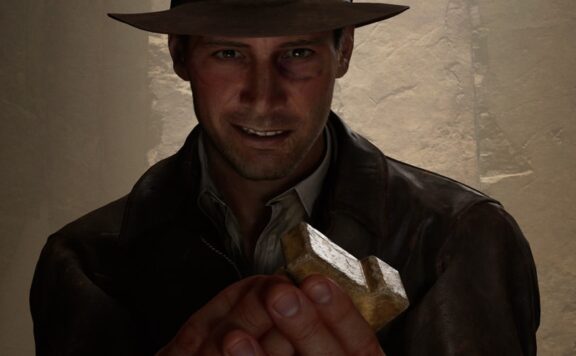
After an interminable wait, Indiana Jones And The Great Circle is finally coming to PS5 this week. Now Sony lovers can rejoice in travelling the globe, exploring beautiful locales, discovering mystical relics, and hitting fascists with a surprisingly varied selection of comedy objects – for my money, an umbrella is the best.
Indiana Jones is, of course, an iconic character. Over the course of three films – yes, there have definitely positively only ever been three films – Indy became the hero of every child of the 1980’s; so much so, that even the character’s shadow became instantly recognisable. Indiana Jones And The Great Circle brilliantly captures all the whip-cracking, snake-fearing, and fedora-wearing excellence of the films, distilling them into an interactive experience that puts the player firmly in the role of the world’s most dashing professor.

I’ve been thoroughly enjoying Indiana Jones And The Great Circle on PS5, and it was whilst clambering the rooftops of Vatican City (before dropping down behind an unsuspecting Blackshirt and knocking him flat out with a handy mandolin) that I got to thinking – has there even been a real-life Indiana Jones? We all get to be Indy digitally now, but has anyone ever done it for real? The adventures, the danger, the thrills and spills?
Fantastically, the answer is yes. But there’s not just one real-life Indy, there are several! Here though, for your eyeball’s enjoyment, are my two absolute favourites.
Born in 1884, in Beloit, Wisconsin, Roy Chapman Andrews was trained by his father to use a shotgun when only nine-years-old. He put that skill to good use, stuffing and selling the animals he shot to pay for college. In adulthood, Andrews became a world-famous explorer, leading dangerous expeditions through China, Tibet, and Mongolia. He lived a life of danger, always on the edge. In one of his many books, he wrote about how he nearly died ten times, “Two were from drowning in a typhoon, one was when our boat was charged by a wounded whale; once my wife and I were nearly eaten by wild dogs, once we were in great danger from fanatical lama priests; two were close calls when I fell over cliffs, once I was nearly caught by a huge python, and twice I might have been killed by bandits.” I don’t know about you, but fanatical lama priests would make a great plot for a fourth Indy film, should they ever make one.
Andrews was a boffin too, just like Indy. He proved that dinosaurs hatched from eggs during an expedition in Mongolia, he discovered that the extinct Gray Whale wasn’t extinct after all, and he wrote a stonking twenty books. Heck, he became so famous that he even featured on the cover of Times Magazine in 1923.

TIME Magazine Cover Featuring Roy Chapman Andrews (29 Oct 1923)
The uncanny similarity to Indy doesn’t end there though, as Andrews wore a fedora and also suffered from ophidiophobia – the fear of snakes. Quite understandable, as in Mongolia Andrew’s tent was invaded at night by a pack of Vipers, forcing him to fight them off with any object he could find – which, as I’ve learned from playing Indiana Jones: The Great Circle, was probably a shovel, a beer bottle, and a wrench.

Then there’s Percy Fawcett, a British Army Officer, who spent two decades exploring the treacherous jungles of South America. Born in 1867, Fawcett was commissioned into the Royal Artillery before finding his way into spying for the British Government. In 1906, to settle a border dispute between Bolivia and Brazil, Fawcett was tasked with mapping an area of unexplored Jungle that separated the two countries. His adventure should have taken him two years to complete, if he even survived, as the jungles were rife with dangerous creatures and even more dangerous and unpleasant human slavers. Yet, despite the challenges, Fawcett wrapped up his expedition in a few months. This proved a turning point for Fawcett, the Amazon became like a drug for him. He returned again and again to the jungle, despite nearly dying on numerous occasions from causes as varied and nasty as starvation, disease, and mutiny. Still, none of that put off Fawcett, as he became dedicated, in a very Indy way, to finding a ‘lost city’. The city of Z.
Where did this idea of a lost city come from? The early conquistadores spoke of towns and villages found dotting the Amazon, yet these had never been uncovered. Fawcett reasoned, why couldn’t there be a large settlement hidden in the Amazon? After all, Hiram Bingham III had recently rediscovered Machu Picchu, a humongous city hidden in the Peruvian Andes for centuries, so why couldn’t there be a mysterious city in the depths of the Amazon too?
Taking a quick break from exploring to fight bravely on the Western Front in the First World War (why not, right? The dude was a spritely 50 years old at the time), Fawcett returned to begin his search of the Amazon. It was in the National Library of Brazil that Fawcett, just like Indy, found a mysterious ancient document, tucked away. Written by a slaver in 1753, the text spoke of a ruined city, an ancient metropolis, rich for the finding. That was all Fawcett needed; he headed out for adventure. His search continued for years, before finally, in 1924, Fawcett and his party disappeared without a trace. No-one knows what happened to Fawcett, did he ever find ‘Z’? Or did he just meet his end at the hands of a naffed off Xavante warrior?
Fascinatingly, Fawcett’s signet ring was found in 1979, but no other traces of the explorer were ever discovered. Still, Fawcett lived his life like Indiana Jones until the very end, yearning for adventure, for the thrill of discovery, to journey deep into the unknown.

So, as you fire up Indiana Jones And The Great Circle on your PS5 this week, as you swing across a pit trap using your trusty whip, as you search dark catacombs with only a candle to light your way, as you solve brain-tickling puzzles in the depths of an ancient temple, spare a thought for Roy Chapman Andrews and Percy Fawcett, who did all that thrilling stuff for real.
For the best part of a decade we’ve explored video games through a historic lens in Playing With History, studying AAA blockbusters such as Ghost of Tsushima to indie gems like Radio Commander, examining the real-world people, events, and cultures that inspired them.
We’re proud to announce that Playing With History is to become a premium print publication with its first volume heading to crowdfunding platform, Kickstarter, later this year. Available digitally and in both paperback and hardback, Playing With History: Volume One promises over 200 pages of developer interviews, deep dives, and retrospectives, all presented in a visually arresting format.
If you would like to learn more about the project and get notified when the campaign goes live, please visit the Playing With History Volume One pre-launch hub. For regular updates you can follow us over on BlueSky and X.



TSBonyman
The most impressive thing for me is how they’ve squeezed the game down to just 20GB for the PS5 disk version..