

I am not a coder. In fact, I view the actual process of development and coding in much the same way as much of Hollywood with hackers being some kind of modern wizard with arcane knowledge. With that in mind, when I was offered the chance to play a game that puts you in the shoes of a hacker trying to access a sinister organisation’s network, my first worry was that I wouldn’t be able to understand what I was doing. The premise intrigued me enough that I gave it a try and I’m glad that I did, as s.p.l.i.t is up there with the likes of Threshold in terms of short experimental horror games.
Content Warning: s.p.l.i.t contains dark elements, with thematic and immersive references to self harm and suicide. I won’t discuss details in the review but these are central enough to warrant caution.
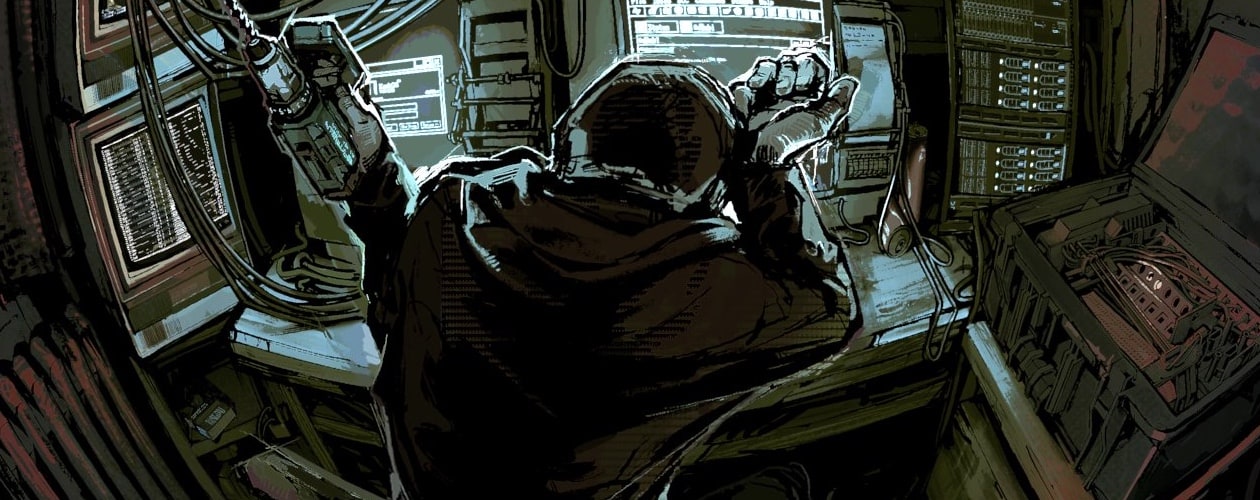
The aesthetics of s.p.l.i.t are perfectly in keeping with the game. While most of the time you’ll be staring at a simulated interface, you can turn to look around your room when necessary. This will mostly be required to switch between your hacking interface and your messaging screen through which you’ll interact with two mysterious colleagues. All mechanics are carried out through the keyboard, which really nails the immersion. Messaging is performed through mashing the keys to simulate actual typing, but all of the hacking has to be done for ‘real’.
The backstory of s.p.l.i.t is deliberately incredibly vague. You and two accomplices are trying to hack into a system in what appears to be an authoritarian dystopia. You have access to an illegal field kit device that can be used to create an authorisation key but will only have a limited time to finish the job once you have access. This scenario, especially when combined with the sheer immersion of the interface, leads to some of the most harrowing and thrilling gameplay you’ll find in indie horror. The fact that this all revolves around using a DOS-like interface to find and access files and programs within the system makes this a game that you have to play to feel.

There are few guidelines in the game but the signposting is so expertly done that I never found myself lost even though I didn’t have any coding knowledge going in. As mentioned above, the main interface is much closer to a pre-Windows experience as you must navigate file structures, find information and use the hints from your colleagues to proceed. Each major breakthrough is marked by a save point and brings you closer to the game’s conclusion.
In terms of dark themes, s.p.l.i.t is not a game with light and shade. This is a grubby and lo-fi experience that never lets up either in intensity or mood. The constant feeling of threat and surveillance makes the hour or so it takes to play through feel like an ordeal in the best possible way and both of the alternative endings offer no real optimism but both feel entirely appropriate for the game’s themes and setting.

Andrewww
Sounds very interesting, thanks for bringing this to my attention. I might just do what I very rarely do, and switch to my PC to play a game (if it runs on my hardware).