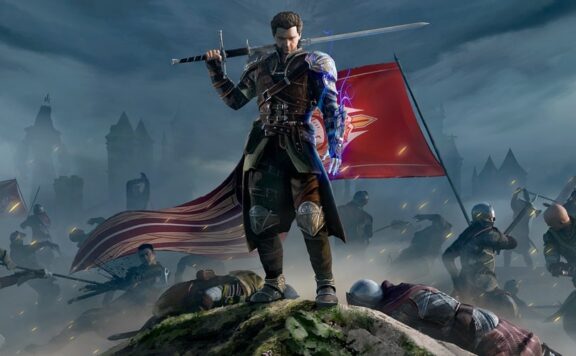


Of all the depressing studio closures of the past few years (and there have been far too many) one that hit me particularly hard was that of Piranha Bytes, the legendary pioneers of the Eurojank RPG. Famous for creating the hugely influential Gothic series, as well as Risen and Elex, all of their games shared a unique feel that garnered a loyal fanbase. While the settings were different, each title featured unforgiving combat and a sense of openness that made many other RPGs feel claustrophobically restrained. A remake of the first Gothic game is still in the works but there is clearly a gap in the market for RPGs that share the DNA of Piranha Bytes’ canon. Of Ash and Steel is one of the first games to aim at filling this niche, and it certainly succeeds in that aim, although this isn’t always a good thing.
In traditional RPG fashion, you begin the game in a safe tutorial zone. You are Tristan, a cartographer charged with mapping the mysterious island of Greyhaft. There is no character customisation or specific class choices to be made here but early conversations can level up different attributes such as strength or dexterity and begin to define your character. The lack of any player contribution to the character at the start is another approach borrowed from Piranha Bytes games but does feel a little dated. This isn’t helped by a common sentiment from players that Tristan has a very punchable face – although this perhaps helps to explain why he gets into so many scrapes.
Graphically, Of Ash and Steel is solid but isn’t exactly cutting edge. The environment is relatively detailed and character models are mostly good (Tristan’s face aside). Enemies are varied, especially as the game progresses and you get past the initial wolves and bugs. The UI is clear and menus intuitive so interacting with the game never feels awkward – that awkwardness instead exhibits itself in the controls and combat.

Early on Tristan is clearly not a trained fighter. Most enemies can – and will – kill you very quickly. You don’t even have access to proper combat controls until you find a way to train your skills, which requires both levelling up and gold to pay a relevant teacher. This means that the beginning of your adventure is supposed to be very linear as you follow the path and avoid straying from it. This enables the onboarding to be controlled for new players, which is welcome given the high difficulty level.
As you gain experience through combat and fetch quests you can develop Tristan’s abilities in usual RPG style whilst also making choices about how you want to learn new skills. Specialising is possible but it’s definitely worth spending skill points in the early ranks of all three trees – war, survival, and crafting. These different trees will allow you to make consumables and equipment from the things you forage, loot, and steal in your journey, as well as letting you swing a sword correctly.

The dangers of Greyhaft are soon revealed as your entire crew are slaughtered in front of you and then you are kidnapped by a gang of bandits. You then wake up in a strange bed and have to begin from scratch to complete your mission and/or take vengeance on your assailants. In true RPG fashion your first quests involve clearing all the empty bottles from your rescuer’s cabin, pulling out the weeds from his garden, and (in a touch of very Teutonic humour) finding out who has been throwing fouled trousers into his yard. These banal tasks teach you a range of basic controls before you can venture out and begin your adventure in earnest.
It’s also typical of the games that inspire Of Ash and Steel that the first hours of the game are potentially very frustrating. Death is rapid, combat is incredibly janky (deliberately so until you learn how to fight), and even early NPCs focus on tricking and betraying you. The usual freedom you might expect from a seemingly open-world adventure is not present here. You need to follow the narrative and take the game on its own terms for the first few hours. This is especially the case if you play on the default difficulty setting when all of the aforementioned challenges are exacerbated by hunger, thirst, and tiredness scales. While I’m not usually a fan of these kinds of survival mechanics it does mean that there is more of a reason to use the things that you are constantly foraging.

Obviously a core part of the Eurojank heritage is the ‘jank’. I started playing Of Ash and Steel with a pre-release build and was enjoying myself despite a litany of bugs and occasional crashes. When an update was released at launch I switched to the full build and frustratingly found my save deleted. This isn’t all that unusual, but it did push me away from the game for a few weeks. Starting fresh to complete this review, and as we approach two months since launch, the game has undergone a series of patches and improvements which make it somewhat more polished.