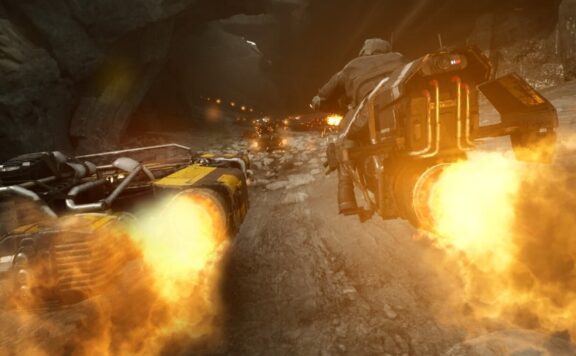

Star Wars: Galactic Racer is more than just a spiritual successor to the classic Star Wars Episode I: Racer, it’s looking to bring something fresh and new to the world of arcade racing, with a run-based story mode, and a snappy multiplayer where you bet on yourself and your abilities to succeed.
We’ve been hands on with both – find our single player preview here, and today’s new multiplayer hands on here – and we also had the opportunity to sit down and chat with Fuse Games co-founder and CEO Matt Webster.
TSA: Let’s start off with planets!
Matt Webster: Oh gosh, yeah…
TSA: Because you’ve got that traditional mix of what Star Wars games always have to do, where you’ve got some fan favourites, some things from the films, but then also you’re just like, “Oh, I want to do my own monobiome planet as well.”
Matt: That’s right, yeah! The thing is, though, they’re characters in themselves in Star Wars. We all know their names, we know their biomes, and so we wanted, from a high level point of view, have a range there. Some of the compromises you make when you make an open world game is you’ve got to squeeze all those bioimes in one place and it feels like Disneyland – there’s nothing wrong with Disneyland, but you’re bringing lots of things into a place and what that does so well is bring a whole lot of entertainment into a small area, whereas the world doesn’t look quite look like that.
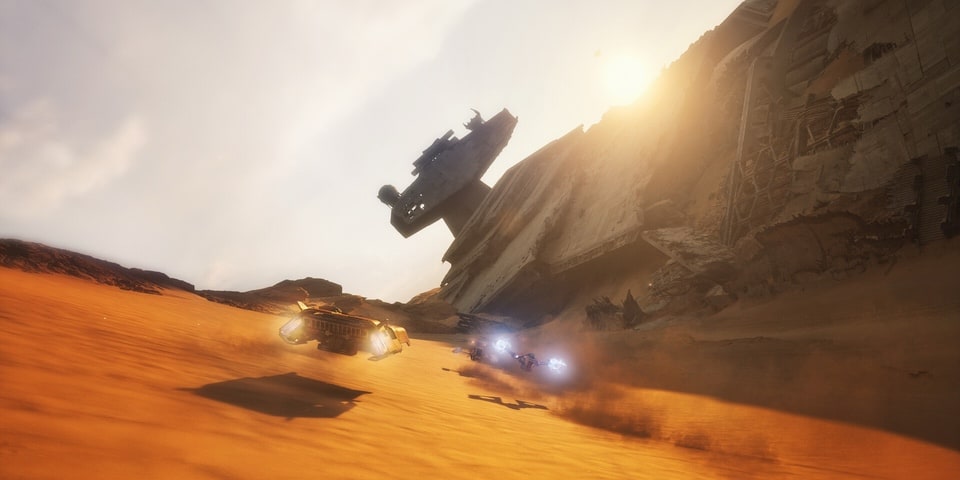
So [we want to] have a sense of journey make use of those biomes in a visually interesting way, but actually more importantly for us, it was to lean into their environmental condition. In many racing gains, the location is just a pretty backdrop for where you’re racing, and that’s fine, but what we wanted to do with this game is actually challenge some of those genre conventions a little bit. So that was one of them in terms of how can we make where you are racing have a more meaningful impact in how you are racing?
TSA: Yeah, the toxic planet got that across a very, very quickly. [laughs]
Matt: 100%! Yeah, they’ve all got those environmental conditions, which then feed very much into what we refer to as the status effects about that the environment has and then how parts can perform better (or not) with those status effects.
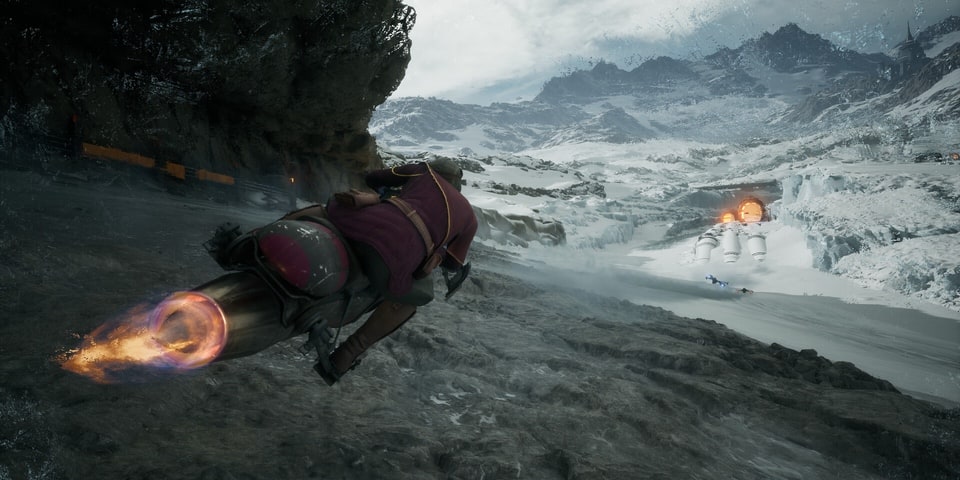
TSA: Yeah, I can definitely see some of the synergies for how you build your load out and stuff like that.
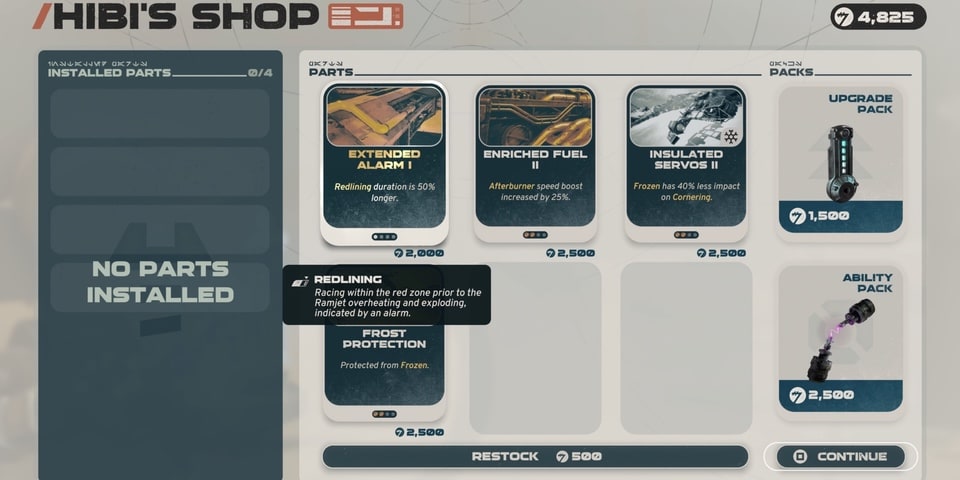
Matt: Correct. You have to look for a synergistic build, and that’s why we’s we’ve highlighted the meaningful words in those [Part and Ability] descriptions so players can start linking those things together. Kieran [Crimmins, Creative Director] will talk about the combinatatoric series, they’re massive.
What we’ll start to see is players saying, ‘Well, hold on a minute, my Ramjet gets hot, so I want to avoid heat… Or do I?” Maybe there’s a part where are there parts that are and of course there are part.
TSA: That give you a 75% chance of not exploding when you overload?
Matt: That teaches you the folly of gambling. Yes, there are, yes.
TSA: [laughs] I’ll have to put some context for that…
Some Context: There a specific Part that I encountered in the hands on preview session, promising a high percentage chance not to explode if you let the Ramjet fully overload. Out of, maybe, half a dozen attempts to gain the benefits, I exploded every single time.
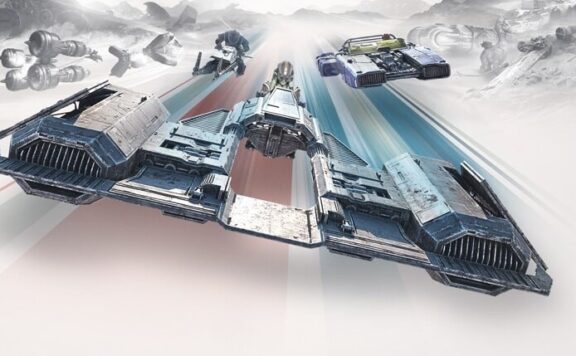
TSA: So beyond before you start applying those parts, you’ve got the base for a vehicle types. Obviously there’s the pod races, they’re the top tier that are the kind of Formula One cars, but I like like that you’re embracing the kind of BTCC aspect of it with with the speeders and things.
Matt: Yeah, and that was kind of the way we looking at it, really. You can’t make a Star Wars racing game without a pod racing, but as Pax says in the prologue, they’re the pinnacle of racing, but hardly anyone can fly them. So that’s a reference to the law, and that they’re 8 to 10 metres long, go 1,000 kilometres an hour – they’re bonkers.
We wanted to tell a sports story, we want to broaden the racing experience inside the Star Wars Galaxy, and so that was the wonderful opportunity that we had working with Lucasfilm to create the Galactic League and to create the racing vehicles within it.
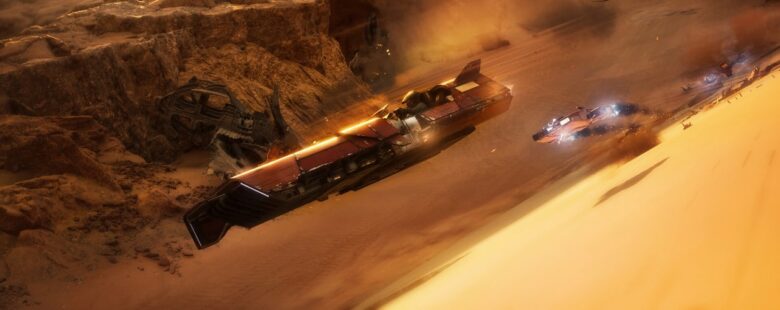
TSA: And I really like that you’ve sort of got this almost middle ground that the skimspeeder. It feels like a middle ground between all the other three, it’s maybe a little bit nippier in some ways, but you’ve got you’ve got the tilting of the pod racers, maybe.
Matt: Yeah, that filled a very specific gap that we needed, which is why the vehicle needed inventing. It doesn’t exist in Star Wars, it’s a new vehicle. It’s got the same performance envelope as the other speeders, but obviously they all describe different racing lines and where those racing lines intersect is where the fun happens.

TSA: Yeah, it definitely felt like there wasn’t they weren’t too far apart in terms of how they handled things, but the skimspeeder, when when you do the Knife Edge turn, that’s a very distinctive aspect.
Matt: Yeah, although the speeder bike has something called Kinetic Bursts. So if you think thatthe land speeder has a drift, and that’s a bit of a nod to our time in racing cars where we were thinking, for me at least, the best way around the corner is sideways with all four wheels smoking and a big smile on your face, that’s quite hard to do.
So, the lands speed there is the drift, the speed of bike is more what you would call, in a game where you’ve got wheels on the road, a grip – you brake, use Kinetic Burst to store that energy, accelerate out of the corner – and then the skim speeder is about to flow. […] The skim speeder is more like an aircraft.
TSA: You’ve got a bit of your Criterion DNA coming through with the takedowns and how it cuts away and it shows the explosive thing going on, but can you talk a little bit about how like you’ve got this this kind of institutional lot of knowledge carrying through to what you’re doing now with FUSE.
Matt: That’s just experience, you know? The more games you make, the better you should be getting at them. But also, I think that comes from… People talk about arcade, but arcade racing is not an absence of depth. For me at least, arcade is in the instantaneous fantasy fulfilment or the spectacle that the makes you want to carry on. So anyone can have fun immediately, but you have the depth.
So when we looked then at the type of racing that we were looking for is obviously, you know, speed and spectacle, and aggression, but what we wanted to do was push the genre forward. That comes in the word that I use all the time, here is consequence.
So crashing is a audio visual spectacle and it’s [bleeping] cool, but it’s got a consequence to it. And the consequence is, you know, I’ve made a mistake, I get a visual payoff, that’s great, I makes me feel I’ve learned something, but I take an impact in the race. But then what we wanted to do and as to why it led us to the run-based structure was make that consequence actually make something.
TSA: Yeah, that’s perfectly leading onto to what I wanted to talk about next, which was like the roguelite structure, but not just like, why did you do a roguelite? But how you you’ve blended that into the multiplayer with the tours as well as the campaign.
Matt: Yeah, well, it was recognising that the racing genre had fallen behind some other genres – it hasn’t really stolen from other games, you know? So when we talked about this, runs base system where there was meaning meaningful decisions to make and meaningful failure. Because in racing, it’s hard to have consequence when you’ve got a rewind button. So I made a mistake? So what. Nothing really means anything. It’s a bit like when you respawn in a shooter, but as soon as Permadath came in and the Battle Royale started coming in, it was like, ‘Oh, this death kind of mean something!’ So we wanted to take a bit of that But then I was very much inspired by Hades, Returnal and Slay the Fire and a whole bunch of other games.
What we realised was if racing thrives on replayability – I get better with the vehicle, I know the tracks, my skills get better – so therefore, having a structure underpinning that that’s built around repiability feels like a match made in heaven. And so we chased it.
Now I’m talking about a vehicle building in ways I’m not talked about since Gran Turismo 2. […] I’m talking about a vehicle build that you know is as a whole bunch of systems in there that decisions that I’ve made that can suit my play style. And then when it comes to consequence, so the consequential decisions, but also consequence in, “Okay, well, I wreck out, I go back to the start, but the things that I’m taking with me give me a more powerful start point.” So I come back to the start of an act, Hibi scraps my build, I’ve got money, I’ve unlocked some par options that get served up to me in a randomised way, My path structure through the campaign changes, I’ve got different decisions to make now. This feels fresh and interesting.
Multiplayer then is a build chase. So it’s six events, but the first five, it’s all about the build. What can you build? What have I got available to me? What decisions am I making? And then can I put it all on the line in the last showdown race
TSA: Yeah, and I like that because it means all stakes are there for our final race.
Matt: And also more importantly, it keeps people playing!
So what we’d always seen in the past, certainly on series of races, if I mess up the first race, then I’ll quit. Here, maybe I’ve got something, maybe there’s something coming my way in the next race.

TSA: Finally, Sebulba is in the game, but for some reason, in my head, he died in Episode I.
Matt: I don’t know why people think that! No, I mean, it was a catastrophic failure, the crash he had,
TSA: [laughs] he might as well have died. The shame! But he’s survived, obviously, but this fake memory got me thinking…. can you play as young Anakin in the scenarios? Like a throwback scenario?
Matt: There isn’t. Who knows what the future holds is, but there isn’t.
But it was wonderful, because we got the opportunity to create some new canon characters, but also bring some other folks back. So you see Sebulba, but he’s older. He’s still cranky though.
TSA: He’s like Alonso…. No. So, Sebulba would have to be Lewis Hamilton, and Quadinaros would have to be Alonso. Maybe he’s only managed to get one championship or something.
Matt: Yeah, well, maybe Quadinaros is like, what’s his name? Kevin Magnussen. Hasn’t won a championship, just one podium finish but he’s been around forever…
TSA: Oh, Hulkenberg?
Matt: Hulkenberg, yeah! There we go.
We’ve got some returning see people like Griff Halloran. So Griff Halloran is from Star Wars Resistance animated series, but we know him as an old guy, so here we see him as a young guy,. Sebulba we knew as a young guy and see him as an old guy. So we get to play, to tell stories in the same era, but we pull from different aspects of different avenues of Star Wars, which is great.
Thanks to Matt for chatting to us about Star Wars: Galactic Racer, the game is hurtling toward release on 6th October 2026.