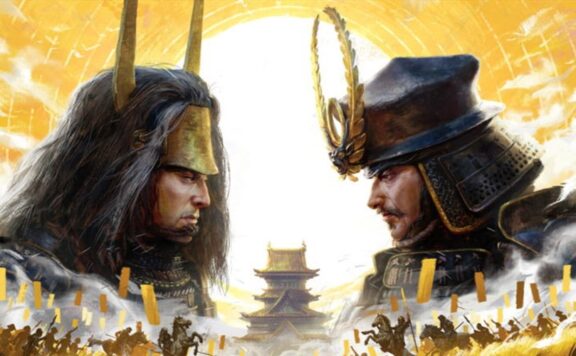


It’s hard not to be exceedingly excited for Total War: Warhammer 40,000. While there’s now almost innumerable ways that Games Workshop’s iconic tabletop wargame has been adapted into video game for, mixing it with the grand strategic campaigns and giant real time battles of Total War feels like a match made in… well, whatever counts as heaven for the grimdark future of the 41st Millennium.
We went hands on with a few aspects of Total War: Warhammer 40,000 at Gamescom, dipping into the opening tutorial, the briefest glimpse of a campaign map, and some of the big real time battles that showcase the possibilities of Creative Assembly’s latest in-house Warcore game engine.
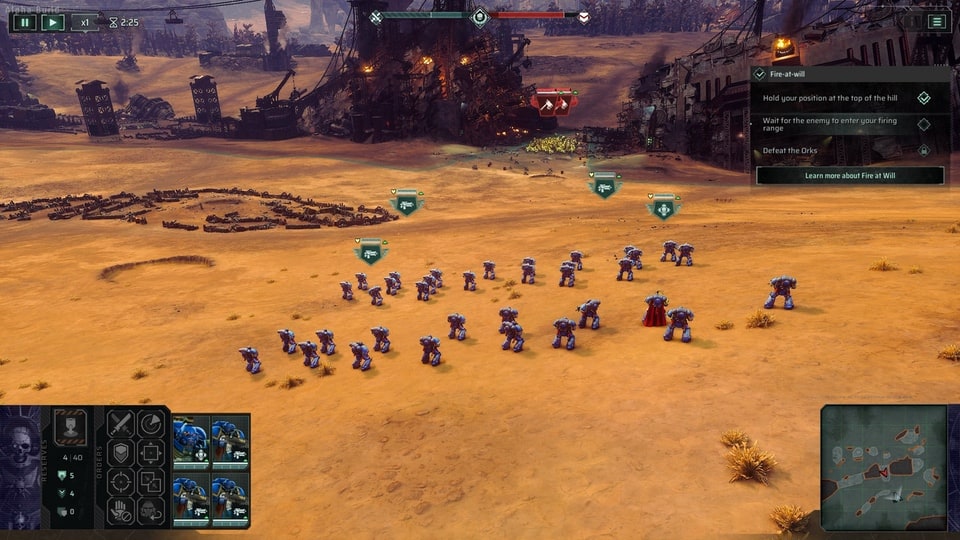
So let’s start with those battles. The initial tutorial sees a detachment of Space Marines dropping down to the surface to investigate a crashed Inquisitorial ship and secure it from a roving band of Orks. As you’re directed to march your units over to stand on an overlooking mound, the Orks blow up a chunk of the side of the ship and come spilling out in a mass of angry green bodies. It’s a moment really gets across the disparity in numbers of these two factions, and this is just the tutorial with a handful of units on either side. Later battles make the Orkish hordes look to a flood of green washing across the planet, the scale here reminding me much more of Epic 40,000 than the main tabletop game, but the Space Marines have exceptional staying power with their limited numbers and greater tactical possibilities. They’re able to call in reinforcements via drop pod, smashing any enemy unit they land on in the process, and call upon a wealth of orbital supports.
There’s a few key additions to battles in this game, with battlefield destruction letting you blast apart already ruinous buildings, create massive craters, and with all this rubble and cobbled together scrap creating cover to hunker down behind. It adds to the strategic patina of the series.
Dave Petry, Battle Product Owner for Total War, told us, “It does matter more and less to different units, and sometimes the right thing to do will be to take position, get out of cover, flank and get around things. It also really depends who you’re up against. Orks do have some pretty awesome firepower, but the army that you’re fighting [in the demo] really just want to punch the crap out of you. Cover is going to useful for avoiding a bit of their arms fire, but it’s not going to be the most important thing in that situation.
“You’re Space Marines, you’re already caked in ceramite and most of the stuff they’re firing at you isn’t too threatening, but if you’re play Astra Militarum, [using cover] matters way, way more because you’re so squishy.”
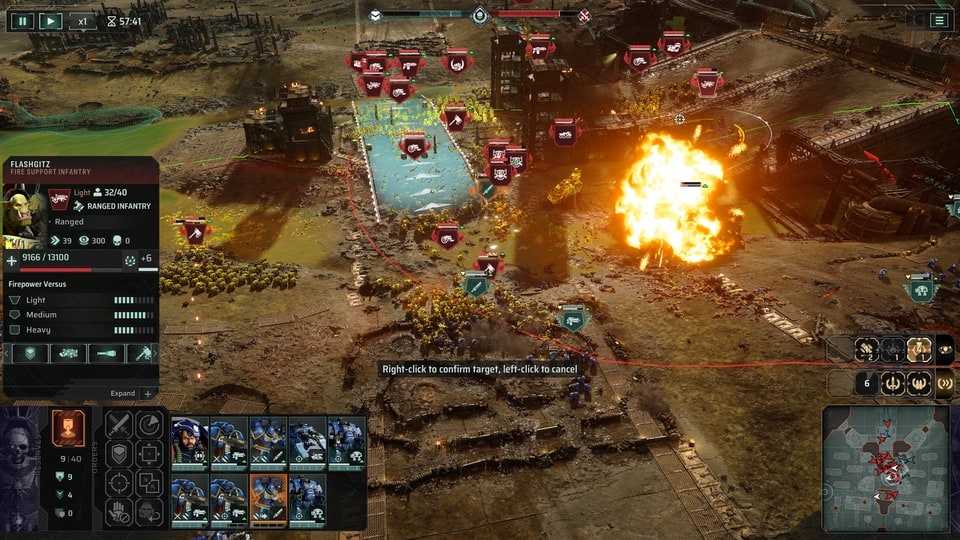
I got to see that first hand. The later battles in our hands-on featured a handful of already embattled Imperial Guard units, depleted in numbers and trying to hold defensive positions in the middle of the screen, and it absolutely works thematically. The Space Marines are the cavalry, they’re the reinforcements. It’s usually too late to really save anyone, though you might win the battle and the war.
There’s quite a few new concepts for Total War veterans to master here, but given the appeal of Warhammer 40,000, it makes sense for CA to really focus on the learning curve for this game. Joy Dev, Lead Designer focussed on game tutorials, explained “Through the tutorial, it’s not just teaching you the campaign, we also have tutorial battles. In this [Gamescom] demo, there’s only one tutorial battle, but there’s going to be quite a few of them in the release version of the game. That’s where we point out what’s new to Total War. In this battle, you saw Orks blow up a building, for example, and in the second tutorial battle you’re going to be the one blowing up the building, so we’re introducing these concepts and getting you to use them.”
It’s a gradual approach, she says, “because there’s a lot to learn, right? There’s a lot needed to be able to play the huge scale battles, and we’re trying to get your there step-by-step.”
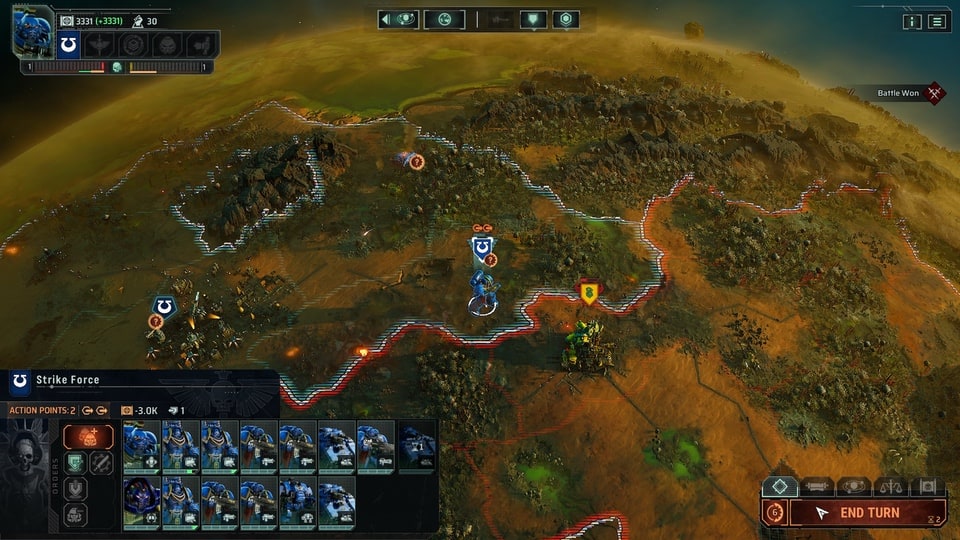
Pulling back out to the campaign map, and we have another major difference to the previous Total War games. You’re not fighting over a single planet, but a solar system and the entire Armageddon sector of space. it makes total sense, then, then each planet is reminiscent of a Super Mario Galaxy planetoid, easily spun around and with a smaller number of sectors and landmarks to fight over. You then have fleets in orbit and have to move and marshal your forces and resources across multiple planets in the solar system.
Another distinction is that you’re not fighting over this entire sector of space all at once, but are instead taking on individual campaigns. This initial game is taking place in the Armageddon Sector, tying in with the story and era currently being explored with the tabletop game, and your fighting through the game’s story will take you there, fighting one solar system at a time.
Dave told us, “The play space needed to be the right scale, and what we settled on is that a solar system feels about the right scale. You’re able to move between planets, they’re big enough for every [faction] to get involved with all of their technology, how they work and representing them in the right way without it feeling too squished and without it feeling too abstracted.”
Joy added, “It’s not just a linear path to Armageddon, you’ll get to choose to start this campaign, and then you’ll unlock two, so which way will you go? There’s different victory conditions, different rewards, so you’ll have to map your way to Armageddon.”
I’m also reminded of the fact that, while human lives are largely expandable within the Imperium’s galactic struggle for survival, the Space Marines are all about being lightning fast response soldiers. “Nobody likes empire-building Space Marines!” Dave quips, “But yeah, they will be working with local planetary governors to be able to make sure they’re supported and have the resources to be the tip of the spear and do what they need to do. Space Marines aren’t there to take and hold and look after things, they’re like the very thinnest blue line, or whatever you coloured them as in [the demo].”
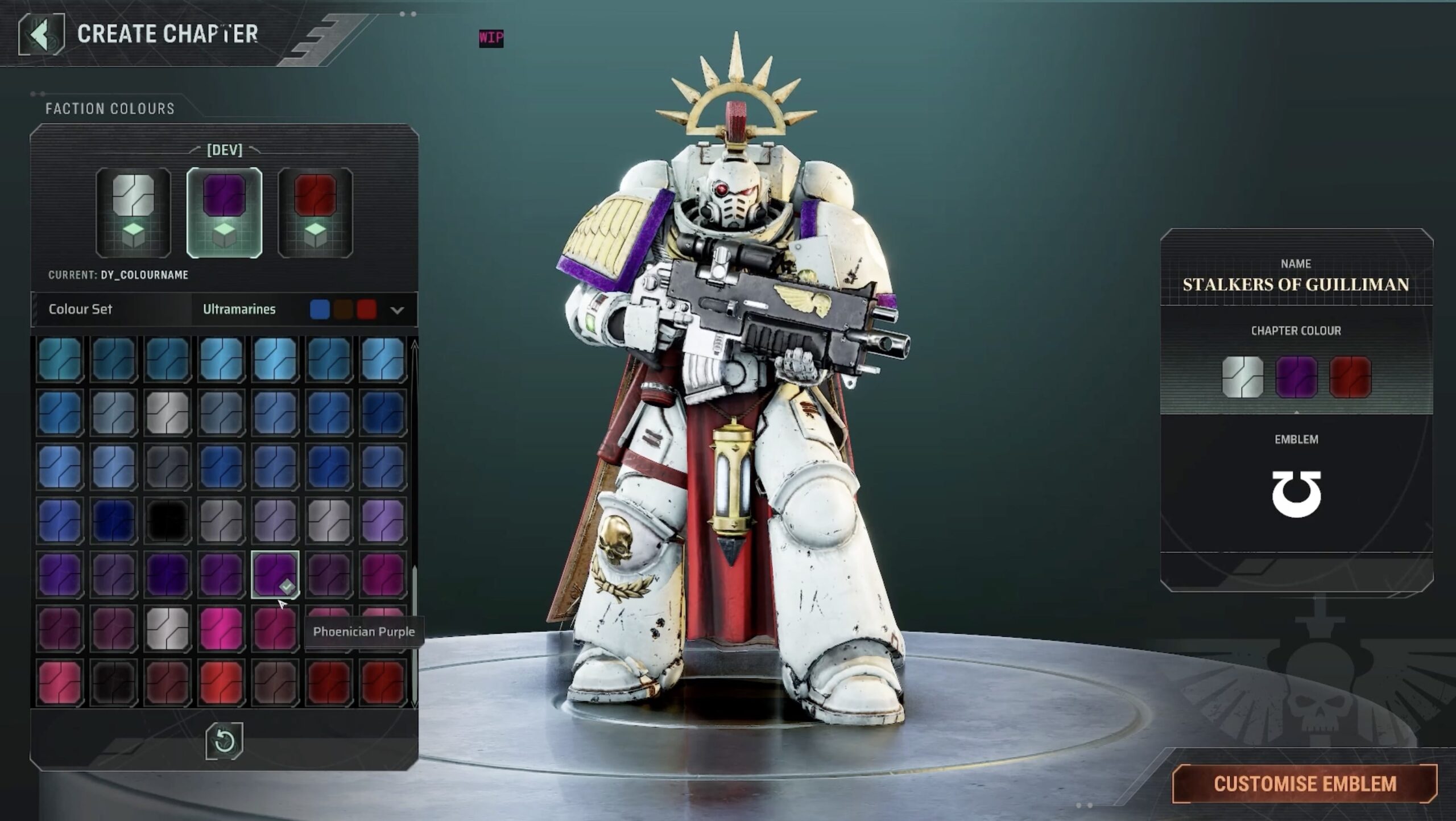
Speaking of which, you have the faction customisation. Sure, you can battle as the big boys in blue – the eternally popular Ultramarines – but you can quickly swap out the colour palette, create a custom logo and select from a name list to create your own chapter. Mine became the Screaming Drinkers pretty quickly, with a mildly confusing murky green.
Joy said, “You’ve just got a taste of [customisation] here. This is the basic form, and there will be more customisation later on. We want you to be able to make it your own, like you can paint your models however you want, you should be able to do a similar thing in game.”
She continued, “Within the campaign itself, we’ve then got unit specialisation, so if you want to give units a different kind of weapon, then you can do that.” This means this will be a Total War first to allow units to stray away from everyone having the same weapon, adding to the story of units you manage to keep alive through veterancy.
There is still a way for Total War: Warhammer 40,000 to go, though. The UI elements for triggering unit abilities was much too small and unobvious, and I also think that the pace of the battles felt a bit slow at 1x speed. 2x speed felt better in terms of how fast units fired, the speed of rocket strikes and the like, but then units also moved a lot faster and gave less time to consider overall battle strategy. That’s something especially important to get right when this game will be fully playable with gamepad, to aid its arrival on PS5 and Xbox Series X|S.
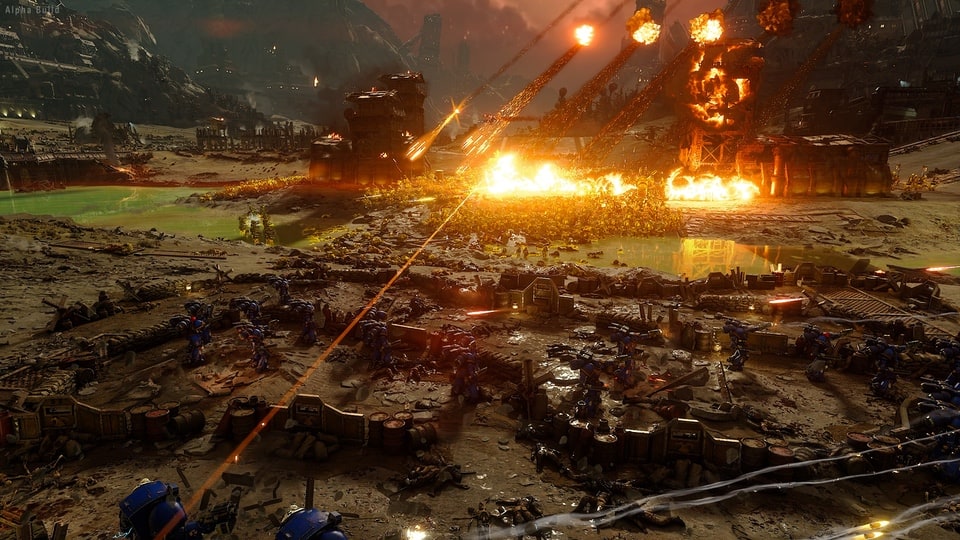
From this early showing, though, I’ve seen enough to be both intrigued and excited for what’s to come with Total War: Warhammer 40,000. The battles are big, bold and chaotic (and bode well for Total War: Medieval 3’s siege battles), the campaign structure puts a distinctive spin on things, and I’m very keen to see how the Eldar and Astra Militarum factions are brought to life with their own distinctive gameplay mechanics.