


Sci-fi and time loops go together like tea and biscuits. Getting trapped living the same day over and over offers its own challenges, as you try to make progress even when each day resets, which is precisely the issue Miranda faces upon the Ares space station. She finds herself alone with her crewmates missing, power supplies critical, and various phenomena plaguing the station which is orbiting the planet Vesta – a potential new home for humanity.
Miranda has a number of mysteries to uncover such as what happened to the rest of the crew, finding the source of the phenomena and, most importantly, trying to find a way to reestablish contact with Earth and getting back home. The problem is that she has lost count of how many loops she has gone through, not knowing if days, weeks, or months have passed by as each day becomes the same.
For simplicity’s sake, Rivage starts us with our own first loop in which to uncover some answers before resetting. You do not have much information at this point or much access to the station, since Miranda’s key card is at the lowest level. This makes early loops a hunt to find ways to get additional access to reach different areas of the space station, from bedrooms and communal areas through to labs, escape pod bays and the fusion core.
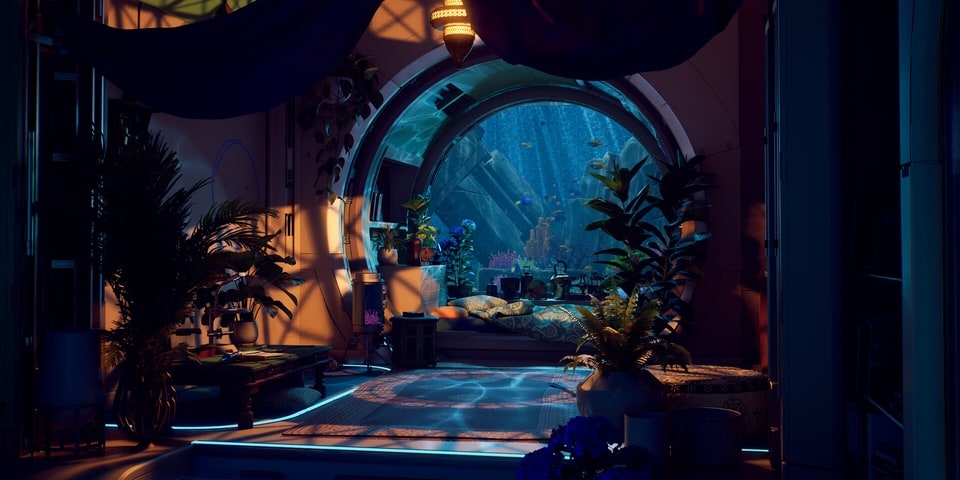
The visual design of the Ares space station is very well done with each area having a distinctive look, with each room and area reflecting the personality of the person who would frequent it most. Amaan’s room is designed with plenty of plants and a giant fishtank to reflect his passion for the natural world, Rafael’s corner in the upper lobby is filled with toys reflects that while he is incredibly smart he is also a child in a man’s body due to development issues, and Miranda’s own room shows her passion for books and music. I do question the lack of stairs in the space station, though, and the inclusion of a small railway to get around the upper level.
Miranda’s access and movement is not just limited by access privileges, but also by the power available to keep the systems going. Each action, such as opening doors, uses a bar of power. When you are limited to four bars for quite a few loops, you really need to plan what you are going to prioritise during the loop you are on, and how you are going to tackle Rivage’s puzzles.

The puzzles range from pretty simple to multi-room hunts for clues and solutions to make progress. For the most part, the puzzles are a satisfying challenge, however some of the puzzles feel like busywork with too many steps. One example is finding fingerprints to turn on a generator which then starts another puzzle of completing a large circuit to power a shutter. Through the messages, emails and audio logs you understand why some of the precautions have been taken and why things are as they are, but it does get tiresome when you think you have found the end of a puzzle only to have to go through a few more steps and loops because someone decided to hide a key component. Hitting those barriers makes Rivage frustrating in instances, especially when you end up having to reloop because you can’t progress unless you do.
This is where I am not sure why the time loop and power limitations were put in place. From a narrative perspective, it adds some intrigue, but from a gameplay perspective, the puzzles could have been just as challenging without having to go back and reset the day. Adding two types of barrier to progress just feels like they were added to prolong Rivage’s run time. Running around to find the solutions, eventually getting them, and then having to reloop so quickly breaks the rhythm you find. Additionally, playing with a controller is not particularly smooth and it seems that the game is better designed for keyboard and mouse. Manipulating objects while also looking at files and screenshots in your K9 device, which saves information through each loop, can get tricky. Moving and rotating objects needs to be smoothed out as the current system feels clunky.
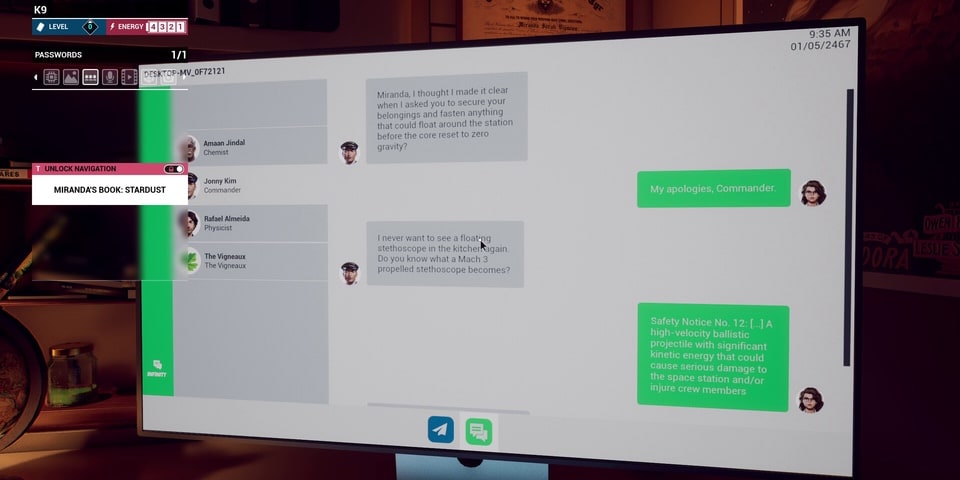
The puzzles almost work against the way the story is delivered. The acting is very well done, with the exhaustion of being on the station and the unravelling of each relationship really coming through the audio performances. The messages and emails are also well written and give such a good insight into those issues of isolation and the stress of being cut off so far from home, along with the pressures each character has experienced. The narrative is overall decent with layers slowly being peeled back to show exactly what the crew is dealing with, and there is a tinge of horror to some of those experiences.

