
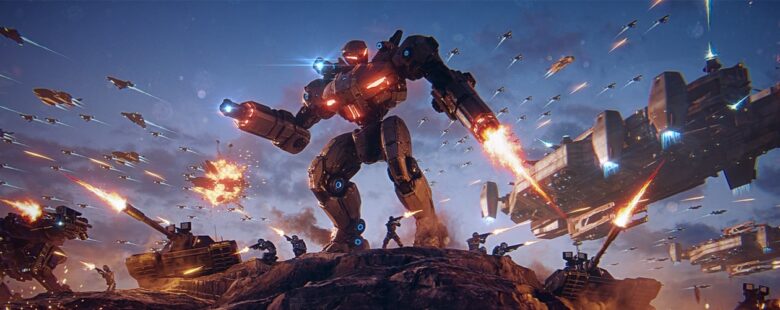
Ashes of the Singularity is a game that, in retrospect, I wish I’d paid more attention to last decade. My only real awareness of it was as a mainstay benchmark for CPU-limited gaming, but was a game that really followed in the footsteps of Total Annihilation and Supreme Commander – both games that I loved – to let you marshal vast resources and an endless churn of military production and might. Thankfully, here’s Ashes of the Singularity II to let me right this wrong.
Mankind stands on the brink – doesn’t it always? – as the Post-Human Coalition, the AI Substrate, and the resurgent United Earth Force, who are a new faction for this game, fight for their own future across the stars, battling across planet after planet for supremacy.
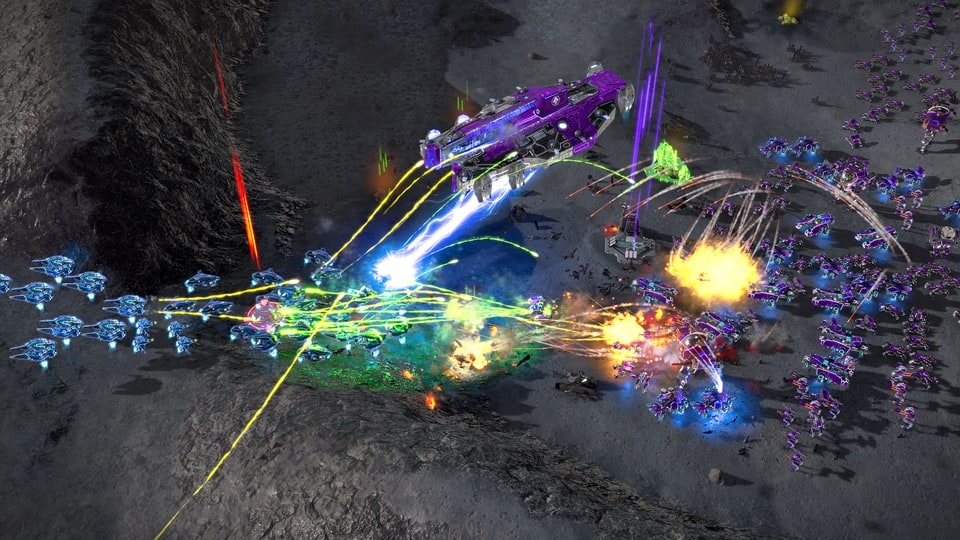
A decade on from that original title – fun horrible fact, it was also a decade between TA and SupCom, and that was almost two decades ago – Oxide Games has returned with a smattering of fresh ideas to revamp the grinding war for territory and control. Showcasing a mission in which the UEF has to stave off waves of the PHC forces attacking their colony, there’s an immediate clarity on the scale and scope of the battle before you. Pulling the camera right out shifts the units from 3D rendering to simple icons, and then switches from showing the terrain to showing territorial control on a topographical map. Zoom right in, though, and you can see the large numbers of individual units – though these units can be made out of multiple individuals – all unleashing an unimaginable amount of firepower, with neon beam weapons, splashy missiles and other munitions.
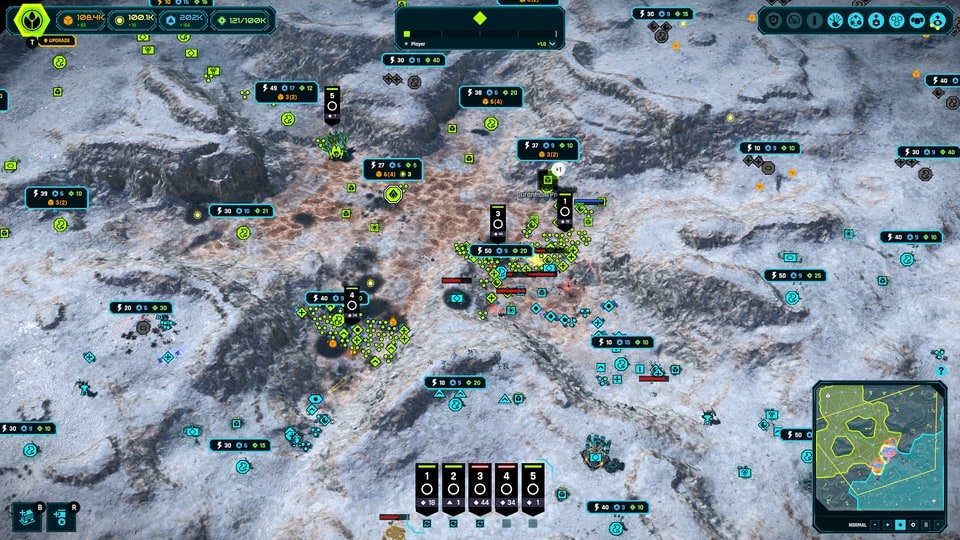
You’re nominally in control of all of this, but Ashes is a macro RTS, aiming to make you feel like you have oversight of this full theatre of war, as opposed to a tactical commander that is controlling individual units. To that end, Ashes of the Singularity II has introduced armies, which you form, send into battle, and then grow and reinforce. It’s similar conceptually to the simple control groups you have in most strategy games, but there’s more depth and nuance built around armies here. It’s the armies themselves that accrue experience and gain veterancy – similar to how real military regiments have certain specialities and traditions – and it has an designed configuration of units that you determine. As those numbers are whittled down on the front lines, you decide whether that army is expendable, whether you want to replenish it manually, or have it auto-replenish to ensure that is never truly falls. In a neat twist, armies will simply replenish from the nearest fabricators, so you don’t have to fuss with rally points and selecting buildings.
Whatever you choose will have to align with your economy – this a streaming economy that replenishes at a certain rate, as opposed to one where harvesting units gather and deposit. Overcommit on auto-replenishment and you can completely tank your Teridium supplies, stalling your defensive and building output.
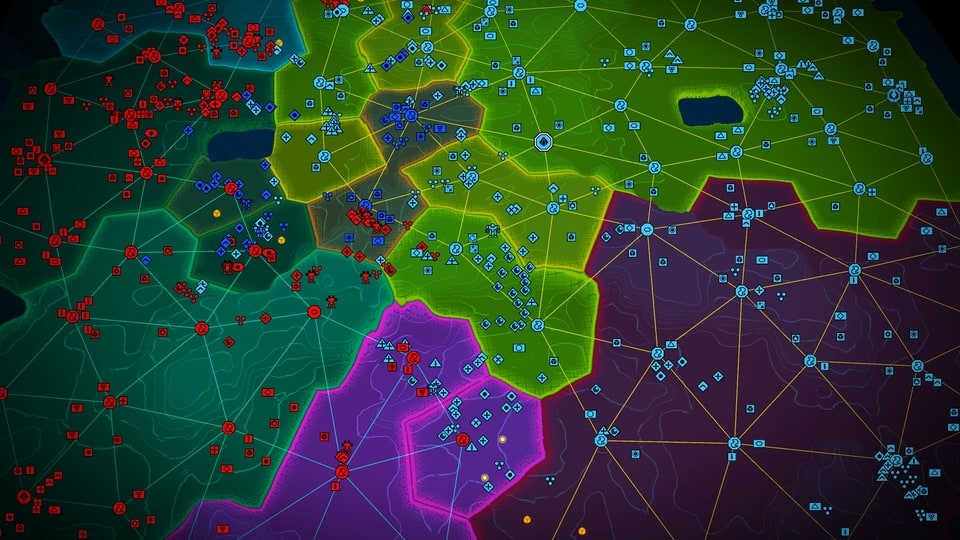
How big and how far you can grow all depends on the regions into which the map is broken up. Each one has a power limit, determining how many and what kinds of buildings you can place, though you can spend to upgrade a region, bolstering manufacturing there or enhancing your defensive turrets and emplacements.
Naturally, these defensive missions ramp up and up in difficulty and scale, but also in the type of challenge they present. The third wave here switched gears from a ground assault to a fully aerial one, the PHC sending throngs of hovering VTOL gunships, fast-moving fighters and sluggish but powerful bombers, building up to the Hyperion PHC dreadnought. If unprepared with the right kinds of ground-to-air units or without aerial units of your own, the UEF would falter at this point, especially as the Hyperion makes a straight line for the central HQ, which would signal complete defeat for the UEF if it’s destroyed, or to destroy key defensive structures like the Obliteratory artillery cannon, which can fire from 3-4 regions away.
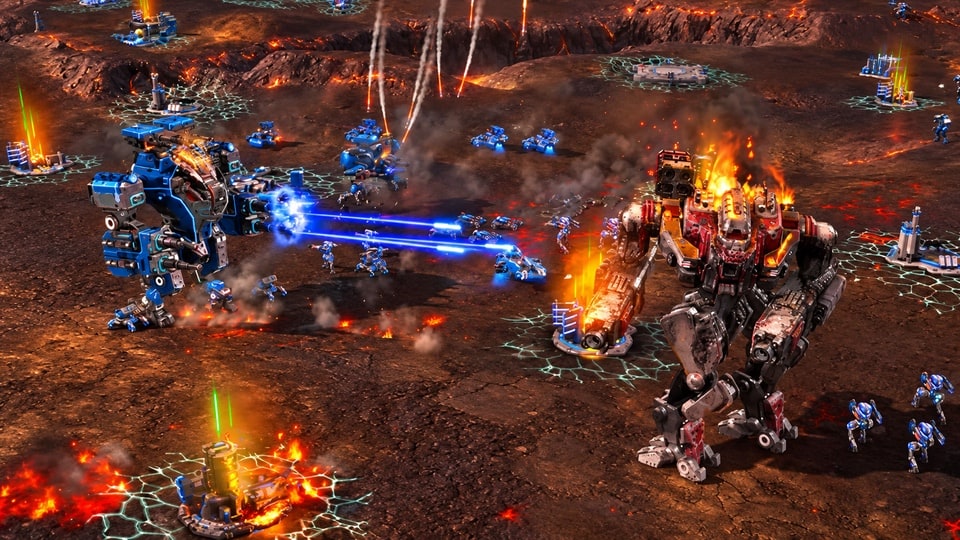
What’s not so handy for the defender is that the Hyperion comes with a massive health bar of its own. All the dreadnoughts do, in fact, whether it’s the bipedal stomping PHC Sovereign and its UEF Godslayer equivalent, the slow-rolling UEF Goliath which functions as a mobile barracks and forward production point, and more. When they appear within an attacking wave, you’ll obviously want to focus fire on them, countering and targeting their weaknesses. The Sovereign, for example, lacks splashy area-of-effect weaponry, meaning it can be bogged down by many small units, as well as easily targeted by orbital attacks.
This is really where the player can have a more direct and immediate impact, whether it’s an EMP strike to freeze enemies, troop drops, or powerful experimental turrets that will last for just a short time.
As the stakes ramp up in a campaign mission such as this, Ashes of the Singularity II will now let you pause the action, halting the game in order to issue commands, pivot your construction queues, rejig an army’s constituent parts, and more. You can do almost anything in this state, though some aspects, such as seeing the impact of an upgrade or ability, will need a tick of the game simulation to proceed.
That’s great from an accessibility standpoint, though this is already intended as a game that’s not too demanding from an actions-per-minute perspective. However, in addition to this, there are three difficulty levels for the campaign – relaxed (easy), engaged (normal), and Intense (hard). The campaign also has a distinct upgrade tree, which has plenty in common with the full tree for Skirmish and Multiplayer, but has been skewed and adapted to meet the needs of the narrative.
Jumping across to a skirmish and playing as the Substrate shows the clear divides between the three factions. The PHC compared to the UEF have units in fewer number but with better stats and capabilities, but the Substrate will play very differently with swarm units and expensive constructs – it’s a fairly classic trio. They also have a unique hero-like unit at the start of a mission, the Avatar, which can provide support on the front line or boost production back at base, but if it dies, it stays dead. They also have more of a web-like tech tree, and armies don’t gain experience, but can be overclocked to gain abilities temporarily – there’s long cooldowns, though, to maintain that macro RTS style.
Getting the balance between the three will, obviously, be key for keeping the game fun and entertaining online. Multiplayer will have unranked quick matches as well as ranked with ELO-like matchmaking. Personally, I’d be more interested in the stock skirmish mode, or custom matches with co-op against AI – and with procedural map generation as an option, that will keep things a little interesting.
I’m eager to dive into Ashes of the Singularity II, with its launch set for just a few weeks from now on 10th November. It’s got that epic scale that I love from its forebears, some neat presentational ideas – a radar system can add movement ‘heat’ signatures to the fog of war you see, for example – and it’ll be fun to see how well my PC can handle it, of course.
