

People sit up and take notice when there’s a big name like Cliff Bleszinski’s attached to a game. When they’ve led the charge on major franchises such as Unreal Tournament and Gears of War, whatever they decide to do next carries a lot of weight.
So there I was in North Carolina visiting Boss Key Productions, the new studio he’s co-founded alongside Guerrilla Games co-founder Arjan Brussee, to play LawBreakers. As you’d expect, it’s a very well thought out multiplayer shooter, and it stands out thanks to how it plays with variable gravity, but as we sat down to talk to Cliff himself (as part of a round table alongside Digital Spy), it was easy to diverge into many of the areas that LawBreakers’ development has drawn upon and other parts of the industry as a whole.
TSA: The obvious place to start is with the decision to go to a fully paid business model instead of free to play, and what it was that drove that decision.
Cliff Bleszinski: Just, you know, free to play still has a sleazy reputation with a lot of core gamers. When I announced the studio, they were like, “Nexon? Really?” and I’m like, “Hang on. they want to make Western games now, they have money to support this, so let them do that.”
[The core gamers] were then like, “Free to play? I was excited when it was Cliff and Arjan [Brussee – former Guerrilla Games & now Boss Key co-founder], and now I’m out.” And I’m like, “OK, but you play League of Legends and that’s free.”What happened was, as I alluded to earlier, all we were thinking about was how we were going to monetise this game. We weren’t thinking about how many cool verbs I can give that yield moments in the game, I wasn’t thinking about what kind of architecture this one level is going to have, I was just studying monetisation on Facebook, monetisation on mobile, monetisation in hero-based games with hero rotations.
How you monetise your game, there’s such a myriad of ways to do it these days, and so for us – not that it’s necessarily going to match the price point or the systems – but the closest thing that we like the most is Counter-Strike: GO. And Counter-Strike: GO is still going – Haha! – for a myriad of reasons. First because Counter-Strike is still one of the most airtight first person shooters ever made, as well as the fact that Valve have been grooming this garden and they’ve been planting seeds, but they started with a core great game.
It’s one of those things where if you have a small fee for entry – maybe $20-40, we’re not sure yet – and then have some interesting cosmetic monetisation within that, it doesn’t hurt gamers mentally as much as the $100 day one pack that then also has DLC on it. I mean, come on!
TSA: How does this affect your plans during development and getting it into people’s hands? Were you previouslythinking of an extended beta, which tends to be the case with free to play games?
Cliff: Let’s put it like this, it’s a very smart thing to have Early Access or have some sort of open beta, because you set expectations. Even saying it’s an alpha or having limited access to it.
When you monetise, there’s also big questions of whether you do it with pre-alpha, do it with alpha, with beta, with post-beta. The thing is that when you’re dealing with people’s real money and you reset the servers, they get real upset, real quick. […]
So how we do that’s going to be tricky, but every studio has a different meaning for what alpha, pre-alpha, beta and so on is. I got so tired of us arguing about it that we all agreed on our terms. The signs aren’t up right now because we’re not ready to expose the dates we think are available during the studio tours, but it’s up in front of the bathrooms. So you’re going to go pee here, but remember it’s going to be alpha, beta, what those dates are, estimated concurrent users, where we’re monetising, etc. and actually having a plan for that.
Digital Spy: You talked a little bit about the game modes in the presentation, but how are you going to make sure that they’re all unique and fresh, and feel really LawBreakers?
Cliff: For me it’s not just aping the standard CTF that other games have. If you look at Counter-Strike again, which I’ve been talking about a lot lately, I hadn’t seen a game at all like Counter-Strike before 1.6.
Unreal Tournament came out before Counter-Strike and it had Last Man Standing, which ultimately didn’t end with a crescendo. What it ended with was “Last Man Camping”, where you’d start of with 4 on 4, they’d fight and you’d be left with two people just going round the map.
You want your game types to end with a bang and not with a whimper, and CS was one of the first FPS to really crack that. Yeah, if you die, you’re out, so the stakes were already really high, but you also have the two bomb sites to plant and defuse for those hard win conditions.
We’re not emulating that game mode, but it’s one of those things with our game modes where we want to end with upsets, reversals, interceptions and all those kinds of things that I’ve learned from learning to love American Football and all those other sports.
I think by not just aping CTF or TDM or anything like that, that’s going to help us stand out. As well as, you know, the gravity, the characters and the look and the feel of the game.

DS: Are you having to think about that this could potentially be an eSport in the future and the way that you could develop that?
Cliff: Everybody just wants to talk about eSports!
What happens with every game now is that everyone says it’s going to be an eSport and they’re putting the cart before the horse. That’s like saying, if you have a son or a daughter, that they’re going to be a doctor or lawyer when they’re five. You don’t know that and where the course of their life is going to take this person.
TSA: Is it dangerous to heap those expectations on a game like that?
Cliff: I think the key is to, in the back of your head, hope you’re going to have that eventually, but to then groom your community and to foster it as well as having a level playing field for people in the wild, which is why we’re doing cosmetics and not having a hero rotation.
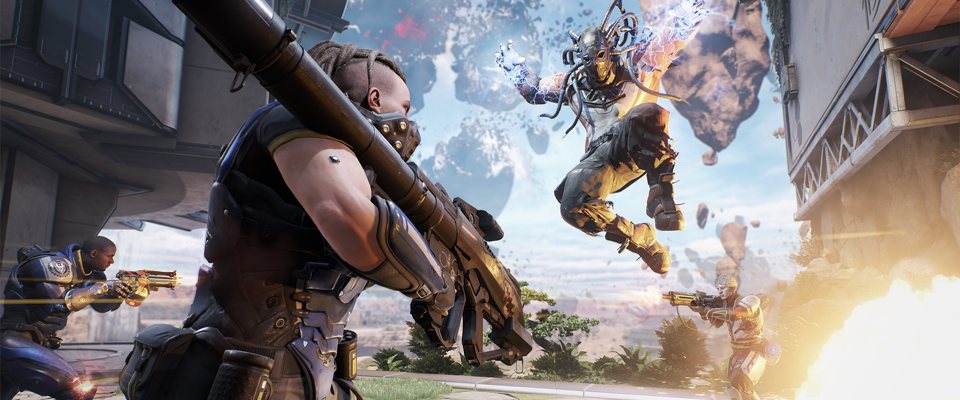
The key for me with this game is to start with verbs for all the different characters, and verbs that lead to moments. I joke about the whole Mad Libs thing, where you’re filling out the different, “And then I did _____, and then I did _____.” You can take the collection of tools that we’ve given you with the various characters and their abilities, from their melee and their movement, and then we’ve added the wacky gravity.
You wind up with these great moments where people are tumbling with gravity, they’re falling off the map and then getting back on, they’re knocking people down on the ground, jumping into them with a leap, then growing really big and electrocuting people! All these kinds of things that you can just keep describing over and over again. Even at the office, after a play test, we send around lots of animated gifs of crazy stuff that happens, which to me is a really good sign, and which you want for Twitch and Youtube.

TSA: How much of this has evolved quite fluidly from creating the characters and seeing how they interact, and how much is by design?
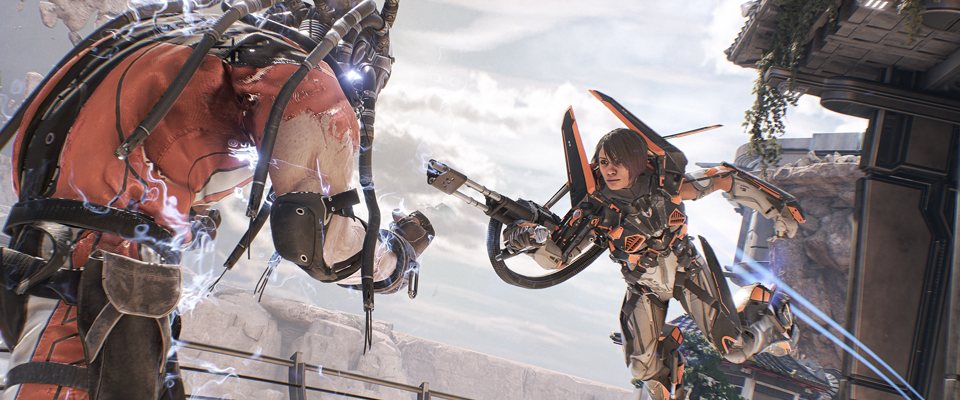
Cliff: Well, there’s the characters and the character’s abilities. A character should generally do what they look like they’re going to do. You look at the two jet characters, Maverick and Toska. Maverick looks like an airplane, Toska looks like a fighter jet, and that was the goal.
What do fighter jets do? They have gatling guns, they can fly through the air. There’s the little energy pockets which are a little funky, but it proved to be really fun, because she’s able to navigate that and send everyone up into the air.
You look at Chronos and Bomchelle, and they look like larger characters that can get even bigger, and then they have lightning going around them – so of course they can do the Emperor Palpatine hands – and they can do the kind of Hulk smash leap. Those are our Hulk archetypes.
Actually, think about the archetypes of our characters – and I haven’t really thought about this in a while – but in many ways, Kitsune and Hellion are kind of like assassin Spider-Men, Chronos and Bomchelle are kind of like the Hulk, Maverick and Toska are kind of like Iron Men…
There’s a reason why Marvel and DC have their own versions of this one hero or villain. So you look at what the characters look like they should do, derive the abilities out of that and throw in funky gravity stuff. That’s the overall mosh of what we’re doing.
TSA: Speaking of the characters and this being a hero shooter, would you call LawBreakers a hero shooter?
Cliff: That’s the joke. My Cliff-speak of marketing is that it’s the “anti-hero shooter”.
TSA: Yeah, because when people see that something’s being called a hero shooter, they’re going to think of a huge cast of characters, because that’s what’s happening elsewhere…
Cliff: The thing is what’s happening in that space with those games is that their biggest strength is also, in my opinion, a weakness. As much as I really enjoy playing Overwatch, right from the get go, there’s like 15 characters, and I’m like, “Can I just have a tab to sort the shooty people, then the melee people and then the wacky people?” Let me start with the shooty, then go to the melee, then the wacky.
They did a good job of generally having the characters look like what they should do, but for me it’s a bit much. I’d rather start with a core of maybe six or so, for the alpha or beta launch we have, as a rough guesstimate of what we might get to. Then every quarter introduce one which comes out at the same time on either side, that everybody gets as well as the new maps, so we don’t fracture the player base. Just build up to that over the course of a year or two, to the point where then we have, I dunno, fifteen on either side.
If this is going to be a living product, we’ve got to walk before we run – we’re a start up, so we have a limited runway. The game was actually asymmetrical at first, but we decided to make it symmetrical. Visually and narrative-wise, it’s asymmetrical, but gameplay-wise we made it symmetrical because we look at what it took to make out anti-heroes with weapons that have alt fire, movement modes, different health, different movement speed, the regular and the ultimate ability… There’s a lot more to it, and then we have to figure out a layer of progression systems around it as well, which we’re planning but we’re not ready to talk about too much today.
DS: It seems like you’re trying to make it more accessible than some of the other shooters on the market.
Cliff: Yeah, I mean, just a little bit more tangible. What’s happened is, and I dunno if it’s the cosplayers being the tail wagging the dog, but a lot of these characters just look kind of ridiculous!
It’s like, I tease Randy [Pitchford – Gearbox] like, “A sentient mushroom? Really?” Do I want to dress up as a mushroom at a costume party?
TSA: [laughs] It depends how much you like mushrooms…
Cliff: Yeah, right? I want to dress as Drogon the Dragon with my wife dressed as Kahleesi. Those are archetypes that I think are a lot more compelling.
With the internet watching all these games, people are trying to make games that are so out there and wacky, and I want to try and make something that’s a little bit more dialled back and has more of the archetypes that we know and love from Hollywood, essentially.
TSA: Talking about bringing it to a more realistic and gritty art style…
Cliff: Well, ‘gritty’ is a dangerous word, because when you say gritty, you picture visceral graphics. You know, Doom looks gritty, and we’re not the game where you’re… ripping people’s eyeballs out and sticking people’s heads up their asses.
TSA: [laughs] But I just want to bring it back to the presentation earlier, where you said about the “brownification” of games. Do you maybe regret that there was this brown period of games, because Gears of War led the charge?
Cliff: It always bothered me, because it’s an art style. You wouldn’t go to, what’s a good example? Oh, the Zack Snyder example. “Oh, 300 is stupid because you chose sepia tones!” You know? Or this one fashion designer’s silly, all their dresses have the bands on them and I don’t like like the bands.
Well that’s a stylistic choice that was deliberately made that dictated an entire generation of games, which was largely led by Jerry O’Flaherty, who was my old art director on Gears.
I look at Unreal, that was developed with colourful lighting and beautiful environments that were largely intact, because Quake was dark, brown dungeons. Then Gears was developed as a desaturated Band of Brothers, because we were tired of working on the bright colours of UT. Now we’re at the half way point, where we have a game that’s slightly stylised, somewhat realistic, has just enough colour that it’s attractive but not gaudy, without being depressingly grey and devoid of heart.
DS: What are you thinking of Gears of War 4 so far? I saw you reacted to their story trailer.
Cliff: Yeah, so it really actually moved me, because Gears for me, although it’s a shooty, shooty game about big dudes and lizardmen with chainsaws, Gears for me has always been very personal.
Some of what I pitched with Rod back in the day is still in there. The fact that, you know, you have JD as Marcus’ son and things like that. And years later, JD has inherited what I believe is some of the mess that his dad tried to clean up. Gears has always been about family and a little bit of daddy issues, you know? Like, Dom was essentially a brother to Marcus, and so from that…
You know, I have a lot of faith in Rod. Rod, he got a f***ing tattoo of the Crimson Omen on his body! That’s hardcore!
Me? I’m more like the rolling stone that gathers no moss. I’m onto the next. If I had to work the next Gears, I’d probably go crazy. I respect it, I’d do it if I had to, but even right now, I’m already thinking of another game idea that’s been stirring in the last few months.
With what LawBreakers is, you know, there’s a lot more to do […] but, by and large, what this game is, the core is there. So half or maybe even 60-70% of my work is just done. I already want to get on to making another world.
TSA: So you don’t see yourself sticking with the same property for quite so long?
Cliff: Well, if this game does well and becomes a living product, then I’ll absolutely be involved and give feedback, but when it comes to making new worlds… Even if we don’t have the ability to make a new game, I’m gonna wanna get a deal to do some sort of graphic novel about something. I like creating characters, worlds and settings. It’s what gets me out of bed.
DS: You’ve always been an active supporter of Oculus, but is that something you’d want to do in the future?
Cliff: I’d consider it. There’s a few things about VR: the launch has been clunky, the price point’s too high, getting it set up and installed is a problem, as well as the fact that most of the games don’t feel like real games, they feel like fifteen minute demos that were done as a proof of concept and maybe they should have combined together in some sort of WarioWare experience.
That said, I still think it’s magical and I still think that in a year or so it’s going to flourish and become mainstream. It’s just not yet. Maybe I’ll dabble, we’ll see!
Thanks to Cliff for sitting down and talking with us. Check out our hands on impressions from the preview event, and you can see it in motion in our video preview as well.
We travelled to North Carolina and visited the Boss Key Productions studios for the purposes of the preview and surrounding content. Travel and accommodation for this event was provided by Nexon.
bunimomike
Good interview, guys. I’d like to slap the word “like” out of his mouth but great to read, nonetheless. :-P
Stefan L
He might not like that…
bunimomike
I see what you did there. Meh. *folds arms* :P