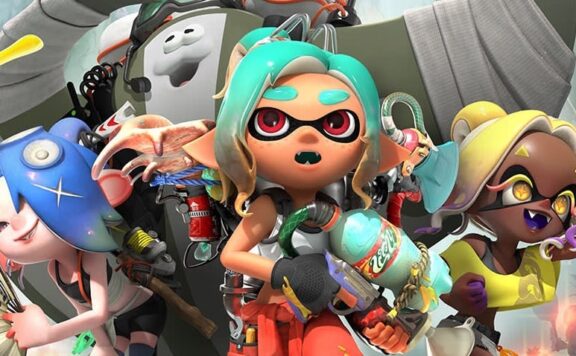

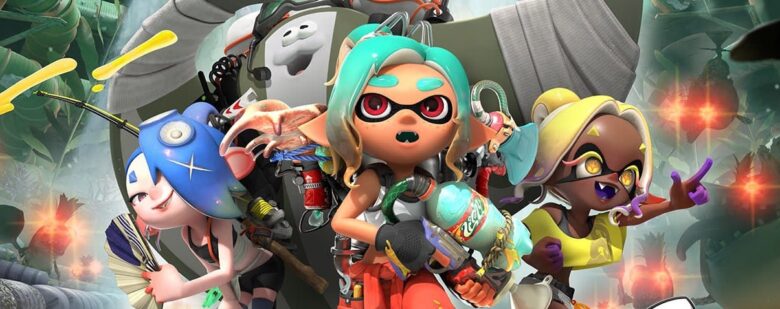
The pop idol trio of Deep Cut might be best known for their attitude-filled stage antics (and Big Man’s thoroughly loveable nature), but Splatoon Raiders brings their insatiable treasure hunting back into frame. And when you’re a pop star with cash to splash? Well, you can just hire a chopper and head out to the ocean on the hunt for Legendary Loot. It doesn’t quite go to plan.
They, and you as their pilot, find themselves gobbled up by a huge storm in the Spirhalite Islands, forced to fend of Salmonid and scavenge for tools and gear just to survive. OK, so you’re doing most of the work as The Mechanic, but this pop idol trio do chip in once you find a dinky little treasure scanning, crystal drilling robot, and they will summon giant creatures and abilities to help you every now and then.
Their drive to secure more and more loot never wavers, though, and each island of this spiral archipelago builds up to give more clues as to what might lie at the centre, drawing them along as they assume a giant cache of golden treasure awaits.
While multiplayer has really been the keystone for the Splatoon series so far, it’s been interesting to see how Nintendo has experimented through both the main games and their DLC expansions. Splatoon Raiders builds in a different direction, so that the solo experience is much more than what feels like a string of abstract missions and weapon tutorials.

There is still an element of that, it’s true, with dungeon stages seeing you dig down to multi-levelled subterranean battle arenas and facing off against big waves of Salmonid, and then there’s the more puzzle-like missions and hidden levels, but a good chunk of the missions here feel like you’re moving through the world, visiting distinct biomes as you go. It’s familiar, but the tone has shifted just a little.
The enemies you face also start off very familiar to anyone that has played the co-op Salmon Run mode from Splatoon 2 and 3. The various boss Salmonid return, from the tower of cooking pots that is the Stinger, to the armoured Scrapper that putters along, missile launching Flyfish and beyond. Some of their behaviours have been tweaked – you can just shoot the Flyfish to take them down now – and there’s a smattering of new additions, but then there’s further evolutions that take these existing ideas and beef them up in extreme new ways.
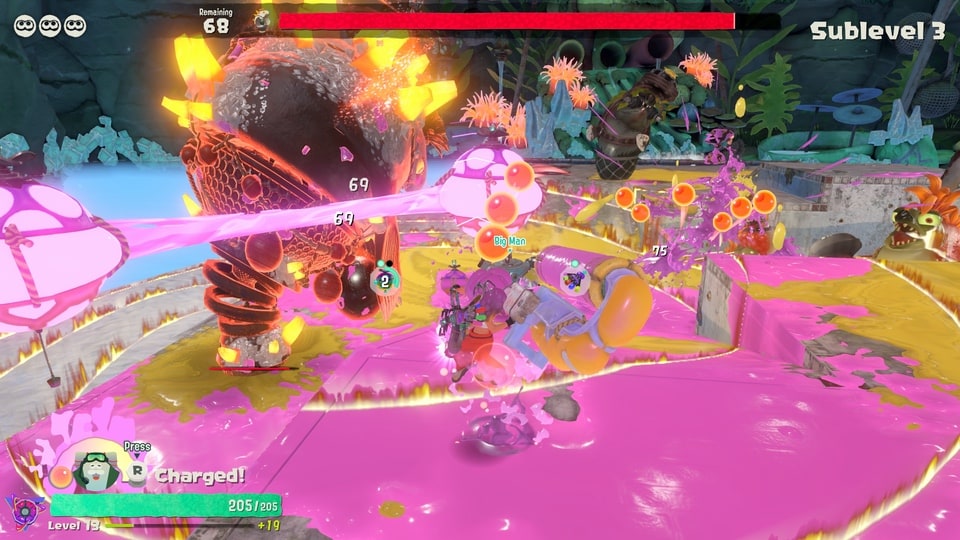
Battles can get chaotic, to say the least. Dungeons in particular need you to earn enough power from defeating enemies within a time limit to drill down to the next stage, and as the Boss Salmonid spawn en masse, all unleashing their specific attacks, it’s screen-filling carnage. Getting out the other side is often a real seat-of-your-pants battle.
You’re given a lot more control over your character’s loadout in Splatoon Raiders in the style of a looter shooter, mixing and matching weapons and abilities as you see fit, and then levelling up and tweaking your player build further to meet the challenges you face. You have a wide array of weapons that are very familiar on the surface level – Splattershots, Rollers, Dualies, Brellas, Brushes, and all the rest – but which have been redesigned with a new scavenged parts look to them. A Brella that’s half palm tree, Splattershots that use a soap bottle for ink, a Slosher that looks like a beach bucket, it all ties in with the scavenged look and feel of our shipwrecked heroes and the trawler that they’ve build from floating scrap.

But where Raiders diverges from the previous games is that the gadgets aren’t tied to specific weapons and developer curated loadouts. Now you have three backpack Ink Tanks to choose from, each of which comes with its own suite of unlockable gadgets for a particular playstyle. The Power Tank initially has a Splatchet gadget to leap in and give an almighty swipe of ink, but soon can summon a ring of Splatelites to revolve around you or a Spinwheel to send off in a certain direction. The Speed Tank is much more about getting in and out of danger, while the Tactical Tank brings turrets and similar placeable gadgets.
Each gadget can be further customised with attachments to simply ramp up the power or change how they behave. Turrets can auto-place whenever it’s ready and you shoot an enemy, or gain extra sprinklers for a bit of local control, the Blast Boot can add explosions both as you take off and as you land, and plenty more. And you can then add Relics to the loadout (and some weapons have relics applied too), which increase movement speed, health recharge, make grabbing Power Eggs easier, increase your damage when in danger.
There’s layers upon layers to the customisation here that really feels rewarding. You can find yourself quite a bit under-levelled for a mission or facing a very specific challenge and enemy type, but through switching weapons, changing Ink Tank, and checking that you’ve optimised your loadout, you can then do a lot better on a repeated try. Another factor here is that, even if you die and are bounced back to the ship, you keep any gear and gadgets you’ve found, any experience you’ve earned, so every attempt will gradually make your character better equipped. Doubly so if you’re circle back around and taking on the toughened up Spicy versions of levels.
And if you’re truly stuck (and don’t fancy changing the game’s overall difficulty setting) you can always call for help. While this is intended as a single player game with no competitive multiplayer, co-op is still an option. When selecting a mission you can ‘Call for Help’ once every 30 minutes (if you complete the level) and anyone that’s queued up to ‘Go Help’ from the map will be able to join you to chip in. Alternatively, you can buddy up with friends locally or online.
That’s going to be a great way to play as you get into the endgame, after the credits roll from the main story, as the difficulty ramps up even further. It really feels like the kind of endgame from an MMO or looter shooter, as you can hunt for that perfect build and team and set your sights on defeating a particular dungeon and challenge.