
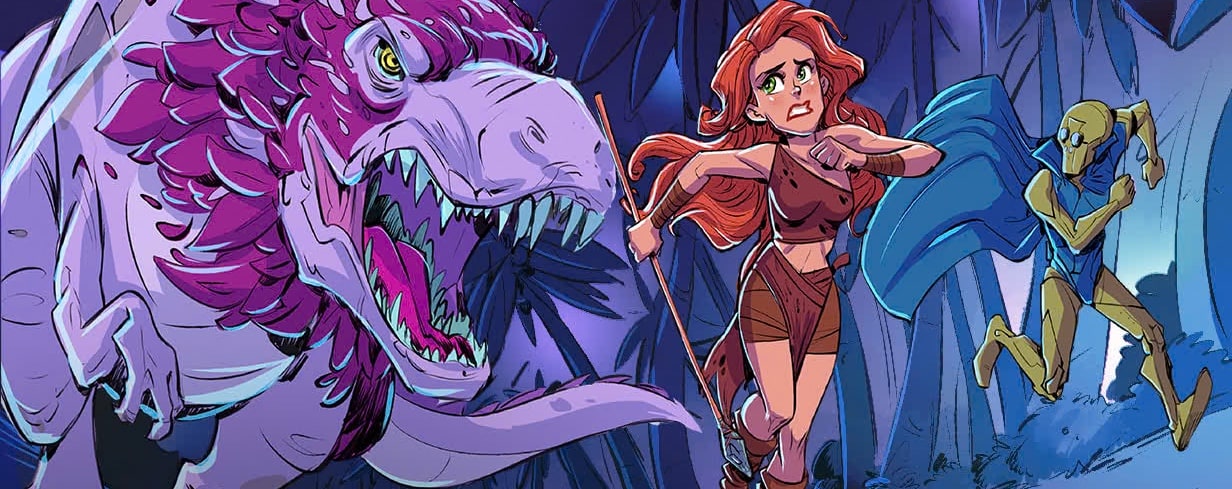

Games are such wonderful vessels for storytelling that it’s always exciting to see the different ways developers can approach narrative and character. While some go for lengthy descriptions and others entertaining dialogue, Theropods is the latest to take the ultimate minimalist approach and have an entire game with no spoken or written language.
Following in the footsteps of games like Planet of Lana and Samorost, this point and click adventure is entirely carried out through contextual and environmental storytelling. This is particularly interesting for this genre, as it is an evolution from the old text based adventures that I enjoyed back in the relative Stone Age of computing. Longtime fans of the point and click would have seen the development from text parsers to graphic interfaces with verb options and now an entirely contextual system.
The aforementioned Stone Age is especially relevant here as Theropods takes place in a (completely ahistorical) prehistoric timeline where man and dinosaur both share the planet. This anachronistic approach is forgivable as the game is clearly playing fast and loose with time and space rather than being a creationist museum affair. The opening cutscene sets the traumatic nature of this environment as your small child protagonist sees their mother devoured by a T-Rex. I wasn’t expecting such a brutal beginning and later scenes continue this savage tone – albeit always mixed with a deft sense of humour.
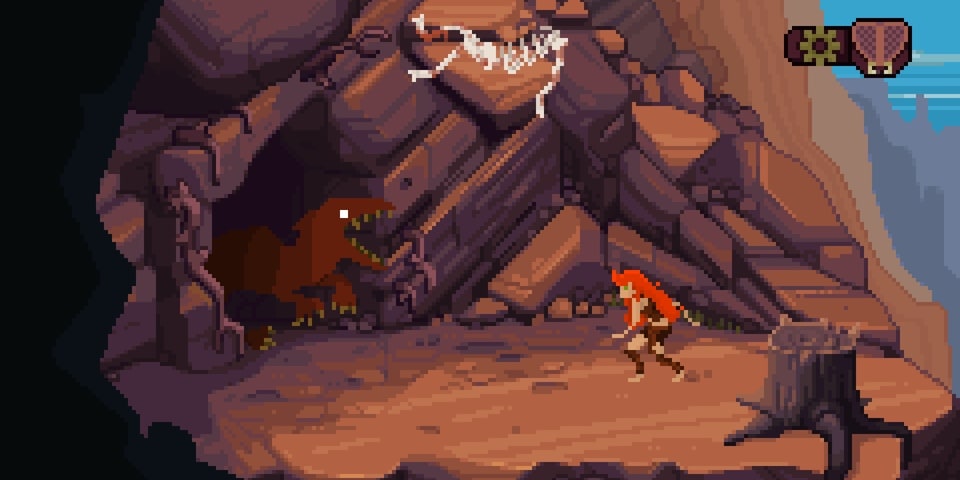
Visually, Therapods employs a lovely, heavily pixelated art style that has genuine character and manages to depict emotion and action despite the apparent lack of detail. Backgrounds are colourful and well-designed whilst interactive objects are easy to pick out (with a welcome highlight button if required rather than pixel hunting). Your cursor changes to match whatever item you are interacting with and everything is really clear to parse throughout. One thing to bear in mind, however, is that there are times when you need to ‘use’ another character, so look out for when they can be treated similarly to objects.
While not an especially long game from start to finish, there are plenty of puzzles that will prove to be entertaining roadblocks along the way. An early multi-step puzzle sees you coordinating several characters and objects to try and hunt a Parasaurolophus, setting the scene for some complicated and rewarding situations. Partway through you’ll be introduced to a second controllable character and there are some lovely puzzles that involve switching between the two.
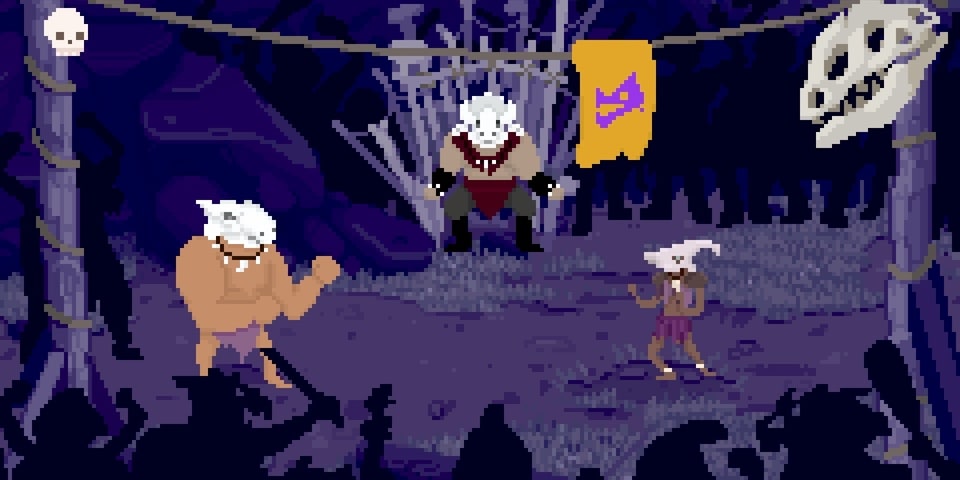
There is a surprisingly dark tone to a lot of the events of the game, with savage predators and marauding barbarians aplenty. As might be expected, the T-Rex is the primary antagonist with some spectacular returning set pieces, but other, more human enemies can be just as lethal. Despite the danger, mistakes you might make commonly result in near misses rather than game overs, so experimenting is still encouraged.
I went into Therapods expecting an entertaining point and click with a retro style and a storyline straight out of a 1970s creature feature. What I found, however, was an emotional narrative about family and loss that manages to tell a fantastic story with no words. The lack of dialogue draws closer attention to environmental and gestural storytelling and Therapods offers up a mix of tragic and funny moments and situations.