

After a long run, the Naruto series looks to be nearing its end. After almost 700 chapters, the manga’s finale is in sight, and soon after its anime and video game counterparts will have no fresh material to work with. The last Ultimate Ninja Storm game released took Naruto’s gaming audience up to the end of the Shinobi World War arc, meaning that little untouched story remains. In the same vein as the anime and its infamous fillers (non-canonical episodes), Revolution steps away from the final story arcs of Naruto’s main plot and attempts to create something different, yet equally satisfying.
The problem with Revolution is that it isn’t quite as satisfying. The experiences in the main instalments: the story, the battles – boss battles in particular – fail to be matched by the alternate game-modes in Revolution. The series usually revolves around 1v1 battles in a circular arena, where two ninja (or sumarai) battle it out with the help of team-support. In its main game-mode, Revolution adds a second form of battle, where the health bar is replaced by collectible orbs that are released upon being damaged, and four players must fight at once. After the timer runs out, the player with the most orbs wins.
It sounds like a good idea at first, but with four contestants on-screen, and the huge roster of 100 characters, the battles quickly lose any trace of balancing or strategy and become a clumsy free-for-all. In lower tiers, which must be completed to progress, CPU fighters will often stand idle, until provoked. In higher tiers, CPU fighters gang up on the player with the most orbs (the number of orbs dropped is scaled with the number held), meaning after a good round, this can lead to an inescapable pummelling, or attacks being constantly interrupted by the series of enemies and obstacles that get in the way.
The novelty of this mode wears thin when the first tier is completed, and it becomes painfully obvious that the dialogue is virtually identical in the tournament cutscenes for each of the five tiers you can unlock and play through. Outside of the tournament battles, the Ninja World Tournament offers little of interest. The player can make friends with other ninja (and add them to their team) by performing menial tasks or defeating them in combat. These missions are a tad dry, however, and end up feeling like more of a chore on the road to completion than a worthwhile side-mission.
After the first tier has been completed, a secondary form of the NWT mode is unlocked: Mecha Naruto mode. Surprisingly, this mode makes a return to the format of previous story-modes, with cutscenes and a continuous plot. This alternate story, set in the (still non-canonical) world tournament timeline, follows the events around a new character called Mecha Naruto. Although this mode is more akin the older games’ story modes, it doesn’t have their level of appeal. Instead of being a display of good writing, Mecha Naruto mode fails to create a compelling story and relies on tired clichés from the Naruto series. It has a couple of amusing lines of dialogue, but not enough to stave off boredom and the compulsion to skip the majority of cutscenes is high.
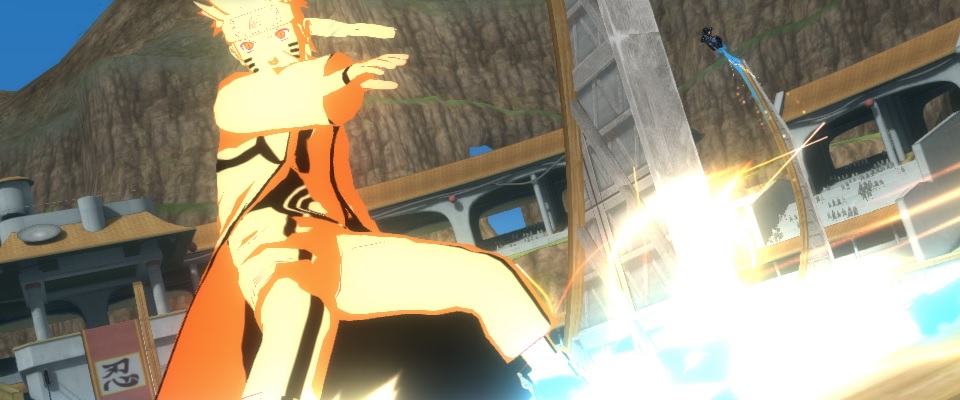
The other story-esque mode that Revolution offers, named Ninja Escapades, remedies this somewhat. Ninja Escapades is comprised of three episodes: two around 30 minutes long, and one extended cutscene of around 5 minutes. The first escapade contains a handful of fun fights, separated by some of the laziest writing of the entire series, while the second offers a compelling 30 minutes of play that builds upon aspects of the main story. It’s a peek into what Revolution could have been if CyberConnect2 had focussed their efforts into a single one-player mode, rather than stretching themselves too thin and delivering a selection of incomplete attempts.
In spite of its disappointing new game modes, Revolution remains a good game. The main point of any Naruto game is the fighting, and the tried and tested 1v1 battles in Revolution are as good as ever. The standard fights retain their simple, yet effective fighting mechanics that have been fine-tuned throughout the series, but with some new twists that revolutionise battling. Most notably, awakenings, ultimate jutsu and the support gauge have all been separated into their own Team Type. At the beginning of a battle, teams choose their specialisation and forsake the other two abilities.
By separating team-types, the game allows players to tailor each fight to their own play-style. In previous instalments, certain characters could grow boring after a few uses, but by introducing different ways to use each character, even the most basic of fighters will have some variation. Due to the enormous roster, however, many characters will still feel unplayable, especially against the more broken characters. This is possibly the biggest flaw with Naruto, seeing as it is, first and foremost, a fighting game: the range of strength in its playable characters is unacceptable. There’s no scoring system for strength; there’s only trial and error and an online mode plagued by the same few fighters.
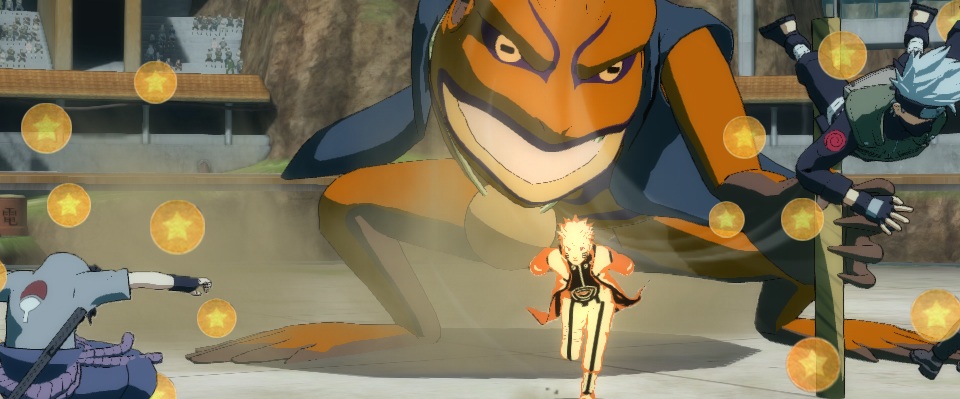
One of the high points of the UNS series is how true it stays to the source material. Every character plays exactly how you would expect them to, and all non-canonical characters and costumes were designed by the series’ writer/artist, Masashi Kishimoto. The visual direction of the game as a whole sticks firmly to the style of the anime, making each battle, oversized explosions and all, feel as much like a scene from the show as it does a fight from the game.
It’s not only Revolution’s visuals that do it justice – the game’s soundtrack flows perfectly with visual style, taking themes from the anime and bringing back tracks from previous UNS games. The game’s design pulls together for a fluid end product that is excellent not only by itself, but as a representation of the Naruto franchise.
What’s Good:
- Improved fighting mechanics, including team types.
- Tonnes of fan-service.
- Attractive visuals, especially in 1v1 battles.
- A ridiculous number of playable characters.
What’s Bad:
- Too many disappointing single-player game modes.
- Character roster is terribly unbalanced.
- New fighting mode is better in theory than in practice.
Naruto Ultimate Ninja Storm Revolution feels rushed. Every game mode feels incomplete other than the Free Battle mode, and much of the new content feels poorly thought through. The game’s fighting and visuals – its key selling points – remain as good as ever, but these small improvements don’t make up for the array of half-baked ideas it attempts to realise.
Revolution has failed to take a step away from the shadow of UNS3, and will have to remain all that it looks to be: a filler while we wait for the final main-story instalment.
Score: 6/10
Version tested: PS3