

Although Blizzard’s Hearthstone continues to maintain a chokehold on the virtual card-game genre, its unyielding popularity has done little to stem the flow of competitors. From straight-up copycats to the truly innovative, each one has desperately tried to snare just a fragment of Hearthstone’s burgeoning player base.
Ascribing to the latter group of rivals is new kid on the block, Earthcore: Shattered Elements. With its unique approach to gameplay, stylised presentation, and focus on story, it’s more than just a pretender to the throne.
Naturally, straight off the bat, comparisons can be drawn between Earthcore and Hearthstone. Both games feature a stunning level of detail that helps to immerse players in a fantasy setting, overrun with gallant heroes, menacing villains, and wondrous exotic creatures. They also share the same out-of-match features, including quests and crafting.
Despite these similarities, it needs to be pointed out that Hearthstone wasn’t the first game to break new ground in these areas. For years now mobile and tablet devices, along with PC, have cultivated an expansive stable of virtual card games. Although it succeeded in bringing the genre into the mainstream, Hearthstone is by no means its sole pioneer.
Comparisons between the two games come to an end whenever a match is in session. A number of design aspects, such as layout, turn structure, and the cards themselves, create a gulf between Earthcore and most of the card games many are used to playing. Although a little confusing at first, it’s easy to appreciate just how unique and experimentative Tequila Games have been in their approach.
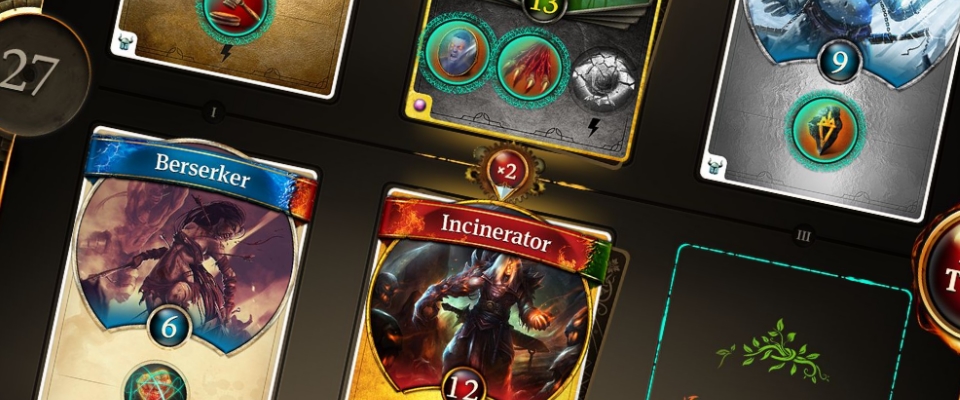
Every match is broken down into phases, each one resolved after players have taken turns placing their cards in the three allocated slot before them. Regardless of how powerful a card is or whatever unique abilities it may harbour, there is one fundamental rule in Earthcore that remains a constant throughout the game. Fire burns Earth, Earth absorbs Water, Water extinguishes Fire.
It’s basically a more complicated version of rock, paper, scissors. If your card has the elemental advantage over the one opposite, the “Risk” value on that card will be deducted from its owner’s life points. Get this score down to zero and you’ll achieve victory.
Where things start to get a little more complex is the cards themselves. Aside from varying in terms of their Risk value, many will come equipped with abilities that can potentially turn the tables if in need of a sudden comeback. These typically include abilities that cause direct damage to players, as well as those that move cards between slots and even change their given element. The more you play Earthcore, the more of these you’ll come across, whether unlocking cards in the campaign or buying them from the store.
As in just about any virtual card game, booster packs can be purchased using either in-game currency or real cash. The latter option is always quicker yet frugal gamers can still get by, especially if they’re willing to put a fair amount of time into Earthcore.
At this moment in time, Earthcore is definitely my preferred virtual card game. Hearthstone may have the existing lore yet its gameplay is largely derivative of pre-existing TCGs such as Magic: The Gathering. There may be an initial learning curve to overcome, though, in the grand scheme of things, Earthcore is actually very approachable and doesn’t require a laborious amount of deck-building. If you have an iOS device and Hearthstone wasn’t your cup of tea then definitely give this a try.