

While we’ve got some pretty great educated guesses thanks to the various Mars landers and all the information they’ve sent back to Earth, there will still be an element of stepping into the unknown for the first humans that might eventually reach our scarlet neighbour. We might find untold wonders beneath the surface of the planet that challenge our very conception of science up until that point. We probably won’t, but we might.
Coming to PS4, Xbox One and PC on 15th March, Haemimont Games’ Surviving Mars is all about creating a colony on Mars in a fairly realistic fashion, but they’re sprinkling the game with a little of the trademark humour that they showed through their time developing Tropico. There’s mysterious things that might start happening and weird wonders to discover as your colony grows, potentially threatening the populace or giving you a fantastic opportunity to thrive.
The choices you make when starting your colony can have a deep impact on how the game unfolds. Choose the USA, China or SpaceY – I wonder who that’s referencing? – and you’ll be flush with cash, have multiple rockets and plenty of resources to get going. Add a rocket scientist, a hydro engineer or ecologist to command the expedition, and they’ll have meaningful improvements to what you can find on the planet. Alternatively, you can do what I did, much to the initial dismay of Haemimont’s CEO Gabriel Dobrev, and you can choose the Church of the New Ark and have them led by an Oligarch. I had fewer rockets, but all of my colonists would now come with the religious trait and the birthrate would be doubled, as they seek to populate the planet like a bunch of evangelical bunny rabbits. Picking a landing site, this gave me a difficulty bonus of between 180-300%…
My couple of hours with the game definitely had more of a survival slant to it than the others playing, so it was pretty good to have Gabriel there to guide my hand in setting out the foundations of my colony. The first rocket can land with whatever you want it to contain, really, but you won’t have any people on board. Instead, it’s the job of some seriously adorable drones to do the initial heavy lifting, setting up water, energy, and other resource gathering operations in order to give the colony an air of self-sustainability. Also air. Air is quite important.
Especially because I couldn’t just throw resources at the problems before me, I had to get to work building a compact starting base around my drone hub, with solar panels tightly packed together, a moisture vaporator to suck in what little moisture there was from the atmosphere right next to a fuel refinery so I could send my rocket home for a second wave of supplies. All of this has to be connected directly with pipes and electrical cables, giving the game’s colonies a rather distinctive look and feel to them that goes beyond being Sim City in space.

The game plays really quite well on PlayStation 4, with the controls fairly easy to pick up and play with. There are a few quirks to navigating some of the menus that Haemimont are still working to iron out, but getting access to the building menu or manually overriding a drone’s controls becomes fairly intuitive after a while.
On a number of occasions, I found myself on the limit of what I had available. First it was the need to build a battery to keep buildings running overnight, and even then I had to turn things off selectively once I built the concrete extractor. Then it was trying to figure out what I could afford and fit onto the rocket as it returned from Earth with supplies.
One brilliant moment came right at the end of my session as we’d scanned the surrounding area and found water that I could drill for. The only problem was that it was well out of range of the drone hub, and so we had to come up with an elaborate plan to send the RC Transport over to a good spot, drop off the necessary supplies for a drone hub, solar panel and short cable, and then manually take a freshly charged drone out of range, repeatedly overriding its programming and forcing it to build the hub. It was a fantastic little success story to end on.

By this point, I already had a dome in which my first few colonists could live. You have a degree of control over who embarks on the voyage, as you can filter a pool of volunteers by age, specialties and personality traits. Of course, everyone here would be strongly religious (and anti-contraception), and in keeping with my dumb starting choices, I then decided to filter for sexy gamer nerds on top of this – I came remarkably close to finding one, actually. More important to start with is their professional specialisation, such as science, engineering, botany, and you need to decide what you need to lean towards. You can worry about how the hypochondriacs interact with the hippies and party animals later on.
With self-sustainability in mind, you’ll really want to grow your own food and start researching so that you can eventually have something worth selling back to Earth. Fascinatingly the tech tree is partially randomised, and though you’ll eventually unlock all of the technologies in most categories, the Breakthroughs category will only feature a third of those in the game, emphasising the potential new discoveries that life on Mars can bring, such as allowing seniors to still work and have children, making them remain a perfectly valid option for colonists.
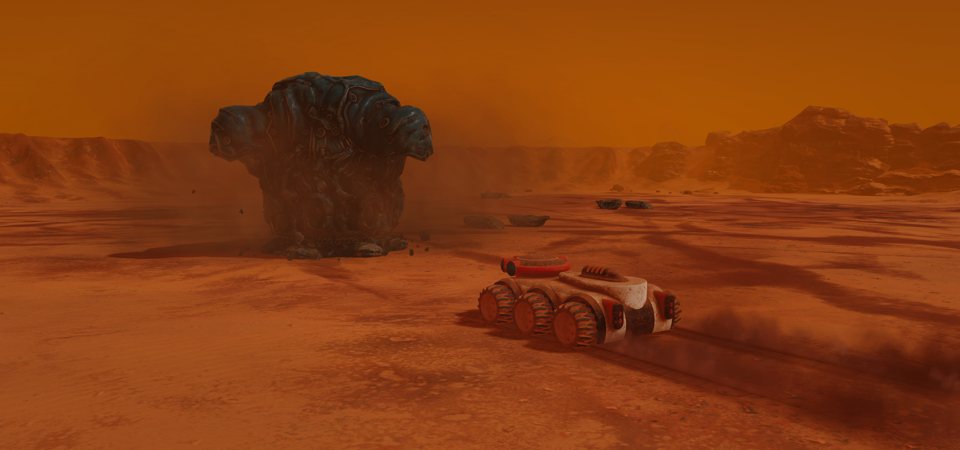
That ties into the newly announced Mysteries, with everything from weird cube-like things to floating bubbles and confounding invisible afflictions. Alas, I was so busy coming up with ways to get my colony just barely running that, even though I had a research vehicle later on to venture out and scan all of the meteorite impact sites and points of interest, I didn’t see a single 60s sci-fi inspired Mystery. Thankfully, if you don’t want to see anything out of the ordinary, you can always turn them off before you start playing.
Even without the Mysteries, Surviving Mars has been an intriguing proposition for me since it was first announced. Taking a more survivalist approach to extra-terrestrial colonisation and borrowing from what modern day thought on how that might pan out is a fascinating one, and makes for a city builder that has its own unique flavour. It might take decades or even centuries for the first human to reach Mars, if we ever do, but come the middle of March I’ll be busy pretending we’re there already.


