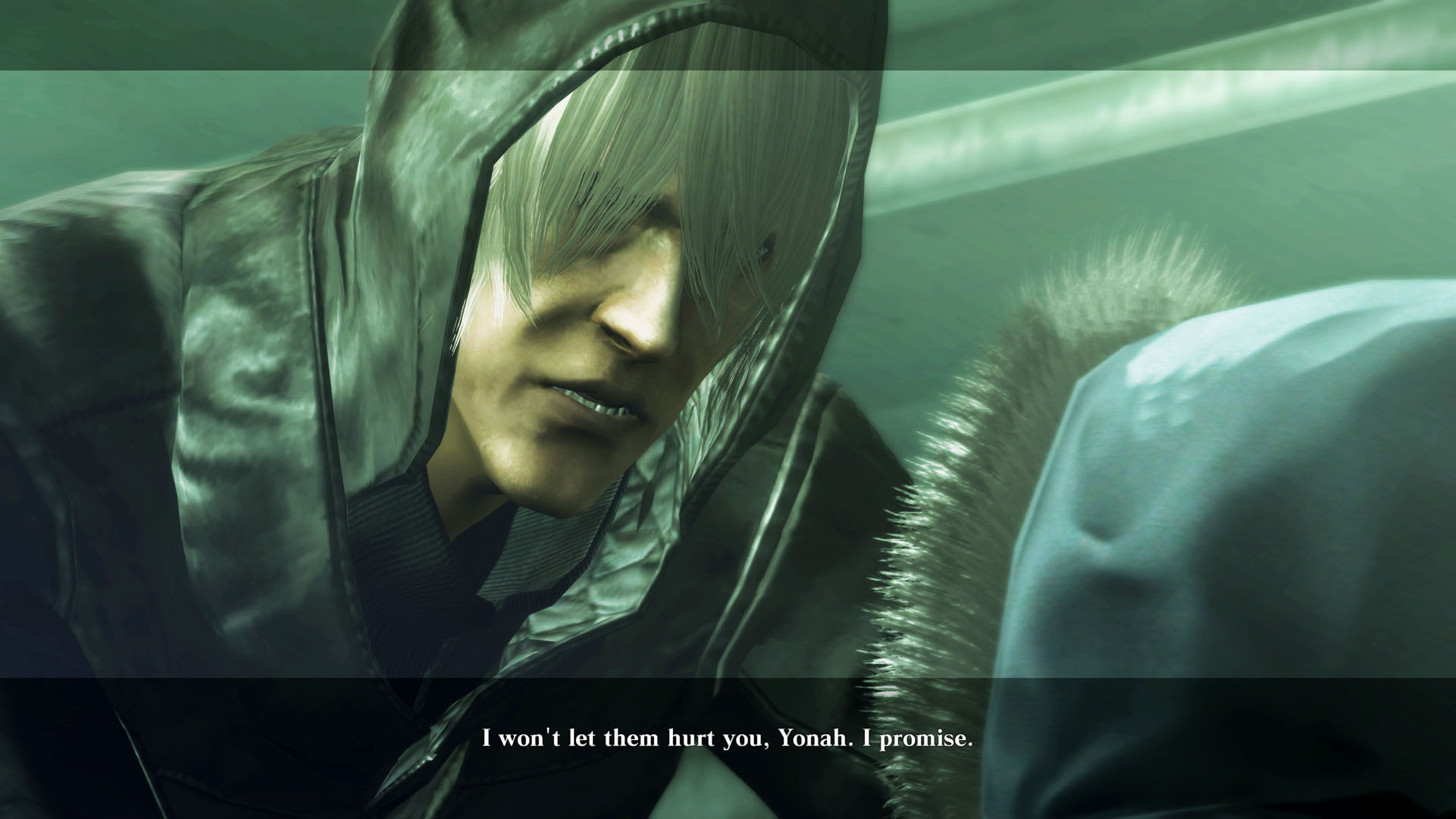
NIER does have its own merits buried deep beneath the clashing of tones and cornucopia of genres. For every quality, however, there is usually a detraction quick to follow. The voice acting and localisation in general is remarkably solid. (That said, NIER in the West is identical to NieR: Gestalt in Japan, so we assume porting duties were minimal.) Nier, his timbre gruff yet warm when talking to and about his daughter, is a likeable protagonist; a character players will become invested in and genuinely want to see succeed. The book, Weiss, is deliciously portrayed with flair and mock vitriol. Even the ancillary spoken parts peppered throughout the game are more often than not of higher quality to similar voice work found in games of much larger exposure and budget. Combined with some delicate and melodic musical themes that accentuate the emotional investment of the tale, character, story and music are easily the game’s strongest selling points.
It’s also punctuated with great humour and dry wit. Nothing is safe from the characters’ constant derision, Nier, Weiss and others blaming everything but themselves when something goes awry. They’re not alone, as in a quirky display of self-depreciation, the designers themselves are repeatedly criticised by their own characters for dreaming up questionably designed locations and encounters. In fact, some of the best parts of the game are when Nier and his scantily clad compatriot Kainé are trading insults and witty comebacks or slagging off the game’s creators. With a knowing wink, the producers frequently acknowledge some of the genre’s renowned and ridiculous traits. One on-screen instruction in particular, “Defeat the woman dressed only in her underwear,” an example of just one bon mot, a reference to similar games’ obsession with dressing their female leads in as little attire as the censors will permit.
When it comes to personality and ridiculing the famed and sometimes baffling traits of the RPG genre, it’s Grimoire Weiss, the talking book, however, who steals the show. Channelling great British actors such as Rickman and Fry, each line is delivered with scintillating haughtiness, the book eager to deride Nier for agreeing to yet another inane side-quest or similar role-playing requirement. Weiss’ purpose in the game is to not simply provide scathing ripostes, however, as he also facilitates in the magic department by allowing Nier to map spells on each of the controller’s shoulder buttons. It’s somewhat redundant, however, as you’ll find yourself sticking with one or two conjurations out of an Argos catalogue of options, testament to how the game once again over complicates something that needn’t be so convoluted. Mapping powers to buttons is usually a welcome addition to most games, but when new spells seemingly offer very little to the mix, the practice of unlocking new incantations becomes trivial and incidental.
Though the characters are easily the best thing about the game, just like the land in which the story occurs, their design is trapped somewhere between generations like fantastical fashion victims. From people to landscape, the game’s presentation is nowhere close to this generation’s quality in terms of graphics and polish. It would be unfair, however, to label the game as having PS2-esque visuals as some naysayers will invariably suggest. The world simply lacks that final level of detail. Care and attention that could have elevated what are at times truly well-wrought and innovative location designs toward something better than what is on show. The open world, interlinked by bland and by-the-numbers outposts, is shockingly devoid of character or detail. At times it’s almost like wandering around an MMO environment, the landscape destitute of activity or attraction. What has been included, often remnants of a lost technological civilisation like shattered bridges or the vestiges of crumbling towers, for reasons probably best known only to the game’s designers, are bizarrely unfocused.
It’s as if the game’s visuals have been enshrouded in a thin veil of muslin cloth, the vistas and hamlets notably hazy and bleached. If such a design decision was done for an ethereal effect or to make the land appear otherworldly, the intention has failed. Instead the result is a game that appears faded and washed out.
Design in general is erratic throughout. Some of the boss characters and the events around their besting are truly noteworthy. Elsewhere, however, the stock adversaries you square up against are non-descript and smack of laziness. In fact, some of the Shades – the game’s basic denizens of malevolence – are merely golden shards of light hovering together in barely humanoid shapes. Hardly groundbreaking or taxing for today’s mighty GPUs.
Nier himself, multifaceted and masterfully acted, is relegated in the looks department to appear like a drunk, elderly Whitesnake fan turfed out of a gig after rushing the stage. He also possesses some of the worst animations you’ll come across in a game this generation; his jump convulsion in particular being exceptionally poor. In true RPG fashion you can customise gear to the nth degree, the game presenting an interesting system of marrying magical words dropped by opponents with weapons in order to create varied and elaborate instruments of death. That said, Nier never really changes. He’s practically always the shock-haired grunt odd-ball, a quality he regularly breaks the fourth wall and happily informs the player about.
The litany of annoyances continues. The maps presented are usually useless; the unhelpful quality of a fixed on-screen depiction of the surroundings uninformative and never to scale. Add in an erratic cone of visibility indicating the direction Nier’s looking, and traversing locales can be onerous and slipshod; arrival at your desired destination often due to pure luck rather than superior navigation skills.
Despite these flagrant flaws, there is still a lot to like about NIER. It’s unashamedly corny and atypical. Though cramming in as many genres and clichés into one melting pot as possible, it still seems to only be happy when it’s off prancing about doing its own thing. There’s so much going on – a genre shift potentially lurking behind the next poorly rendered corner – that you’re constantly waiting to see what crazy notion the designers can come up with next. Paradoxically, the game often suffers from pacing issues. Frequently you’ll be wandering in the wilderness killing sheep (who can comically deliver a resounding kick to the face when approached from the rear) for mutton or collecting berries for some other mundane reason, and you’ll quickly realise that you’re off the beaten track once again story-wise. It’s this fluctuation between plot arc and mindless roaming that detracts from what is really a well told story.
Pros:
- Varied, long and sometimes engaging gameplay
- Interesting characters, unique and well acted
- Challenges norms and tries to be different
Cons:
- Poorly presented at times
- Dated in multiple areas
- Can drag in places, directionless and meandering
- The mishmash of genres can be disconcerting, often executed with average results
Conclusion:
About half-way through, NIER experiences a gear-shift and really picks up pace. Unfortunately by this point only the dedicated or die-hard RPG fan may still be around to enjoy what is truly one of the weirdest gaming conundrums of this generation. NIER is far from perfect – in fact, it’s decidedly below average at times – but for every sloppy design decision or hackneyed rehash there are charming and often unique aspects that are worth the investment. Like stopping to enjoy a one-man band, you’re not admiring each of the individual instruments in isolation or even the overall music produced, but the combined spectacle of watching it all come together. And though the song itself may be poor and probably out of tune, you can’t help but clap as so many moving parts work together, happily in unison. NIER is one such plucky street-performer. Flawed and disjointed in places, it’s often beguiling in its own peculiar way.
 Score: 6/10


This review is based on the PS3 version.