
This article contains Portal spoilers.
Portal transcends the typical socially acceptable time limits normally imposed on videogames; the internet memes still played out today might have grown a little tired now but if you were there, when nobody knew, even your Granny politely informing you that the damned cake is a lie can fire off enough synapses to invoke special, personal memories of one of this generation’s most memorable titles.
And if you weren’t around at the beginning, if you hadn’t seen the embryonic seeds laid down by Narbacular Drop – if you played through Portal knowing what was to come, then you’d managed to spoil one of the biggest and yet most secretive parties this industry has ever had by pre-empting everything that was so powerful about Portal. The gradual yet spectacular decline of GlaDOS, the escapable fate of the player, that ending – all surprises worth experiencing first hand.
Remarkably, there’s a third group of gamer – one that hasn’t actually played Portal at all, and really, there’s literally no excuse: you can pick up The Orange Box for next to nothing, or you can buy Still Alive on XBLA if you’re scared of going outside. You might have spoiled the ending, but that doesn’t really matter – Portal’s last act might be where the game shows its true colours but the rest of it is gaming gold anyway.
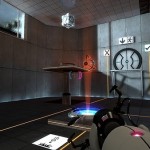
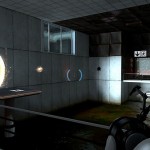
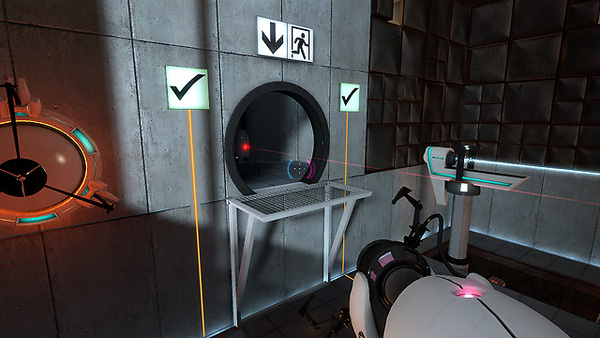 It’s a powerful concept, Portal’s central premise, but it’s one introduced to the player in a series of baby steps designed to ensure familiarity with the ideas of Portal in the early stages before letting him loose on the remainder. At first, the Portals (both blue and orange entrances) are pre-determined and fixed, and even when the player gets the wonderfully named Aperture Science Handheld Portal Device in his hands it’s only one colour he can fire at first.
This isn’t restricting for the sake of it – the very notion of Portals was a tough one to explain. By limiting the Portal Gun’s abilities and smoothly building up the ways in which the player can use gravity, velocity and direction to progress through the game the player never feels like there’s too much going on, and by the time he’s left to his own devices as the game kicks up a gear or two the training wheels are off and, hopefully, the puzzles can take care of themselves.
Portal completely changed the way we think about first person shooters. For one, there were no bullets fired by the player beyond the thwap of the Portal Gun as it propelled the harmless but utterly crucial orange and blue energy balls towards the nearest suitable wall. Secondly, walls were no longer a physical boundary – assuming you can see beyond your current obstruction you could fire one portal into the wall ahead and another where you’d want to emerge once you stepped through the first.
But then Portal was never really a first person shooter and although it was bundled alongside Half Life 2 and Team Fortress 2 Portal was every bit its own game, its own genre. From the very first screen, with the player making their own baby steps out of the glass case and into their first portal, the game manages to both captivate and divert at every single junction. You never really know what’s coming next even when you think you do.
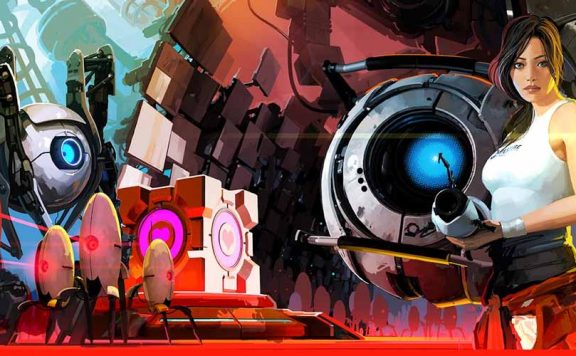
Towards the end of the game, once Portal has removed the stabilisers and notched up the difficulty, Valve’s delicious puzzles take over, wrapping GlaDOS’s spiraling paranoia and some utterly wonderful gameplay mechanics into one hell of a freefall. The pacing’s perfect, the ingenuity a constantly controlled stream and some of the cleverest moments – like the delightful Weighted Companion Cube – providing key stand out moments you’ll think (and talk) about for weeks.
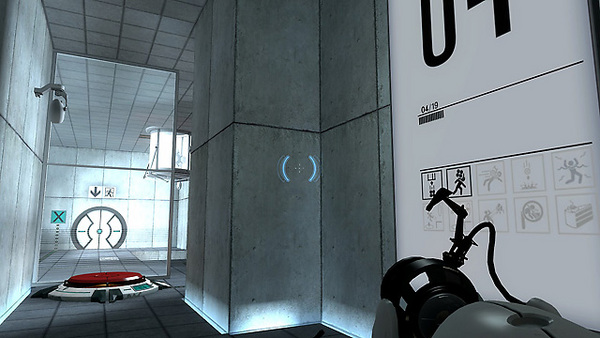 Of course, then there’s the twist. You might have seen it coming – the ajar sections of the lab, the hastily scrawled comments and the overwhelming sense that something’s not quite right – and then there’s the fire. I’ll admit, it caught me out a couple of times and really, at one point, I thought this was the end. Why had I been asked to invest a good six or so hours on something so abruptly concluded without any real closure?
Naturally, curiosity got the better of me, and a far flung portal opened up what is the game’s defining moment, the realisation that now it’s you against the machine and that last chapter, utterly unsignposted on a first run through, proving to be the best in the entire story. Ramping up to furious levels of adrenaline inducing excitement, the ultimate face off with GlaDOS an anticlimax only on the grounds that this is the true end of the game.
A second admission – the end song hit me right in the chest. A beautifully poised love letter to Portal’s latest contestant, and one that too managed to find its way into videogaming legend. Lucious vocals and some great lyrics are married with some geektastic terminal graphics that found their target perfectly. It’s all over, Portal is done and finished, and there’s only the teasing final shot – outside, finally – that lingers in our minds.
Oh, and the cake, of course.


Quinlank
You know, considering that Portal 2 is coming to PS3 from Valve themselves, you’d think it would make sense for them to release that XBLA version of the original on PSN before the sequel hits to improve their profile with PS3 fans a little.
If they’re going to rely on that awful port of Orange Box to have PS3 owners chomping at the bit for the sequel they clearly aren’t thinking straight.
I do agree though, Portal is an incredible game.
clone555
I started reading this article, but I stopped at about the 5th paragraph. I got the orange box about a year ago and tried portal, but I got drawn into half life and team fortress and I never gave portal more than 5 minutes, and I was utterly confused.
So I decided to give it another go over the weekend. It was incredibly enjoyable. Once I put in some time to understand what was going on, it really started to grow on me. It is a classic. And the song at the end is the most brilliant ending in any game I ever played.
I have no idea what to expect from portal 2, but they have a mountain to climb in order to outshine the original.