

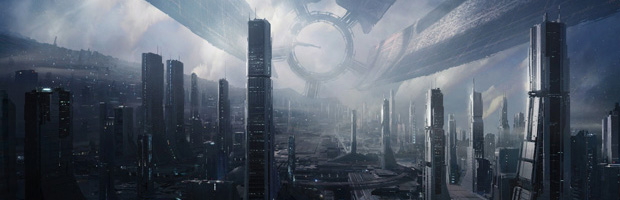
Shawn McGrath’s comments at the recent GamerCamp have prompted much discussion of late, mainly because of his statements about Mass Effect, and in particular, the way the game tried to convey the story, and the linear way the plot developed largely regardless of your actions.
I caught up with Shawn recently (he was literally just getting a whiskey, at about 6 in the morning – although he later points out that that’s his ‘bedtime’ drink, and he’s not an alcoholic) and chatted about his quotes, and the subsequent online debate over just what he was meaning. You may well have missed the fallout, but he wasn’t hugely happy with how things had been portrayed.
TheSixthAxis: OK, so, tell me what’s happened in the last few days. I hear you don’t like Mass Effect.
Shawn McGrath: Ha ha I don’t! But that’s hardly the crux of my issue.
TSA: It’s not?
SM: I was talking about a linear story not fitting particularly well within an interactive system. I suppose I was a little too combative with the language I used, but it was a very quick interview, and I was really high on cough medication – I was very sick! I definitely prefer to speak in such a way that is more conducive to a constructive discussion, and that wasn’t a good example. That being said, the way in which the interview was picked up by other sites practically guaranteed there wouldn’t be a useful discussion. For example super imposing a screenshot of my game with one of Mass Effect, or titling the article: “guy who made Dyad calls Mass Effect worthless”, etc.
TSA: Do you think you were unfair to Mass Effect?
SM: Not in the content of my argument, but I guess in the way I phrased my argument. I had just played it because I was trying to work on my points, and it was recommended to me as an example of good story in an interactive system. I think it’s a poor example, hopefully people who disagree with me can find better examples – hell I can think of many better examples.
TSA: Your point seemed to be that regardless of what happens in Mass Effect, the outcome is still largely the same, and that’s all wrapped up in a plot that’s hardly likely to win any literary awards.
SM: That wasn’t my point, that was an example to illustrate my point. My point was regarding branching stories. I’ve further developed my anti-story ideas into 3 separate ideas.. well 2 and a half.
TSA: That branching stories can never really exist on a computer?
SM: Well, they can exist, and in fact they do; they exist in Mass Effect, it’s just not very granular. I said a much better example is “Home” by Benjamin Rivers, but, to get to the scale of the Mass Effect world, and to the degree of granularity that I would deem acceptable, it’s an extremely difficult computation and data problem.
TSA: It’s unlikely to ever be “there” in a large scale game?
SM: I think we’d have to solve the AI problem first.
TSA: Surely the difference then is that Home is a much simpler 2D title? It’s easier to account for the choices a player may make? Simpler visually, and in terms of AI at least.
SM: Right, but that’s kinda central to the idea. Doing something with the branching granularity of Home in a world as large as Mass Effect is currently impossible, and is unlikely to ever be possible – at least until we solve AI. You wouldn’t have to solve AI to get to Home’s level, but you’d have to make a lot of text, and I think it’s a really bad approach to making a game.
TSA: Have you ever tried One Chance?
SM: I haven’t, no.
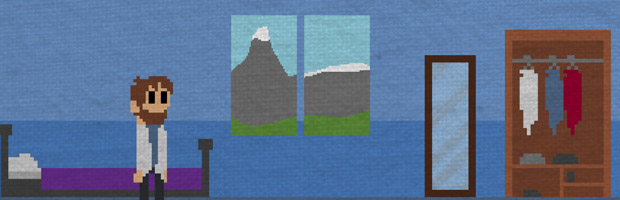
TSA:: That gives the illusion of choice, on a very small scale. Basically you invent a cure for cancer, but realise that the cure is actually going to kill everyone. You have 5 days to try to save everyone. It’s tragic, but the outcomes are there and possible because it’s so refined and small in scope. Games like Mass Effect will never get to that stage.
SM: Well they may, I don’t want to try to predict the future… but even if they do, I don’t think it’s particularly interesting.
TSA: Why not?
SM: One of the issues I brought up was the argument of a story being told through a protagonist’s eyes, and how in a game you are the protagonist. Telling a story through someone’s eyes means you aren’t the protagonist in the game. The protagonist is just an avatar that you control, which adds a level of disconnect between you and the underlying game system and I think it’s worthwhile to figure out how to remove that layer.
TSA: In what sense? So that the player is you, or further abstracted?
SM: That’s exactly right, the player is you, and when you’re controlling a player, you aren’t the player anymore. I think that’s a massive step backwards in terms of what games were doing before, and is the wrong approach moving forward.
TSA: There are very few games where the player is you, though.
SM: Well, that’s not true… in old arcade games, you’re the player. It’s when we tried shoehorning story into games that we created this disconnect. I’d like to return to where we were, then move forward in a different direction. That’s what I tried to do with Dyad… it didn’t move particularly far forward but that’s what I’m thinking about now.
TSA: I think, personally, that the issue is with ‘forced’ stories – ones that continuously break the 4th wall because the character doesn’t do what you’d do.
SM: Right! that happened to me so many times in ME2 (and not so much in ME1). In ME2 Shepard would say something that referenced knowledge that I didn’t have. It was really jarring.

TSA: Some games can have avatars and still tell a successful story. Journey, for example. Or Unfinished Swan, because the tale is in the telling, not on screen with stupid prompts.
SM: Yeah, I think Journey does a pretty good job, but I claim you are the avatar, not you are “controlling” the avatar – it’s an important distinction. I have some quarrels with certain aspects of what Journey does, but I think it’s definitely one of the better examples of moving in what I consider to be the correct direction. Journey and Shadow of the Colossus share the same problem in this regard I think: there’s no choice with how you end the game, or how you even hit certain milestones in the game. I think they worked extremely hard to limit those milestone choices – Journey especially – and I really respect their direction, but they aren’t there yet, not even close.
TSA: You mentioned that Dyad tells a story. I think that’s a fairly abstract story. At least in the traditional sense.
SM: It definitely is!
TSA: Let’s be honest, people want a story with a defined beginning, middle and end. And by that I mean plot development, character interactions, and so on. I’m generalising, of course.
SM: Sure, people can want all sorts of things! I don’t think anyone’s done interactive storytelling very well yet… and I don’t even know what ‘very well’ would be yet. So it’s pretty hard for people to want something that doesn’t exist! I’ve been thinking of how to do it for a few years now, and basically the only thing I’ve been doing for the last 4 months is thinking about this problem and I’m nowhere near an answer.
TSA: Do you think there’s a market for something truly new in that sense?
SM: I dunno, I don’t think about that when I consider what’s interesting for me to spend my time on.

TSA: Take the recent stuff with BioShock Infinite – it seems the general populace just wants the lowest common denominator.
SM: Yeah, but I think that’s true for everything. The larger your population sample, the fewer things people have in common, therefore there’s fewer interesting things are that appeal to everyone. So I think that’s a tautology.
TSA: Neither you nor I (or anyone) really knows where storytelling should go. I guess it’s more important to a publisher to get people into a game rather than the story. What I mean is, perhaps most don’t really care.
SM: Yeah, it’s a touchy subject. Humans are generally attracted to stories about humans, and then further things that they can personally relate to, so I think anything that tries to do anything fucked up will find a fairly small audience, but I’m okay with that. I don’t make things with an audience in mind, I just make whatever I think is interesting.
And with that, Shawn returns to his whiskey.
yogh_wayne
Who is Shawn McGrath?
Peter Chapman
Ha, I guess that could have been made clearer!
Most recently, he’s the guy who made Dyad :)
mugsybalone
Alrighty. Strike 1: “I was talking about a linear story not fitting particularly well within an interactive system.” It’s not a linear story. There’s three outcomes, not one. Linear suggests one outcome. Linear. Like, a line. One start, one end. There isn’t one, there’s three.
Strike 2: TSA: Do you think you were unfair to Mass Effect?
SM: Not in the content of my argument, but I guess in the way I phrased my argument.
But you were wrong, as clarified by strike one, captain fancy-pants. Not unfair. WRONG. A slight – but significant – difference. Oh, man. That hole’s looking mighty deep, there.
Strike 3: Everything further relating to Mass Effect – where does this guy get off? Did he get sacked by someone at Bioware? Shawn makes gross assumptions that Mass Effect – 2, in particular, leads the player with hand-holding throughout the story, as in, “In ME2 Shepard would say something that referenced knowledge that I didn’t have. It was really jarring.” and yet, provides no evidence that this is the case.
Strike 3: Assuming that, based on Dyad’s performance, his opinion actually has any weight: SM paragraph 16, starting “Sure, people can want all sorts of things!…” based on the vague assumption that 1 in 1,000 people who rated Dyad bought it, the 52 ratings on the UK PSN store currently equate to 52,000 purchases, in the UK PSN Store catchment, at least. Taking a series with multiple storylines, say, oooh, I dunno – Mass Effect – VGChartz (for what they’re worth) note’s Mass Effect’s sales, across all formats, as a series, as 10.2 million.
Now, I hate to sound like a corporate drone, but really, if, across a series, 10.2 million units were shifted, that would indicate Bioware’s approach to storytelling – with it’s traditional “beginning, middle and end” sequences – were pretty much on the button.
On the back of this, it would occur to me that, perhaps, people like SM should STFU, take their footnotes in gaming history, and perhaps leave their finger-in-the-wind, spitball opinions to people with an experience of the industry. Just a thought, like.