

As I sit down to put the headset on, it’s almost a slightly daunting task. The helper behind me gives clear instructions about what I need to do; place the displays in front of my eyes first, adjust them until the images properly resolved and as sharp as they can be, and then pull the strap over my head to secure it properly.
Now that I’m blind to the outside world, I need more help, with an Xbox 360 controller placed in my hands and the handful of controls I can play with explained, before the headphones are put on. They’re not too loud, so that I can still hear the Eurogamer Expo show floor, but loud enough for the rumble of the aircraft in War Thunder and the game to make sense.
Even though I’d been instructed to move my head and look around the cockpit of this WWII fighter, I’m still playing it as though it were just a monitor directly ahead of me. I don’t really move my head to look around, but instead rely and moving the plane itself to change my point of view. I’m doing it wrong.

It does take me a while, but I start to consciously decide to look around me as I’m flying. That way I can track my targets – who invariably escape me anyway – better, as they go “off screen”, so to speak, and catch up to them without the need of arrows to point me in a direction. It’s certainly immersive, but an experience which you really need to get accustomed to.
However, it’s also a very revealing demonstration of what Oculus Rift is all about. This is not really a system designed for first person shooters, which is the first kind of game which I feel everyone jumps to as an example of what VR can do. Yes, you can combine the Oculus Rift with the Omni – omnidirectional treadmill – so that you can have that physical experience, but even there you’ll bump into problems.
This is very much a sitting down system, for games like War Thunder or Gran Turismo, where you can sit in a cockpit and look around. This was my own logical conclusion before I played with it, and going face on with the system only affirmed my beliefs, along with talking to Joseph Chen, Product Lead and part of the team presenting the system to people on the show floor.
This is still a somewhat flawed experience too, with control inputs in particular needing a lot of work and thought put behind them. You need a natural understanding of a 360 controller right now, because mouse and keyboard inputs would be seriously impractical, and this is one of the simplest and most basic systems out there right now.
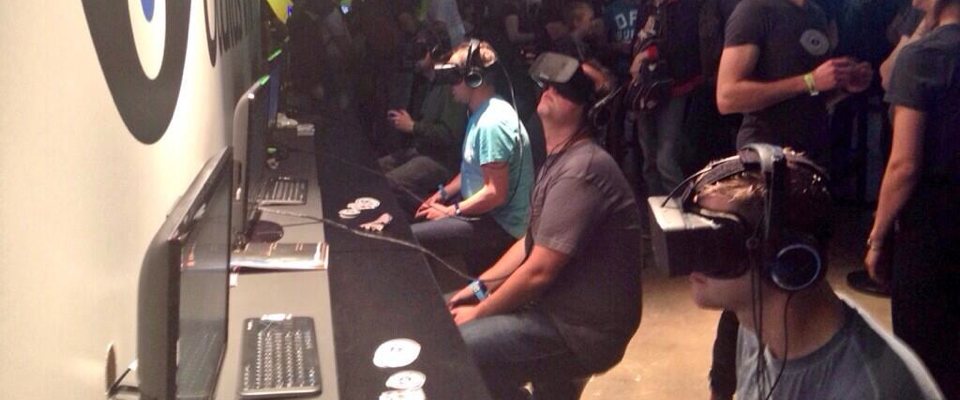
It’s still not perfect, and especially from the point of view of learning an unfamiliar control scheme, not being able to look down at the controller and see what is what in comparison to something shown on screen makes it near impossible to give universal access. This is something which Oculus VR have to work on over time, with some developers creating innovative solutions like crafting a 360 gamepad in game, which shows you exactly what you’re pressing. It could even be that Valve’s new Steam Controller might hold some value in this regard.
Thankfully, I came out of this experience without an ounce of motion sickness. Again, I think that this is down to the kind of game I played, with a first person view and plenty of in-game constants for me to effectively use for spotting, like a ballerina. I do know that others have struggled with games such as Half-Life 2.
This too will come down to developers getting their game up and running, and working to create as slick and seamless an experience as possible. For Gaijin with War Thunder, they were able to get a working build within a matter of days, thanks to already having support for 3D screens and head tracking via TrackIR.

It all boils down to a system which, though still in the midst of heavy development, is shaping up to be a very slick and polished experience. The main problem that can’t be solved via smart software solutions and innovative control systems is with the screens themselves. I was playing with a unit which featured the higher resolution 1080p display, and yet even with this higher resolution, I could still resolve the pixels, and lose that little element of immersion. A slight element of eye strain and watering may have come as a consequence, too.
This is still very much the beginning of a long journey to explore what the next step in gaming could be, and despite the flaws, the problems still waiting on solutions, and the clear position that this is a work in progress, it’s quite an exciting and enticing prospect.
Joe
Me likey