

You stare as Zurburan once again fails to cast a fireball. Despite a 70% chance of success, this is the third that has fizzled out, urgently needed as Naurim, the fighter dwarf, is one hit away from death. The 18th crypt louse in the area takes a swipe at him and he collapses. The other crypt lice turning their attention to your main character, whose heart you can practically hear skip a beat as they swarm him and you realise you’ve lost the battle. Meanwhile, Zurburan fails to cast a healing spell on himself.
If this is the kind of sequence of events that would infuriate you then Blackguards is a game of which you should stay well clear. Based on the Dark Eye, a pen and paper RPG that is particularly popular in Germany, it’s a faithful recreation of its source right down to its probability-based attacks. If you are a hardcore fan of strategic, turn-based combat in RPGs then Daedalic have seemingly crafted something specifically for you, but this is to the detriment of everyone else.
You begin in the unfortunate situation of being arrested for a murder you didn’t commit and soon find yourself escaping from prison with wisecracking mage Zurburan and his perfect comedic companion, the gruff dwarf Naurim. You journey through the world of the Dark Eye together in your search for answers as to what happened while trying to avoid the law, the troops of the husband of one of Zurburan’s past lovers and others.
The story is good enough that if you enjoy the game you will follow it with interest, but it’s not compelling enough if you aren’t, while the dialogue alternates between amusing and cringeworthy, as the voice-acting similarly goes between being acceptable and outright bad.
But it feels like all of this is merely there to serve up the combat situations that make up the majority of the game. You can’t talk your way out of encounters or find an alternative means of accomplishing something, and this pulls away from the RPG experience as there is rarely anything other than combat waiting for you. This might not be a problem for those who love strategic, turn-based battles, but for people looking for a “proper” RPG experience rather than one aimed purely at facilitating fights will be disappointed.
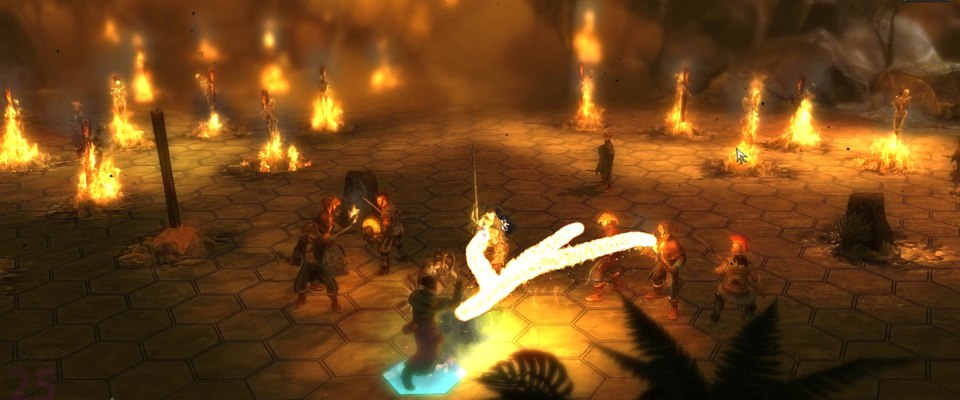
It is a shame that the rest of the game is lacking, as the combat is well done. On a hex-based grid your party and your enemies take turns moving, attacking, and casting spells, in areas that are often host to interactive elements. These elements can be anything from a pile of boxes that you can knock over to form cover, to explosive gases that can be lit with a fire spell. It certainly adds some interesting depth to what is already a good combat system.
The problem is that the game doesn’t tell you what interacting with them will do. That’s fine when it is a bee hive in a tree, but when I first encountered explosive gas I had no idea it was even an interactive element and assumed it was just some fancy graphical effect.
When you do notice an element and know how to take advantage of it, however, Blackguards really shines. There is an invisible wall spell that can be used to make choke points or guide enemies into hazards, whether it’s dropping bees on groups of enemies or ensuring only one enemy can attack your dwarf at a time, and it is at times like this when you really see how good the combat system is. Further to this, when fighting human opponents, a win is satisfying not because of the game’s difficulty, but because you have outsmarted a reasonably intelligent enemy instead of endless swarms of dumb crypt lice.
There are a variety of enemies for you to fight throughout the game and while humanoid enemies can be quite smart, other creatures can be dull and/or frustrating, often just swarming around the nearest party member while the others launch spells and ranged weaponry at them. Not to mention that some of them have interactive elements in the environment that cause them to keep respawning until you do something, like covering a hole with a rock to stop crypt lice from appearing. Considering their swarming behaviour and the inability to move when surrounded it is quite a frustrating experience.
Unfortunately, you will find yourself wrestling with the game’s clunky UI, though combat is the least afflicted by this. The radial actions menu feels clunky, not least due to its use of small split icons for power level selection, when the icons themselves are already too small to facilitate quick, smooth selections. However, each character does have ten hotkeys that you can assign actions like spells, attacks and items to though, so it is simple enough to avoid the radial menus a lot of the time.
As you earn AP for finishing battles and quests, you can spend it leveling up your character’s progression through a five page character sheet that is packed full of options. This means there is a lot of depth and places to take your character, but it is presented in such a way that it is mostly just confusing, particularly for players who are new to the game. It’s also completely unforgiving, so those newer players are going to be in trouble later on because they invested some points in the wrong places. Not to mention that you can’t make up the difference by grinding, as each battle is a specific set piece as part of a quest and there are no random encounters.
Despite this, there are encounters that are dull or frustrating for one reason or another, whether because of respawning enemies or just being too long. An early quest had me fighting the most crypt lice I’d ever seen in one place through surely the longest map in the game and it was just relentlessly dull. I didn’t even get any nice loot from it, partly thanks to the world of The Dark Eye. A sword +1 is a rare and powerful magic item in that world, which mostly just leads to you finding plain old swords and clubs all the time to either ignore or sell. To compound this, exploring to find loot is usually just clicking on a simplified map, which invariably leads to more combat.
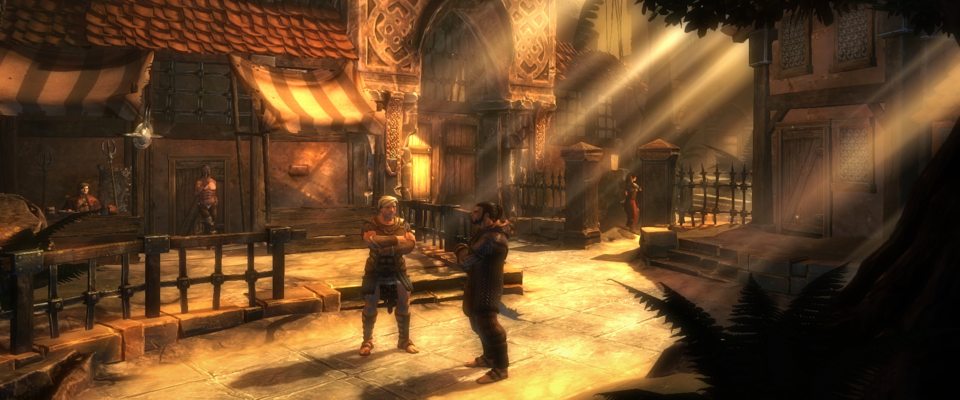
Visiting a city or village just presents an animated scene with a single camera angle, with clickable people for quest-givers and other people of note. They look nice enough, provided you don’t have any aversion to bloom effects, but they seem a bit empty due to their relatively static nature. Even cities with multiple areas are just a few animated scenes with buttons to move between them. Nevertheless, you will need to return for both quests, unlocking skills and spells at trainers, healing, and to sell your disappointing loot.
Graphically, the game is less than stellar. Character models in particular are low in detail and textures are blurry up close, which is strangely at odds with the reasonably detailed equipment you can equip. Thankfully you spend most of your time at a distance above a battle, but there are moments where the game just looks dated. Cutscenes in particular serve to draw your attention to the lack of detail up close.
What’s Good:
- Combat is where the game is at its best.
- Map interactivity can add depth.
- Character progression is deep.
- Story is interesting enough.
What’s Bad:
- Graphically dated.
- Outside of combat feels empty.
- Loot is dull.
- UI is clunky and cramped.
- Interactive map elements not obvious.
Blackguards has plenty of flaws but what it does well, it does very well, and it’s in a genre that has seen all too few entries in recent years. If you are a fan of hardcore, pen and paper, tactical-combat based RPGs then it’s likely you will enjoy the plentiful combat on offer, and fans of The Dark Eye will enjoy the lengthy trip through its world. But the lack of freedom to explore and choose other methods of completing tasks will reign in the excitement of those who prefer role playing elements.
It has plenty of potential in its combat, but its UI and the lacking gameplay outside of this damage the experience too much to recommend outside of its niche.
bunimomike
Such a shame. It’s not really my sub-genre of game as I prefer things to be a lot lighter, as such. However, had this been a real barnstormer of a game I might’ve taken a look. Perhaps in a Steam sale in the not too distant future.