

Your small town is one of the last bastions of hope for the human race, situated out in the blank white Void that Earth has been transformed into by a 60s Cold War experiment gone wrong. The collected human consciousness has been absorbed into this void, and it’s the job of you, your town and the myriad of other towns across the globe to try and rescue as many of them as you can.
http://youtu.be/9bnfz3XjUxQ
Easily one of the more intriguing announcements from Sony’s Gamescom press conference, Q-Games’ The Tomorrow Children is a terrifically unique concept. It’s an entirely online game, in which you and between 50-100 other players band together to look after your town and the human folk that you can rescue.
Periodically, great islands will appear in the great white expanse for you and your town to mine and explore. The surface will have been hand crafted by Q-Games, and could literally be anything that they can come up with, from the shape of a giant banana or hammer and sickle sticking out of the featureless ground, to the example which was shown, a half submerged face with giant bombs falling into it. It all looks particularly gorgeous thanks to a “cascaded voxel-cone raytracing” engine, though all you really need to know is that it figures out how light bounces and looks incredible.
However, the inside of the islands are randomly generated, with the inside of the example island that Dylan Cuthbert mined into featuring all manner of trees and glowing mushrooms. As he wandered around, there were the ghostly visages of the other workers from his town, and herein lies one of the game’s most curious twists.

Rather than run it like an MMO, with all players in an area visible to all the others, The Tomorrow Children blends in aspects of asynchronous play. As you play the game, you see the fruits of everyone’s labour, but you only see the other players when they are in the middle of an action. That could be mining a block out of the island, firing a huge cannon or simply standing in the town square and saluting. At all other times, though, they are completely invisible to you.
It’s interesting because it takes the actions of your town and merges them all together into this twisting of the Communist ideals to which the town is run, but also means that you can rarely be quite certain of how many players are mining an island and how many are actively engaged in defending the town from monsters.
Just as new islands will appear over time, so too will attacks of huge metallic spiders and giant Godzilla-like beasts, collectively known as the Izverg. It’s at these points that you will generally want to head back to town to man the cannons and take down the invaders before they can deal damage to the town, but with dozens of players, you don’t necessarily have to. You could quite likely continue mining the island for resources or simply log off and do something else with your time.
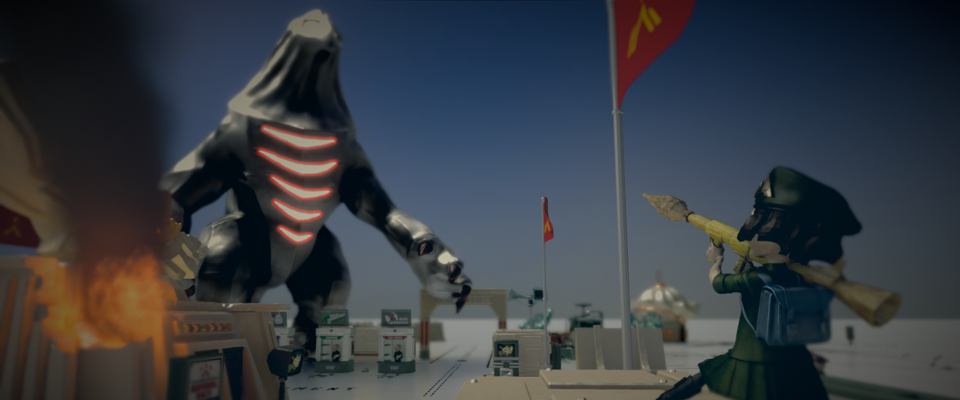
If you are there for the monster battles, however, you’ll be able to help in one of the most critical and time sensitive periods of play. For just a few minutes after its death, these monsters will solidify and become mineable, with the town invariably rushing to get to it and strip it of as many resources as possible. Your rewards, should you be quick enough, will be much greater than those of mining the islands.
The monsters will be the two main sources of the matryoshka dolls that you can turn back into civilians for your town and gems that you can use to expand and improve your town. Naturally, as a pure and idealised Communist town, any additions to the town will be voted upon by its populace.
The communist overtones even extend to your rewards, whereby you earn rations from the Labour Office, itemising all of your actions since your previous visit in the process. These can be used then to improve your character, by buying a better pickaxe with which to knock through walls, bigger and better weapons with which to fend off the Izverg and you can even buy a little car, so you don’t have to take the bus out to the island you’re mining.
However, as time passes, it’s quite likely that your town will eventually die. You’ll need to find the right balance between the human civilian population and the food and electricity that you have, but as players find they’ve had enough of the game or start to log in less frequently, keeping this balance up will become more and more difficult. It could be that the Izverg overrun your town or that the electricity runs out, the lights switch off and, with light playing a major role in your survival, you perish.


It’s here that the wider world of towns come into play. Not only can you visit another town, to see how they are getting along, you can also actively participate in helping them to fend off the Izverg and mine out their own island – with all towns receiving the same semi-randomised islands at the same time. When a town is in trouble, however, other towns could feasibly receive a call to arms to visit and help out in its defence. You can even permanently move between towns, and this is an option that will appear alongside founding a new town, should your own fall.
Yet it feels like I’m scratching the surface of what The Tomorrow Children is trying to do. I know I’ve listed the main constituent parts, but as I saw Dylan Cuthbert demonstrating it and watch the trailer for the umpteenth time, I can’t help but feel that I still don’t quite understand how it works.
It’s probably something that Q-Games have grappled with internally, and no doubt even Cuthbert himself, who I imagine ran naked from his shower to the the office in Kyoto while babbling about a semi-synchronous pseudo-MMO Animal Crossing-Minecraft hybrid with Godzillas set in a post-apocalyptic Communist state.


TSBonyman
Thanks for that Stefan, you’ve answered a lot of my questions about the game – but now i have even more questions! I think we’re all in the same boat though until they release more details. :)
I have some concerns about the dependance on other players but it still sounds original and intriguing and i simply have to see that gorgeous cascaded voxel-cone raytraced artwork running in real time.
Stefan L
Fire away, and we’ll see if my notes from Gamescom can answer any of them!
For your own character, you don’t really depend on others, as it’s your own actions that earn you rations that can be traded for a better pick axe etc. etc.
For the town as a whole, it seems to be that it relies on everyone doing a little bit of everything whenever they play, so you have a 20 second run on the electricity treadmill, pick a few apples for the food stores then head off to work in the mines and do battle with the Izverg. But I did ask specifically about how a town can survive once people stop playing, and Dylan Cuthbert responded by saying that it’s just part of the cycle. Your town will almost inevitably die at some point, and you then either found or join another town.
TSBonyman
What i was wondering was how long it would take for a village to be completed, and might it work out that you could start a village and play a few hours, then not log in for a few days only to find that it has been completed without you?
Or alternatively, could you join a village but only be able to play there when the original creator is online?
Also, it seems to me that as you mostly won’t see the other players, there won’t be any communication/organisation between you apart from the occasional voting. At the same time there’s a certain Journey-esque sound to that so it will be interesting to see how it works out.
Stefan L
So I don’t have anything specific on these, but inferring from what I do know:
– It doesn’t seem that there’s a “complete” state for a village. The main aim is to find more human civilians and look after them. To do that, you need to build out, get more and more resources to sustain them and fend off larger and larger waves of Izerg with increasingly better defences. You’ll probably see things have changed in a noticeable fashion, if you haven’t logged on for a week.
– Villages to my understanding will be persistent and always active, but I’m sure things will scale up and down depending on concurrent players.
– Yep, there doesn’t seem to be much direct communication, but there are things like whistles and gesturing. Your actions are guided by the common goals of mining, defence and expanding your town.
TSBonyman
Lovely stuff Tef, i think you have answered everything and the whistles and gestures make it sound even more like the interaction in Journey. As someone who normally shies away from online gaming, i really like that approach.