

Splash Damage make a very particular kind of multiplayer first person shooter. Perhaps best known for Brink, which came out four years ago, they had previously cut their teeth on Enemy Territory: Quake Wars and Wolfenstein: Enemy Territory, all centred around the same objective based attack and defence multiplayer.
Dirty Bomb is a game with a rather convoluted history. Splash Damage announced the PC centric game in 2012, changed its name to Extraction in 2013 alongside a partnership with Nexon and then back again in 2014, and now in 2015 they’re finally ready to open the doors to the public.
“The truth around the announcement is that it was probably a bit premature,” admitted Chief Branding Officer and Splash Damage co-founder Richard Jolly. “It probably shouldn’t have come out that early, but at the same time, we started as a mod team originally, so from the very outset our games used to be in the public eye from the beginning and then we were constantly refining it.
“I think with Dirty Bomb that’s kind of helped us as well. We’ve had a dedicated and hardcore group of fans who have been helping refine that game over a series of years and it’s really helped. I think that now it’s in that solid state where we can push it out to a wider audience.”
The gameplay is fast and slick, as the two teams butt up against one another to complete objectives or repel the attackers. One moment you’ll be trying to plant a bomb on a barricade, the next you’ll be trying to stop the other team from escorting a vehicle through the level, using certain points in the environment to open up new paths, fill tunnels with poisonous gas and so on, to make your opponents’ lives difficult. This is really another evolution on what Splash Damage have been doing all along.
Richard said, “It’s been our kind of special sauce of gameplay since Wolfenstein: Enemy Territory, which was the first game [that featured this gameplay]. We started as a mod team and the mod we made was Quake 3 Fortress, so the reason the whole company started was because we used to play Team Fortress competitively against each other, so we’ve evolved what we enjoyed from that game into our own kind of special approach.
“We always tried to put a bit more story into the missions that you’re doing, or we’d have the different classes in their different roles. I think with Dirty Bomb, we’ve kind of exploded that a bit more, so there’s so many different mercs and we’re going to be introducing new ones as we progress through, and that’s going to change the way the game plays, which is awesome. Year one to year two is going to be very different because the play styles are going to be all mixed up because of these new mercs coming in.”
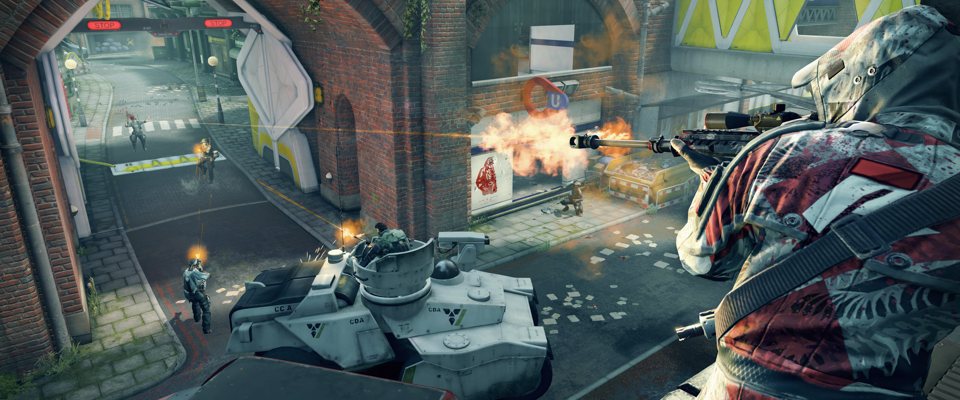
Set in an abandoned futuristic London, after a major incident with a titular dirty bomb, everyone is a mercenary, simply out to make as much money and complete as many jobs as they possibly can, and strip the city for all it’s worth. It’s a very rudimentary backstory, but it lends the game a rather pleasing setting, with a mixture of classic red brick buildings, tight streets, the occasional cobbled road and market mixed in with more futuristic looking structures.
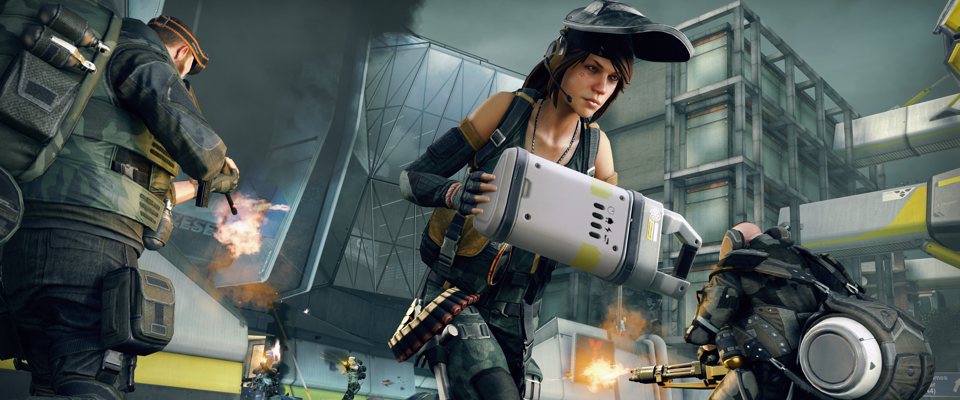
And on those streets, you wage a small war. Working together as a team will be key, and part of that will come down to picking the right class and character each time you head into battle. There’s the usual assortment of archetypes, with medics and snipers and so on, but what’s quite refreshing is that these are subdivided further with specific characters. It’s a curious cross between Evolve’s selection class characters and the way that separate characters exist in MOBAs like League of Legends, but then with its own twist on character management and evolution.
With twelve mercenaries during the initial few months as the game heads into beta today – and with more on the way – you pick three which you want to take into battle with you, and which you can switch between during a match. It might be that one objective suits Proxy’s faster move speed and greater agility (and proximity mines to defend planted explosives), while defenders would want to lay down a barrage of fire with Skyhammer. Tactics quickly formed based around particular characters and how they would help in a given situation.
“It gives you more variety,” Richard explained. “You’re not just fixed into having this particular play style, and I think there’s going to be new play styles coming along from just seeing other players playing existing mercs that give us ideas for making new and more interesting ones.”
It’s a notable shift from having a more freeform loadout selection, as Richard added, “That’s the route we went with in some of our previous games, and you just end up with decision paralysis, where you’ve got so many different options, you just don’t know what to choose. So we want to just guide gamers a little bit through at the start, so they kind of understand, ‘This is something I like, I want to play more of it,’ rather than, ‘Here’s ten thousand weapons, pick one of them.'”
However, each character is represented by loadout cards of varying value, going from plain cards to Lead then Iron, Bronze, Silver and Gold. Up to Bronze, you gain more perks for that character, such as being able to get a second wall jump in, and the weapon loadouts of weapons and perks are slightly randomised.
“[Silver and Gold cards are] not necessarily more powerful,” Richard said. “We’ve got different tiers, so the starting cards are basic cards, then we’ve got Lead to Iron and then you’ve got Bronze, if I remember correctly – we’ve literally just redone it! […] But when you get to the Bronze tier, you have got all three perks or augments on there, and then they just change out for different things as you go up. All that changes at that point is just cosmetic changes on the merc; there isn’t any gameplay changing.”
You can have multiples of each character as a consequence, but outside of buying and opening equipment cases – earnt through play or by buying them with Credits – to get new, randomised cards, the only way to get higher levels is to combine existing cards, using several Bronze cards to make a Silver, and so on.
And that’s where the monetisation potentially comes in. Taking a leaf out of League of Legends’ book, two characters at a time will be available for free on a monthly rotation, while a mixture of using in-game Credits or real world money will let you buy permanent access. Alternatively, the starter pack gets you five of the mercs for good and a bundle of Credits for $20/£15 and instant access to the game – otherwise, you need to sign up and wait for confirmation. It’s an interesting system that ought to keep a relatively level playing field at least, with the most valuable cards focussing on cosmetic differences rather than adding abilities, and equipment boxes can drop the higher tier stuff too.
It doesn’t help that the menus for the game are a bit confusing and time confusing to deal with. It’s not entirely clear at which point you can pick your loadout cards for your characters, merging cards in order to upgrade them could be so much smoother, and there’s plenty more to work on as the game heads into beta with a series of rapid fire updates and features set to expand over the course of just a few short months.

Yet what’s at its heart is the solid class based gameplay that can, when teams are evenly matched, really deliver the goods in terms of enjoyment. Brink had issues in that regard, with map design that failed to deal with spawn camping and lots of other bugs that spoilt the party, but Dirty Bomb hopes to overcome those problems with a more robust matchmaking system. Getting trounced is never fun, but it can be excellently tense when the maps and teams are well balanced.
Even with four years since Brink, it’s still surprising to hear Richard say, “One of the big changes with Dirty Bomb, we put out a video right at the start about Echo, which is our first stats and recording system, and it was the first time we ever started to use stats to look at how players were playing. Every game prior to that, we didn’t really know what was happening in the game and we just had to look at anecdotal evidence. It was like, ‘How can we still be doing this?’ so that’s why we put the whole system in place and now we have the ability to record everything that’s being put through the server.
“That’s been so valuable all the way through development where we can see that a weapon is definitely overpowered and we need to adjust things. That stat driven approach has changed our development quite a lot, and we can do things like heat map analysis, so we can see that players are always dying in a chokepoint and that we need to adjust things.”
Through it all, Dirty Bomb is suddenly a game that has grabbed my attention, with the fast pace, varied objectives and ease of hopping into the action. There’s a few oddities with the interface and monetisation, and it’s strictly for PC at the moment – as to a console version, Richard replied, “Never say never” – but most importantly, it looks like Splash Damage are back on track to recapture what made their early games so popular.
Tony Cawley
Shame it’s pc only, really sounds like my cup of tea, I loved brink.
Stefan L
Yeah, I think it’s been in development for such a long time that the market has shifted, and even though the pitch at the moment is around having a PC-centric experience, these new consoles are powerful enough (Brink sucked graphically on consoles) and Sony and Microsoft are open enough that this could make the jump.
Hopefully the PC launch goes well and they can look that direction soon.