

The PlayStation 4 Pro is a difficult piece of hardware to review, so we’re not going to just yet. That doesn’t mean we don’t already have a lot of things to say. Difficult to review, it might be, but it’s easy to talk about.
This is Sony’s big play at the 4K market, delivering a console right here and now that can take advantage of some of the latest TV technology. 4K has been around for a few years, with TVs coming down to quite reasonable prices, but HDR is new and exciting. See it side by side with a SDR TV or toggling HDR on and off and there can be one hell of a difference.

But first things first, the actual console itself. It’s quite surprising how heavy it actually is, and while it is bigger than the original PS4, it’s kept the same footprint and disguises its added heft by having three thinner tiers to its design. Yes, it was easily lampooned at the console’s announcement, but it works well.
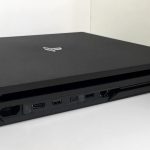
The stylish LED light along the front has the physical, clickable power and eject buttons at either end, but while better separated, they’re not satisfying to click, feeling fragile instead, and still not particularly easy to find when reaching for them blind. Two USB ports are tucked down to the right hand side, while the standard Blu-ray drive slot is above the LED light.
Round the back, it’s a larger kettle-style power cable – albeit missing the ground pin – with your regular assortment of outputs. Notably, the optical output has been retained on this model, and there’s a third USB port here as well, at long last! The hard drive is just as easily removed as in other models, with a small panel that clicks out and just a single screw holding the drive cage in place, for you to replace the standard 2.5″, 9mm thick HDDs; the same as before.
Turning it on, it’s not a silent machine when idling, as the slimmer PS4 was, with a noticeable fan. It is, however, quieter and a much more neutral sound than the original PS4. Getting it to spin up is pretty easy with games that make use of its power, where it has a similar maximum volume as other PS4s, but when playing games that haven’t been patched for Pro or aren’t pushing it anywhere near as hard, the fan spins at a lower speed as the hardware just takes it in its stride.



It’s roughly twice as powerful, and that makes getting 4K out of this machine and four times the pixels a simply remarkable achievement. Many, if not most developers are relying on a process called checkerboarding, which is a very advanced form of upscaling that analyses the surrounding pixels and adds new data. Something that’s baked into the new GPU architecture, it’s cheap for developers to implement.
It also does a remarkable job of upscaling the image and feeling like it’s running at native 4K. Yes, if you peer closely at the screen, pay close attention to certain factors, you’ll might be able to spot some artefacts from the process, and the overall image is softer and less defined, but even then it’s a marked step up and very close.
HDR is the other big talking point for the PS4 Pro, even though it has been rolled back to the standard PS4 models. What you get out of this is more dependent on your TV’s capabilities, but at its best, it is a huge step up over standard dynamic range. Colours are more vibrant, there’s much greater contrast in the image, there’s detail in shadows while you can still see the detail in bright areas at the same time. SDR can look flat and muted in contrast. Importantly, a well calibrated TV won’t make these things look unnatural, just put all the potential colour, brightness and darkness in a scene there for your eyes to take in.
The thing is… buying a HDR TV is a bit of a nightmare right now. A lot of TVs are marketed as being HDR compatible, but the cheaper models miss out on key features like local backlight dimming, to allow for the greatest possible contrast ratio, or they only have 8-bit panels and cannot display many more colours than SDR TVs. I say ‘cheaper models’, but you can spend £1000 and get a TV which doesn’t meet the UHD Premium specifications, despite outputting a beautiful image.

For gamers with more humdrum 1080p TVs, the step up is much, much less pronounced. The biggest benefits will come for games that had to settle for 900p on the standard PS4, with the PS4 Pro allowing developers to either give their game a small bump up to Full HD with nicer AA and some added visual effects, or make use of the extra oomph to go well beyond that and shoot for, say, 1800p. That can look great on a 4K screen – the added pixel density helping to disguise that it’s not a native resolution – but for 1080p, it can then be supersampled back down for both an increase in resolution and free anti-aliasing.
Uncharted 4 looks absolutely phenomenal on PS4 in single player, but the Pro does add just that ever-so-slight improvement to the image. At times it’s difficult to spot, but busier scenes such as the bustling Madagascan marketplace can have a shimmer of aliasing as you move around on PS4, which are largely dispelled by playing on PlayStation 4 Pro with super sampling – Update: this is reportedly 1440p with temporal anti-aliasing as opposed to checkboarding. However, the Pro’s biggest improvements here will come with actually playing in 4K and HDR.
Multiplayer does see a much more noticeable upgrade, the base PS4 limited to 900p in order to achieve 60fps. This soft image is improved upon as the PS4 Pro simply boosts this to 1080p60 – Update: our initial assumption was incorrect – giving a very noticeable improvement to clarity and sharpness for 1080p gamers.. It’s not quite the step up to 4K that people might expect, and it will be curious to see how games like Battlefield 1 tackle the same jump.




For the actual screenshots at native resolution, head to this imgur gallery.
Ratchet & Clank was another simply sublime looking game released for PS4 earlier this year, but its bright and colourful graphics were marred by aliasing. The PS4 Pro update brings with it Insomniac’s own home grown temporal injection technique that takes a 2624×1476 native frame and then adds around 4 million extra pixels into the frame – information we gleaned from speaking with Greg Phillips, Senior Producer at SIEA.
Honestly, it does a fantastic job of getting a 4K-like image on screen, but funnily enough, temporal anti-aliasing has been rolled back to the base PS4 version, negating some of the benefits of upgrading. Comparing the two at 1080p, the standard PS4 isn’t quite as clean and crisp an image, but it’s not far behind.



For full sized images, head to our R&C gallery on imgur.
Rise of the Tomb Raider gets to be the third game under the spotlight here, and with good reason; it offers several different options for players to choose from. You can play at standard PS4 quality 1080p, but with an unlocked frame rate, at 1080p with additional visual effects at 30fps, or at standard PS4 quality but in 4K.
First things first, the game looks great regardless of what you choose – and it takes 10 seconds to toggle between modes in the menus – but I have to say that the step up to playing in 4K and the added clarity it gives the image is worth it at 1080p. Where cities off in the distance of the Syria level become slightly indistinct blurs in native 1080p, 4K makes them clearer and easier to make out, even when supersampled down. The game doesn’t feel quite as locked to 30fps, and cutscenes seem to be a culprit, just as the Enhanced 1080p might add improved lighting, its own improved AA pass (and keep the console’s fan from spinning up, unlike the other modes), but 4K wins out here.
It even holds up very well against the PC version of the game, from comparing with 4K screenshots and footage – captured from an AMD RX 480 struggling to output 20fps, let alone a steady 30fps – but it’s clear that it’s a step down in certain areas, such as lighting . It’s equivalent to the PS4/Xbox One version of the game running at a much higher resolution, so compared to the highest settings on PC, you lose texture quality, shadows are of lesser quality, and distant objects switch to a lower level of detail. However, considering what it takes and costs to achieve native 4K of this quality on PC, it’s a ringing endorsement of the PS4 Pro at that level.



For full sized images, head to our gallery on imgur.
PlayStation VR is even less tangible right here and now. Of the numerous games available on the system, practically all of them were designed with the base PS4 hardware in mind and the task of eking out 60 frames per second from the hardware. While plenty of PS4 games have been patched for Pro support, very few have been for PSVR. In fact, there was only one game: Battlezone.
The patch notes say it all, really. There’s a higher super-sampling resolution, but there’s still plenty of aliasing because of the PSVR’s base resolution, and lighting has been improved with more dynamic lights in the tank’s cockpit and higher resolution reflective lighting. I really noticed the dynamic lights of the green glowing radar plate, definitely, but it’s a small step.

The other game we tested was Robinson: The Journey, which is out later this week – see our review here. It’s Crytek pushing the boundaries yet again with their fantastic game engine, and it shows. The planet you find yourself stranded on is vibrant and colourful, with plenty of foliage and excellent visual quality.
The thing is that the step up from PS4 to PS4 Pro offers little to no tangible improvement, despite the game having a PS4 Pro profile built in. There’s still noticeable pop in for objects in the middle distance, texture filtering has, if anything, only seen a minor improvement, and shadow detail remains intentionally soft. Crytek have managed to extract a phenomenal amount out of the base PS4 to the point where stepping up to Pro gains you comparatively little within the limitations of PSVR.
For the first generation of games and those that are already getting the best out of PSVR, it will be small steps that define the step up to PS4 Pro. Improved lighting, better Level of Detail, better texture filtering; they’re all positive improvements, but the inherent limitation of the PSVR’s 1080p screen limit how noticeable these things are. However, as patches come out, I do hope to see a dramatic reduction to pop-in in Driveclub VR, a much improved resolution in VR luge, and similar in games most clearly limited by the base PS4’s power.
So, early impressions of the PlayStation 4 Pro are good, but it’s not the most exciting console release. 4K and HDR can be truly stunning – if you have a TV capable of showing them off – but there’s still question marks for us over how worthwhile an impact it has for 1080p players and PSVR. At this moment in time some key titles like Battlefield 1, RIGS and Driveclub VR remain unpatched, so we’ll hold fire on drawing firm conclusions for a few more days.
In the meantime, feel free to ask questions below and we’ll answer as many of them as we can.




JustTaylorNow
So it does nothing major to improve PSVR?
Stefan L
Not that we’ve seen so far.
Voolar
That was my main interest… I’m gonna hold off I think.
Tuffcub
I don’t think PSVR needs much improvement tbh. Works fine as it is, the whole “You need a Pro for PSVR” thing was cooked up by internet idiots.
Stefan L
PSVR is good as it is, but there are some games that could really do with the Pro’s power to make them run better and look prettier.
Avenger
Interesting that this article sounds almost like a comparison of new and old graphics cards. All the TAA, 1440p, Super sampling is great, but honestly it doesn’t venture into exciting new ground. I wonder if the same will be true of Scorpio, albeit with a few games being native 4K. I’m not feeling the mid generation upgrade just yet.
Ouninpohja
Does this model use the same power cable as the original PS4?
Stefan L
No. It’s a larger kettle-style cable, as opposed tot he smaller figure 8 style one.
freezebug2
It now sports an Earth cable alongside Live and Neutral….ooh the power!
Ouninpohja
Ah,bugger. I thought that’d be the case.
No getting around dragging all my TV stand out;to replace the old one,then… :(
Stefan L
No earth, bizarrely enough. The supplied cable only has the two prongs, as well. You can just use a standard kettle lead though.
mclarenrob2
I had one pre ordered but after doing hours of research on HDR tvs they are ridiculous money for the 10bit panel ones which are what you need. Either I’ll get one in a year or so or just make do with the current PS4 ( which is bloody awesome ) until the PS5.
JR.
I’ve traded in my Original PS4 and pre-ordered the PS4 Pro. I like to trade them in every 2 years or so I dont have to worry about them dying on me out of warranty. Wish it was available in white though. The black just looks so drab.
Stefan L
If I didn’t have one now, I’d be holding out for a “crystal” frosted plastic model, just to get that classic 90s N64 vibe.