

Homeworld 3 is the kind of game that feels exactly like you remember the originals being like, but is in truth having to go miles and miles beyond what those 20-year-old games were like in order to match the rose-tinted memories you have of them. By modern standard, Homeworld and Homeworld 2 are bound to look fairly rudimentary, the ships made of a limited number of polygons and low-resolution textures, the lighting systems rather basic, but admittedly with an engaging and evocative style despite this.
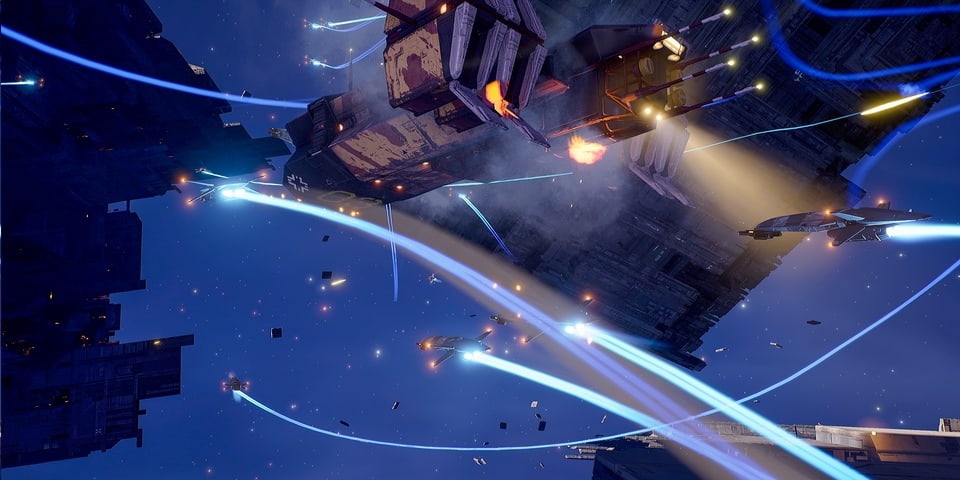
While Homeworld 3 isn’t pioneering in 3D graphics in the same way and is built on the reliable foundations of Unreal Engine, it can use modern gaming PC hardware to really push the graphical fidelity through the roof. Play on a high-end PC, turn on ray-tracing and zoom in and out for a closer view of the action, and you can just bask in the glorious amount of detail and small touches that Blackbird Interactive is able to lavish on the game. There’s tiny details, like the Mothership’s defensive gun batteries being on rails and moving up and down its hull while tracking and firing at fast-moving fighters.
The game’s story kicks off with a familiar sense of crisis, just as the first two numbered games did. It’s been 100 years since the end of Homeworld 2 saw Karan S’Jet unlock a hyperspace gate network that has led to a golden age of prosperity, but now an anomaly is spreading, taking gates and planets off the grid. Karan led a fleet through to search for answers, but never returned, so now it’s up to Imogen S’Jet to take up the mantle and lead a new fleet to find her and stave off this threat. Of course, that means bringing core fleet functions out of cold storage, building up your strength on the go and jumping from one conflict flashpoint to another. It’s a familiar opening.
“There’s a certain tone with Homeworld in general and we want to stay within that,” explained Game Director Lance Mueller. “Especially coming up with the story, we’re trying to think of how to be fresh, but it’s also a video game and you can’t have everything at the beginning. So we have to think of inventive ways of getting to that power escalation that RTS’ always have.”

Playing through the second and third levels of the game, we were working through some of the early build up of gameplay and mechanics, tutorialising how to engage with strategy gaming in fully 3D space. It’s easy to imagine that, just because Homeworld did it in 1999, 3D space combat has been completely solved, that it’s now easy to do. That’s not exactly the case. Blackbird Interactive is working to modernise the controls, the UI and everything about how the game plays for modern systems.
Lance said, “It’s about making sure we’re true to the original franchise and the experience that they’ve enjoyed and wanted, so we focussed on making sure that the core game is there for [our fans].
“I think all gamers have certain expectations now in 2022 of the games that we play, and the streamlined elements that have come from modernisation of all games in general. So we focussed on making that all the things that were there before are there, but if anything was clunky or had fallen out of date, we made sure to update those for a more modern audience.”
So yes, there is plenty of common ground with the originals, from fleet building and management, to the persistence of forces between levels, and the switching in and out of Sensor mode (with the familiar “Bwooooorm” sound as you do so), but they’re also looking to reinvent some parts of the wheel.
In particular, the game is now more physically-based in its calculations during combat. Where previous games would abstract damage values in the fight, now every projectile is tracked with true ballistics so that every hit hits and every miss misses.
One area that Blackbird Interactive is trying to push boundaries is with the pathfinding in-game. “The pathfinding system, like GPS or the internet, was actually a military system,” Lance said, “and in the last 10 years conventional pathfinding for drones, rescue drones and stuff like that. All of this technology was built off those [military] technologies which then eventually made it into consumer products. That’s something that our whole pathfinding system is based off, and again, 10 years ago, that didn’t exist.”

That ethos also filters through to the level design, as megastructure provide vast set pieces for battles to take place in and around – a big reason why the pathfinding is so important. As the newly formed fleet jumps to Kesura Oasis, it finds one of the huge hyperspace gates partially destroyed by the anomaly, and as you try to restore it to working condition, using harvesters to gather and reconnect power cells, you’re attacked once more by a scavenger fleet, setting up powerful missile frigates to prevent your continued progress.
Taking them on, you bring online new parts of the mothership’s construction capabilities, enhancing your output with heavy bombers alongside the more nimble fighters, and later on with frigates of your own. A frontal assault is not advised though, especially with the new cover system to take advantage of.
Megastructures in Homeworld 3 were inspired by the concepts made for Homeworld 2 – “There’s an E3 video from 2001 for Homeworld 2 showing the ambition,” Lance pointed out. “Within that, the iteration on the terrain and the iteration on gameplay allowed to find the cover system, the tunnels and hiding within all that. Those came from us, but the giant space terrain pieces, the Megaliths as we call them, really came from the concept art from Rob Cunningham and Aaron Kambeitz from those times.”
The megastructure of the hyperspace gate features huge tunnels for you to send ships through, while the destruction previously wrought upon it has thrown up large chunks of debris that can block the view. Beyond the simple fog of war and limited sensor range – you’ll want to send out probes to monitor your surroundings for incoming attacks – you can now use these physical obstacles to spring surprise attacks on a flank. On a baseline level, the AI of your fleet’s smaller, more nimble ships will see them try to take advantage of cover, slightly deviating from their path to hug surfaces that they pass nearby.
Lance revealed, “The pathfinding system actually takes all of our art geometry, high poly counts and everything, voxelises the whole world, so everything under the hood is like a little Minecraft world. That’s how it knows for certain areas and volumes that it’s a giant open voxel and it knows that’s open space, whereas you start getting closer to the terrain, the cover system and pieces there, and they know that those are tighter packed voxels, so it’s a tighter area and it will have to pathfind a bit more carefully.”
There are still some challenges for Blackbird Interactive to overcome, though. Simply navigating in completely empty 3D space can still be tricky to visualise, even with UI overlays to show distance, depth and elevation, but now there’s the awkwardness of setting a path through an obscured tunnel. Thankfully, there’s time dilation tools so you can take your time to plan and hand out orders, and waypointing can create more complicated routes through space.
As one of the many groundbreaking strategy series of the mid-late 90s, it’s fantastic to see Homeworld getting to step back into the limelight with a fully fledged sequel, but it’s equally gratifying to see how Blackbird Interactive are looking to take the series forward, not simply retreading the familiar ground of the decades old originals, but to introduce new ideas and modernise the series along the way. Homeworld 3 is out in 2023, and I can’t wait.