

Supermassive Games has been honing their The Dark Pictures Anthology horror formula since 2019, each entry sharpening the balance between cinematic storytelling and player-driven horror. Directive 8020 feels like the next evolution of that template, taking a step away from the anthology branding entirely to deliver a standalone experience, albeit one that’s still sprinkled with references for long-time fans.
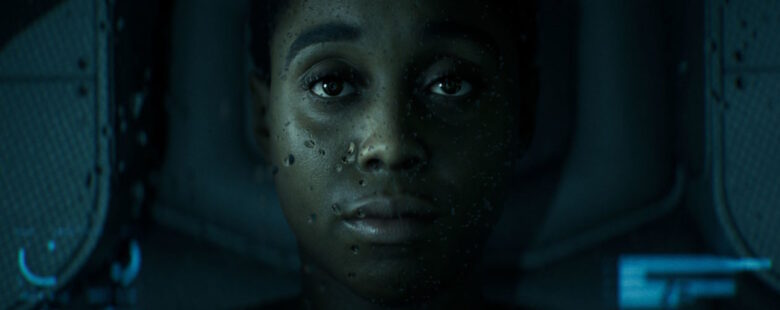
The story opens aboard the Cassiopeia, a starship en route to Tau Ceti F. With the rest of the crew in stasis, Simms and Carter are two sleep technicians, just relaxing when the ship is suddenly thrown into chaos, forcing them to react and investigate a hull breach. Once the initial chapter is completed the rest of the crew are introduced, including performances from Lashana Lynch as Brianna Young and Danny Sapani as Commander Stafford, the two main characters who will drive the plot forward.
Directive 8020 wears its love for Alien and The Thing like it’s one of those mash-up graphic t-shirts. There’s the isolated spaceship, the exhausted crew dragged from stasis, and corridors tilted at unsettling angles. Instead of a xenomorph, the threat is a grotesque shapeshifting organism, a mass of pink, fleshy matter capable of perfectly imitating the crew. The homages to those two iconic horror films are everywhere, from tense hunts through ventilation shafts to the inclusion of a suspicious corporate operative clearly has a different mission to everyone else.

Unlike earlier Dark Pictures titles, where half the cast often felt expendable, the whole crew are genuinely engaging, and you will want to keep them alive. As the story progresses, each character develops traits that subtly influence their behaviour and dialogue, while a new Fate system locks in certain narrative outcomes based on decisions made hours earlier. Supermassive also deserves credit for its understated representation; one male character casually mentions their husband and the story simply moves on as it should.
In games with branching story paths, there can often be a jarring whiplash between scenes as characters’ moods and emotions drastically change, but I am happy to report that is not the case here. Everything flows effortlessly, no matter what choices you make.
While the experience remains broadly linear, the environments are far more open than previous Dark Pictures entries, encouraging exploration for logs, recordings, and environmental details that flesh out the story. Quick time events still appear, but are far less frequent. Instead, much of the tension comes from fully fledged stealth sections, where players must guide characters through shadowy corridors while avoiding the creatures that roam around. A handheld scanner helps track enemies, locate power conduits, and identify useful objects. These can include batteries, which are needed to unlock doors, and power conduits, which can transfer energy between consoles and other devices. The stealth itself is tense without becoming frustrating, as creature patrol patterns are predictable once you have observed them for a minute or two. If you do get spotted by an enemy, you can temporarily fend creatures off with an electric shock baton, though repeated mistakes quickly prove fatal.

Supermassive has clearly been listening to criticisms of the previous games that had deaths that felt cheap, with little warning that something is about to happen. 8020 comes with three pre-set difficulty modes, which change factors such as how much time you have to react to events, and you can make your own custom settings. Also new is the Rewind feature which lets you revisit crucial decisions and explore alternate outcomes. Since you can lose a crewmate within the first 15 minutes, it’s a feature many players will appreciate.
A full play-through takes around 8 hours, or a little more if you explore, and it’s absolutely worth replaying to see the different outcomes. I’d also suggest you do not let everyone survive on your first playthrough, as there are some spectacularly gory deaths, especially right at the end.

Visually, the game is spectacular. The Cassiopeia feels authentic to the genre, with detailed textures and atmospheric lighting creating an environment worthy of a Hollywood blockbuster. The human characters are exquisitely detailed, down to the fluff on their gloves, with expressive features that convey emotions. Later scenes lean heavily into grotesque body horror too, delivering some impressively nasty creature effects.
The sound design is also top notch. Things creak, bubble, roar, with the ambient soundtrack pulsing and sliding in the background. I was playing on a 75″ TV, with surround sound and in complete darkness, and my flatmate sat beside me for a good couple of hours just watching the game as if it were a movie.
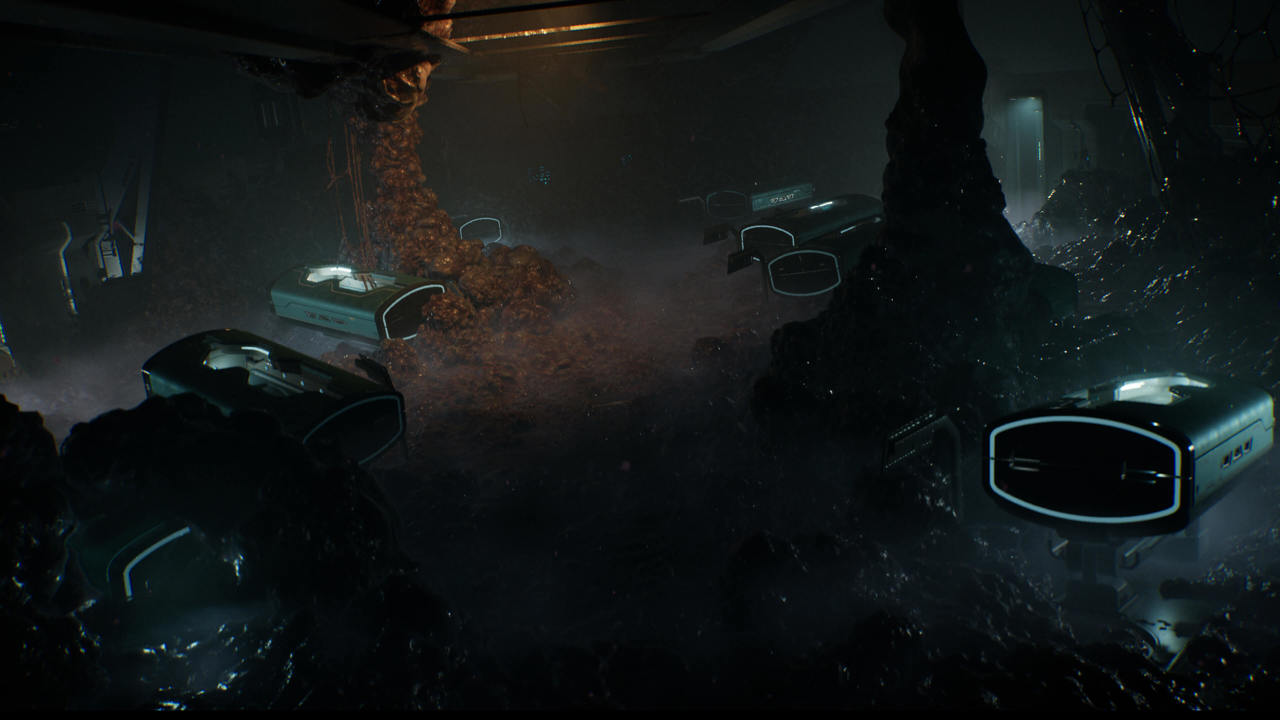
Despite a few dramatic flash-forwards designed to maintain momentum, the middle section of the game does drag slightly. Each character also has Space Whatsapp on their wrist and can send and receive text messages from the crew. It’s a nice way of fleshing out the characters and relationships, but allowing a character to start texting while being stalked by seven feet of teeth and flesh reminded me I was playing a game where real-world logic does not apply. Clearly, you wouldn’t stop to have a casual chat in this situation; it would have been realistic for the character to mutter “Nope not now” if you tried to text that when under threat.
The game also takes a while to build up the reveal to the crew that the pink space gunk can assume human form, before then forgetting about it for a good while. Crew members go off on their own before re-joining the party without so much as an “Excuse me, are you human or a murderous space blob?”
The biggest problem lies with the entire concept of Dark Pictures, with each game taking a horror movie style and turning it into a game. There are hundreds of horror films set in haunted woods but far fewer set in space, and as such 8020 does feel more derivative than previous titles. Barring the customary Dark Pictures twist, the plot has few surprises.


Andrewww
Sounds very good, is wishlisted.
But, was it possible to jump over crates in the game..? ;-)