


Imitation is the sincerest form of flattery, as the more pleasant half of the saying goes, and it is a form of flattery that we often see in video games. It’s how I discovered Kumitantei: Old School Slaughter, a title that was originally a fan game based on Danganronpa, and has now spun out into its own game.
Kumitantei broadly follows Himari Sanada, one of the elite Absolutes in an alternate reality Japan, with her designation being the Absolute Barista. Himari and fifteen other Absolutes of wildly varying expertise (including gems such as the Absolute Beekeeper) are abducted by an organisation called the Janus Institute. These young folks are locking in a sealed building to participate in an experiment to ascertain whether they will kill each other to escape.
If this is sounding very familiar, that’s because it is. Kumitantei shamelessly foregrounds its inspirations right from the outset, bringing in key influences from outside Danganronpa too, such as Ace Attorney, retro arcade games, and 1980s anime. All of these elements play into the opening chapters, but it’s really Danganronpa that is the primary inspiration and Kumitantei hits a lot of the same beats.
The gameplay itself is broadly divided into two sections, one based in exploration and investigation, and the other being the frenetic trial segments. During the exploration, you will mostly be wandering around the rooms and corridors of the school building, interacting with the other students and giving them gifts to raise your trust level with them. This is where you will investigate crime scenes and gather evidence and information to help you in the trial segments.
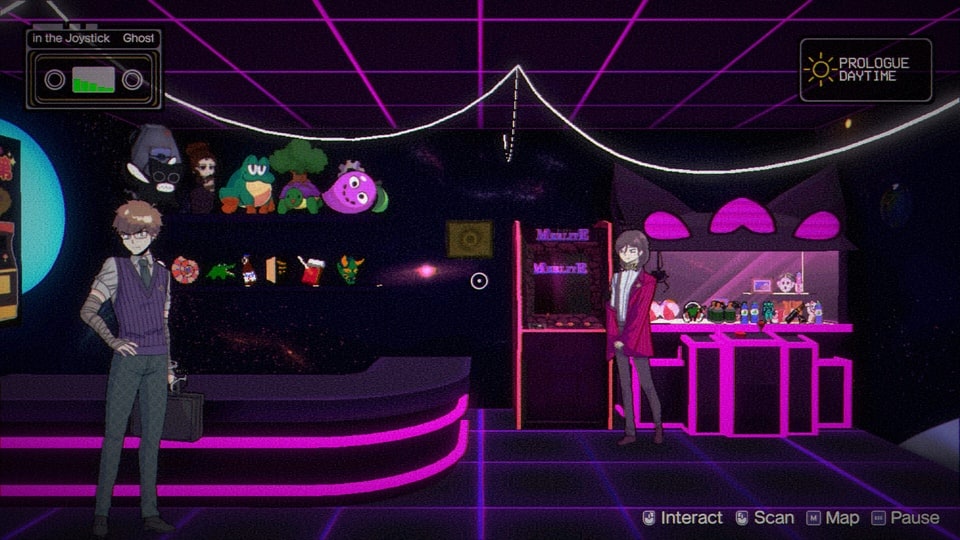
This is also where a large proportion of the story will unfold, as you interact with the environment and the other characters, learning about their pasts, motivations, and personalities. There is some great voice acting through this, giving additional depth to the colourful array of what are essentially complete weirdos. I was constantly impressed by these fully voiced segments, and the performances are incredible.
The downside is that it highlights how grating some of the situational lines can be that accompany unvoiced text, when full voice acting isn’t used. The variety of these is very limited, with each character only possessing a handful and these being heavily related to their characterisation or expertise. The result is that they repeat quickly and often bear no relevance to the content or tone of the text, undercutting the good characterisation elsewhere.
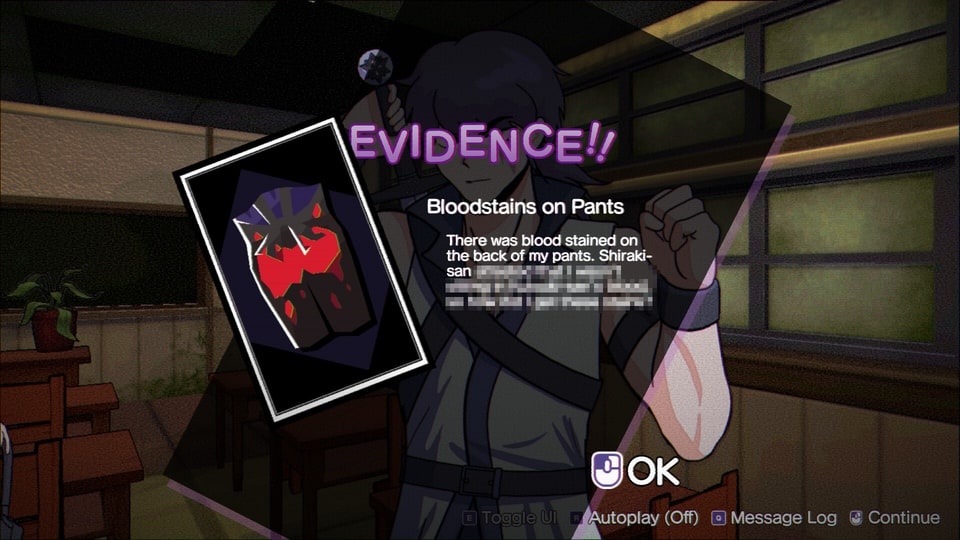
The other main segment of the game is the Clinical Trials, which are just as frenetic and active as you would expect. Here you need to use the evidence you gathered – represented as cards – to shoot down incorrect statements and corroborate correct ones to ascertain the true culprit of the murder. Occasionally it will throw mini games at you that are required to progress – which you can practice in a game area while exploring – but these are more of a palette cleanser and still maintain a breakneck pace.
One of these takes a little more precedence though, which are the card-based battles. In these, you hold a hand of cards of different colours and numbers and attempt to defeat your opponent by playing cards that have a higher number or are in a circle of stronger and weaker suits – red beats blue, which beats yellow, and so on. Hitting a weakness allows you to play more cards in a chain to build up more of the bar, and you win by filling said bar before your opponent can do so.
These are mostly easy to win, as you can generally just play the higher number, but they do get more tense as you have more instances of these card battles, with opponents breaking your chains and exacting their own chains against you. The important thing here is that it’s something different and new thrown into the mix, and if these maintain a consistent difficulty curve, it could be a highlight of the game.

The glaring issue with the Trial segments is that the logic of the solutions just isn’t quite as consistent as it should be. This occurs in this game’s inspirations as well, but for there to be this degree of inconsistency in only Episode 1 is concerning. Coupled with the difficulty in restarting segments the trial as you must play through the whole sequence each time, and it’s an exercise in frustration.
Additionally, the control systems are similarly inconsistent, with the controller-based scheme being inaccurate for shooting down statements in the trials, as if the crosshair is poorly aligned. Keyboard and mouse controls are simply not appropriate for some of the intermittent minigames, so I spent a large portion of my playtime with my controller on my lap while using keyboard and mouse for much of the gameplay. Just a small tweak on both schemes would do wonders for future episodes.
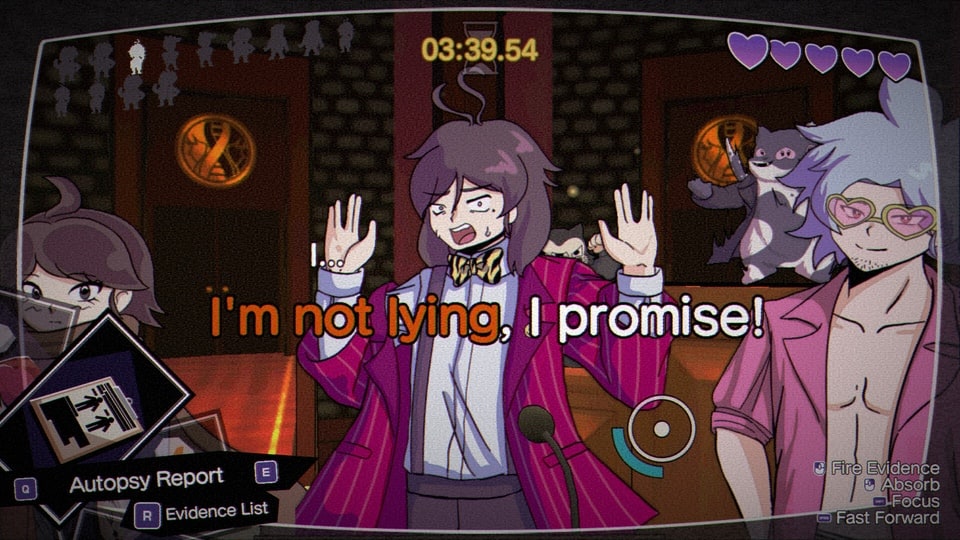
The visuals can also feel ropey and unappealing at times. The characters are either bland to look at or overdesigned to a degree that would make Tetsuya Nomura balk. Their proportions are absolutely unhinged at points as well, creating bizarre contortions of what a body should ever look like. And yet there is a kind of cohesion to this messiness that is just so endearing. The cartoonish wackiness of Kumitantei is a breath of fresh air and I’d even say that this visual approach balances out the more horrific elements of the game far more effectively than the stylised approach of Danganronpa. Its tone leans closer to the more daftness of Ace Attorney.
As one final note, the soundtrack of Kumitantei is nothing short of incredible. The tracks range from unsettling atmospheric ambience to thumping electronic dirges and really add a palpable dimension to the game. The same cannot be said for the sound design more generally, which errs more towards the grating repetitiveness of the voice lines I described earlier, but that takes little away from the music, which I would happily listen to outside of the game itself.